


- Home
- Companies
- Fraunhofer-Institut für Holzforschung - ...
- Services
- Technology for Wood-based Materials ...
Technology for Wood-based Materials Service
Besides procedural innovations primarily new products or product types contribute to a more widespread application of wood-based materials. The development and the optimization of wood-based materials belong to the classic research fields of the WKI.
While only a few years ago particle board was the main focus of numerous research projects, today it is primarily MDF and structure-oriented wood-based materials offering a high innovation potential. Tests regarding the suitability of different adhesive systems for various wood-based materials belong also to the focal fields as well as investigations aiming at an effective utilization of raw materials. To this end, besides wood other regenerative raw materials like flax, hemp and agrarian residues are processed to board materials and tested. A new focus is formed by composites reinforced with natural fibers, so-called Wood-Plastic-Composites (WPC).
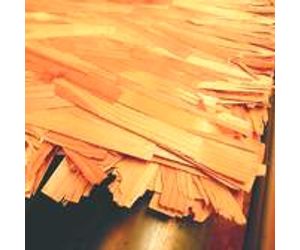
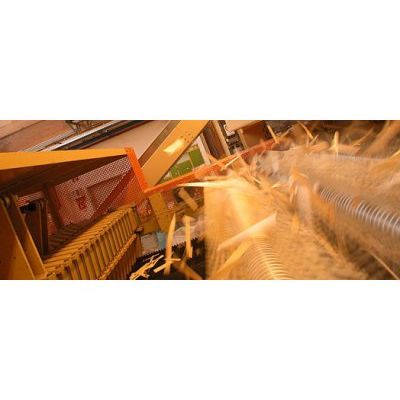
WKI`s pilot plant station allows the manufacture of all well-established wood-based materials as well as the investigation of their mechanical and hydric properties. The equipment comprises different facilities for pre-breaking, for particle preparation and for manufacture of wood fibers. Different blenders are available for the gluing process allowing a adhesive addition which is adapted to the raw material. Two modern SPS controlled hot presses simulate also the continuous industrial pressing process. A pressing surface of 1200 x 1600 mm² allows the manufacture of board dimensions corresponding to a small industrial scale. A new extruder unit completes the existing refiner plant to a closed WPC manufacturing process.
- Technology of wood-based materials
- Materials engineering
- Efficient use of wood
- Production of wood-based material
- Wood-Polymer Composites (WPC)
- Adhesives and wood chemistry
The department`s employees are involved in developing and optimizing wood-based materials. Besides plywood, particleboard. fiber and wood-polymer materials (WPC). there are engineered wood products, structure-oriented materials such as oriented strand board (OSB) and laminated veneer lumber (LVL), moulded parts and composites in the focus of the research work.
Research into the suitability of anorganic and organic raw materials on a petrochemical basis and on the basis of renewables as adhesive components or matrices are ]ust as much a focus of the work as the efficient usage of raw materials. As such, the potential for the wood-based materials industry of other raw materials containing ligno-cellulose. such as annual plants, and secondary raw materials such as recovered wood and paper and production residues, is examined besides wood itself. Additives for reducing emissions, the Improvement of moisture resistance and surface enhancement for wood-based panels are further research fields which are currently of interest.
Developing measurement methods for process and quality control in the wood-processing industry forms another Important research field. Non-destructive testing methods such as infrared thermography. Image processing and spatial near-Infrared spectroscopy are of particular interest. These measurement methods can be used both in the wood industry for example in detecting impurities or foreign material {when recycling recovered wood) or characterizing particle sizes and in other fields of industry. Nondestructive testing is always in demand where structural errors arizing In manufacturing such as layer separations, undesired structural anomalies and cracks have to be detected. This allows the reliable detection of production-related defects or the results of wear-and-tear in heavy-duty composites for wind turbine systems.
- Development and manufacture of wood-based panels In dry. semi-dry and wet processes on a small industrial scale
- Compounding and extrusion of wood-polymer composites
- Reducing, separating and treating raw materials containing lig no-cellulose
- Efficiency of new and industrial additives and active ingredients
- Material and process investigations to improve the material properties (emissions, stability, moisture resistance, surface)
- Consultation and expert reports on wood-based materials and wood-based material technology
- Mechanical, optical and chemical characterization of raw materials
- Suitability of adheslves/matrices. additives and active Ingredients
- Ascertainment of mechanical, thermal and hygric wood-based material properties
- Infrared thermography for detecting cracks and delamlnations
- Image processing e.g. strand direction detection and particle size analysis
- Spatial near-infrared spectroscopy for detecting Impurities, contamination and adhesive concentrations
- Digital correlation techniques for determining structural In homogeneities
- Simple handling and analysis of thermography image series
- Interactive analysis of hyper-spectral images
- Forecasting material yield in veneer production
- Direction detection for wood-based material particles in fleece
- Statistical analysis of particle sizes and particle size distribution