


- Home
- Companies
- C-Therm Technologies Ltd.
- Services
- C-Therm - Thermal Conductivity Contract ...
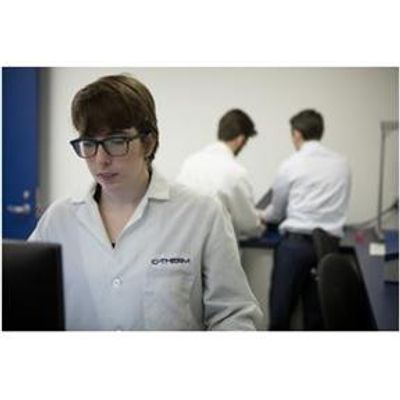
C-Therm - Thermal Conductivity Contract Testing Services
C-Therm is the global leader in high-sensitivity thermal conductivity testing services. Learn more about what thermal conductivity is and how to measure it.
Check all the details about contract testing services here.
Thermal Conductivity
The thermal conductivity of a material is a measure of its ability to transfer thermal energy from hot to cold regions. In classical thermodynamic terms, this means that the heat flux, Q, moving from a hot to a cold region within a material obeys the relationship (known as the Fourier Law)
here A is the cross-sectional area through which the heat flows, DT/Δx is the temperature gradient between hot and cold areas, and is the proportionality constant for this relationship, known as the thermal conductivity. Thermal conductivity is a characteristic material property, unique for each material phase and formulation. It is normally defined in terms of power and the relationship written as the following with units Watts/(m∙K):
How to Measure?
Thermal conductivity can be determined using either steady state or transient methods. Steady state methods require the entire sample to be in thermal steady state during the measurement. Transient methods do not require steady state. In both methods, the sample must be in thermal equilibrium with its surroundings prior to beginning the measurement procedure equilibrium. Consequenty, this means that steady-state methods can have much longer thermal equilibration times, even days, for completion of a single test. While steady-state approaches provide high precision and accuracy determinations of the thermal conductivity of a sample, the combination of very long test times with certain other drawbacks in steady-state methods has largely caused them to be supplanted, at least for routine measurements, by transient techniques.
Steady-state Methods
The Guarded Hot Plate Method is traditionally a primary steady-state method for thermal conductivity measurements (ASTM STP 879; ASTM C177-13). It is a proven, effective method for characterizing the insulation quality of materials (e.g. R-Value). C-Therm offers steady-state testing with its C-Therm HFM 518. The instrument is particularly well-suited for insulation and building materials. The effective thermal conductivity range of the instrument is 0.002 W/mK to 1 W/mK. Unfortunately, certain requirements of this method limit its broader application as a routine analytical method. The sample must be at thermal equilibrium during the measurement. Combined with the fact that the test often requires very thick samples, this can produce exceedingly long testing times which inhomogeneities in a sample can prolong even further, particularly with very high porosity materials such as aerogels. Acceptable measurement accuracy requires a sample with a large ratio of area to thickness that is flat and parallel within limits defined in ISO 8302 resulting in very exacting sample preparation. The method is ill-suited for higher thermal conductivity materials (e.g. metals), liquids, pastes and powders.
Transient Methods
Transient methods have become the preferred approach to thermophysical property measurements, especially for routine laboratory testing and for field or in-situ evaluations. In transient methods, the heat source is applied in a periodic manner or as a pulse rather than continuously, as in steady-state methods. Since the measured thermal effects are transient, these methods do not require long thermal equilibration times, resulting in dramatically shorter test times for transient vs. steady state methods. Additionally, the extremely short test times allow less opportunity for the interference of other heat-transfer mechanisms, such as radiation or convection, which avoids the need for complicated experimental design to avoid parasitic heat losses. Short test times also mean that there is less opportunity for the redistribution of any volatile components within a sample, producing a measurement that is more representative of the material in its unaltered state. Transient methods typically do not require multiple temperature sensors; this reduces errors due to thermal contact resistance between the sample and the temperature probes. Finally, the equipment required for transient measurements is relatively small. This means that it can easily be designed into a portable unit for field measurements and keeps sample sizes both cost- and space-effective.