


- Home
- Companies
- OGI Groundwater Specialists Ltd
- Services
- Thermal Resource Assessment Services
Thermal Resource Assessment Services
OGI is able to conduct a Thermal Response Test to demonstrate the sustainability of any heating system that takes heat from or adds heat to the ground. As buildings designed to utilise heat from the ground are becoming increasingly bigger relative to the landmass available, it is becoming essential to balance the annual heat abstraction from, and any injection back into the ground. Under these conditions OGI’s Ground Energy Resource Assessments (GERAs) are increasingly in demand.
- OGI apply hydrological mathematical models to assess the sustainable ground energy for open and closed loop heating and cooling systems.
- For over 20 years, OGI has provided industry with an assessment of available groundwater resources and the ability to exploit such resources without exhausting the aquifer and impacting on a neighbour’s resources.
- In recent years, OGI has developed a capability to assess the ground energy available within the land mass beneath a property.
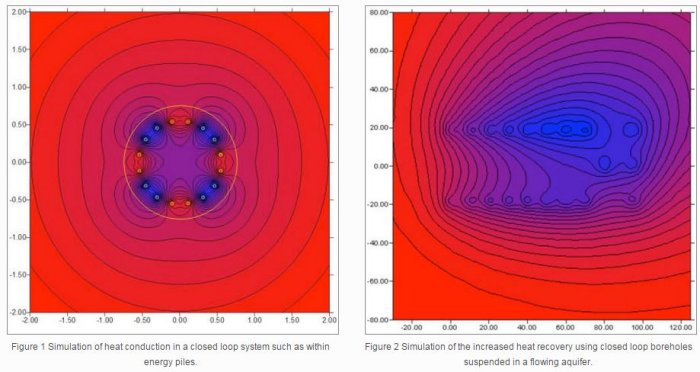
This has been a natural progression for OGI as the equations governing heat flow are all but identical to those equations governing groundwater flow through a permeable aquifer, so allowing the simulation of heat conduction to a closed loop system such as within energy piles (see Figure 1).
Thermal Resource 2
Figure 2 Simulation of the increased heat recovery using closed loop boreholes suspended in a flowing aquifer.
The simultaneous heat transport within a flowing aquifer can be simulated with OGI’s groundwater flow and contaminant transport models, modified to include thermal properties. The simulation of the increased heat recovery using closed loop boreholes suspended in a flowing aquifer is shown in Figure 2, with the simulation of the injection of heated water and abstraction of cool water from an open loop system is depicted in Figure 3.
This capability allows OGI to simulate accurately the movement and storage of heat energy in the ground for a range of scenarios of heat demand and thermal ground properties and so provide a Ground Energy Resource Assessment (GERA).