


Validated Haloacetic Acids Analysis (HAAs) IC/MS Workflow
Drinking water disinfection by-products by IC-MS/MS: Disinfection is important in ensuring the supply of pathogen-free drinking water. However, excessive consumption of disinfection by-products (DBPs) like haloacetic acids (HAAs), bromate, and dalapon can result in health issues. With increasing regulatory focus on DBPs, drinking water facilities around the world need hands-off, high-throughput analyses of these contaminants.
That`s the reason for the Thermo Scientific™ Disinfection By-Products Application Workflow. Comprised of an integrated Thermo Scientific ion chromatography-tandem mass spectrometry (IC-MS/MS) system with direct injection to eliminate sample preparation, this workflow provides rapid, cost-effective drinking water testing per United States Environmental Protection Agency (U.S. EPA) Method 557.
Compared to gas chromatography-electron capture detection (GC-ECD) per U.S. EPA Method 552.3, this workflow does away with time-consuming and complicated manual sample preparation steps. Unlike other IC-MS/MS solutions, Thermo Fisher Scientific manufactures, installs, validates, and services the complete workflow, speeding deployment and maximizing uptime.
Meet global requirementsFrom the United States Safe Drinking Water Act (SDWA), to the European Commission (EC) Right2Water initiatives and emerging regulations in China, government regulations and proposals are driving needs for more efficient DBPs monitoring. The Thermo Scientific DBPs Application Workflow is ideally suited to meet the requirements described by the U.S. EPA and the EC.
Increase sample throughput, reduce costs
There are two EPA methods for HAAs analysis: GC-ECD Method 552.3 and the more recent IC-MS/MS Method 557. Besides differences in the instrument technology used, the methods differ in sample preparation requirements. Time consuming and labor intensive, Method 552.3 requires multiple extraction steps and derivatization exceeding four hours. Method 557 uses direct injection without sample preparation, offering significantly higher sample throughput. For labs running more than 24 batches of 25 samples per month, the DBPs Application Workflow can provide substantial cost savings.
Broaden analytical scope
U.S. EPA Method 557 can be used to directly determine bromate and dalapon in drinking water samples, broadening analytical scope. One IC-MS/MS system can analyze anionic polar pesticides such as glyphosphate and glufosinate, as well as anionic environmental compounds such as bromide and perchlorate.
Broaden analytical scope
U.S. EPA Method 557 can be used to directly determine bromate and dalapon in drinking water samples, broadening analytical scope. One IC-MS/MS system can analyze anionic polar pesticides such as glyphosphate and glufosinate, as well as anionic environmental compounds such as bromide and perchlorate.
Cost of ownership comparison
Relative cost savings and throughput advantages of GC-ECD and IC-MS/MS are based on instrument price, sample cost, labor cost, and sample prep time. Check out our Haloacetic Acids cost of ownership calculator to see how much your lab can save based on throughput needs.
The DBPs Application Workflow provides proven reliability based on integrated high-performance IC-MS/MS components sold and supported by a single trusted manufacturer. Thermo Fisher Scientific is the only vendor today that provides a complete validated system for DBPs testing per U.S. EPA Method 557. Unlike other systems, the workflow includes proven methods that provide confidence and time savings. To get you up running samples quickly and minimize downtime, the complete system is validated at our factory, and at time of installation and servicing.
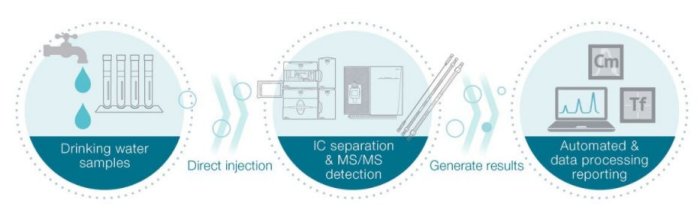
Water samples can be directly injected into the IC system for separation and subsequent MS/MS detection. Automated data processing and reporting are used to generate results.