


- Home
- Companies
- Advetec Holdings Limited
- Services
- Advetec - Waste Streams We Work With
Advetec - Waste Streams We Work With
At Advetec, we specialise in transforming the most challenging waste streams into valuable resources through innovative biotechnology solutions. Our advanced systems can dramatically reduce volumes while helping businesses meet sustainability goals and regulatory demands. From landfill diversion to producing clean energy sources such as Solid Recovered Fuel (SRF), our solutions are designed to work with a wide range of waste types.
Non-clinical offensive waste includes sanitary products, nappies, tissues, and paper towels that are high in moisture, resulting in heavy, ammonia-rich, and odorous waste.
Sources include:
- Facilities
- Entertainment
- Education
- Care facilities
- Retail
Once washroom waste has gone through our XO process, these are the parameters of the floc output – which meets the minimum requirements to be classed as an SRF.
De-packaged waste or Anaerobic Digestion (AD) reject waste consist of plastics, cardboard, and other food packaging materials mixed with organic residue. With high moisture content and a significant organic fraction, this waste type is typically found in:
- Anaerobic Digestion (AD) plants
The Results
Once de-packaged reject waste has gone through our XO process, these are the parameters of the floc output – which meets the minimum requirements to be classed as an SRF.
Mixed residue from the mechanical treatment derived from the separation of municipal solid waste and sewage sludge from municipal wastewater treatment plants, currently processed for disposal as waste. Typically, a sub 60mm size fraction.
Sources:
- Municipal waste
- Waste Water Treatment
The Results
Once organic fines have gone through our XO process, they are stabilised to meet AT4 landfill requirements, meaning they won’t biodegrade any further. There is also the possibility of an SRF offtake, as they could be blended with another material.
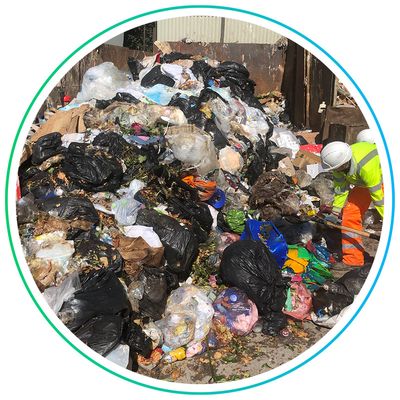
Mixed solid waste (MSW) or mixed residual waste (MRW) is the most prevalent form of discarded material. It is non-hazardous by nature and typically produced by the following areas:
- Trade
- Commercial operations
- Domestic settings
- Retail
- Facilities
- Entertainment
The Results
Once mixed residual waste has gone through our XO process, recyclable materials are now dry and ready for extraction. The remaining output is stabilised, meeting AT4 landfill requirements, meaning it won’t biodegrade any further; which means it can still be sent to landfill even in the wake of Scotland and England’s landfill ban, for incineration and in some cases, used as SRF.
Pure organic waste is typically excess waste created by the following areas:
- Food production
- Industrial processing
- Windrow composting
- Agriculture biproducts
- Market spoils
- Fish processing