


- Home
- Companies
- Bentley Systems, Incorporated
- Software
- PLAXIS - 2D Dynamic Loading Modelling ...
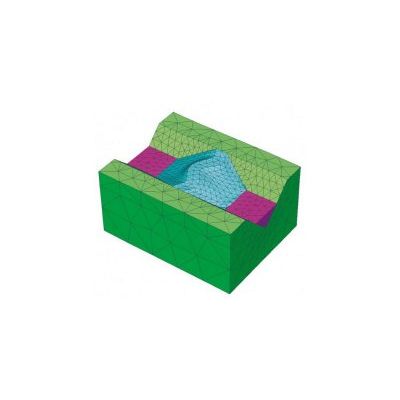
PLAXIS - 2D Dynamic Loading Modelling Software
2D Dynamics is an add-on module to PLAXIS 2D. Soil and structures are often not only subjected to static loads due to construction in and on the ground surface but also to dynamic loads. When loads are powerful, like for example earthquakes, they may cause severe damages. Vibrations may occur either man-made or natural. The source of natural vibrations in the subsoil is earthquakes. With the Dynamics module PLAXIS can analyse the effects of vibrations in the soil.
Low frequency vibrations can normally be calculated with a pseudo-static analysis, by default available in PLAXIS, however for more advanced seismic analysis the Dynamics module is required.
The effects of vibrations have to be calculated with a dynamics analysis when the frequency of the dynamic load is in the order or higher than the natural frequency of the medium. PLAXIS helps users to perform dynamic analyses in a user friendly, efficient and accurate way.
All material models contain extra parameters, which take into account damping due to material and/or geometry. Models especially useful in dynamic analysis are for example the UBC Sand model in order to predict liquefaction. This model calculates excess pore pressure build-up during dynamic excitation. For soils other than liquefaction susceptible sand, the (Generalized) Hardening soil model with small strain stiffness generally offers a good choice.
In modelling the dynamic response of a soil structure the inertia of the subsoil and the time dependency of the load are considered. The time dependent behaviour of the load can be assigned through harmonic, linear or table multipliers. Via table input users can import real earthquakes signals, in order to perform meaningful seismic design, of for example jetties or foundations. Dynamic multipliers can be assigned independently in the x- and y-directions.
Dynamic analysis in some cases also requires some special boundary conditions. For the benefit of 1D site response analysis, the tied degrees of freedom boundary conditions are available in PLAXIS 2D. To reduce spurious reflections of waves reaching the model boundaries, free-field and compliant base boundaries can be selected.
- Free Field & Compliant Base Boundaries (VIP)
- Dynamic loading in x and y directions with real earthquake data
- Simple 1D analysis or advanced earthquake engineering
Modelling
- Dynamic loading in x and y directions with real earthquake data
- Upon request: UBCSAND liquefaction model (available as User-Defined Soil Model) (VIP)
- Time-dependent dynamic load systems for point loads, distributed loads and prescribed displacements (velocities, acceleration)
Calculations
- Simple 1D analysis or advanced earthquake engineering
- Option to fix all nodes in vertical or horizontal direction in dynamic calculations
- Option for semi-automatic determination of calculation sub-steps
- Selection of Newmark time integration scheme (aN and ßN)
Results
- Velocities and acceleration in addition to displacements
- Time-displacement, Time-velocity, Time-acceleration curves
- Switch from time-curves to frequency-curves using Fast Fourier Transform
- Pseudo Spectral Acceleration respons
Applications
- Structural response under earthquake loading
- Racking of tunnel lining
- Machine and traffic vibrations
- Impact loading
- Evaluation of natural frequencies and