


- Home
- Companies
- EXELE Information Systems, Inc.
- Software
- EXELE - Version OPCcalc - Advance ...
EXELE - Version OPCcalc -Advance Calculation Engine for OPC
OPCcalc allows you to easily create process calculations that use OPC tags as equation inputs and outputs. OPCcalc handles all of the “plumbing” for your equations, letting you concentrate on your calculation logic. Users create and build their calculations with the built-in Equation Editor; under-the-hood, our calculation products use the Microsoft.Net Frameworks and to build high-performance calculation libraries. OPCcalc is an open calculation “framework”, shielding calculation authors from the complexities of custom programming, yet giving users the option to access and use all features of the Visual Basic.Net (variables, loops, if..then..else, user functions) and the .Net Framework (relational databases, file read/write, Web Services, XML etc.). OPCcalc is more than just an OPC calculator. It brings unmatched performance and features to OPC-based calculations.
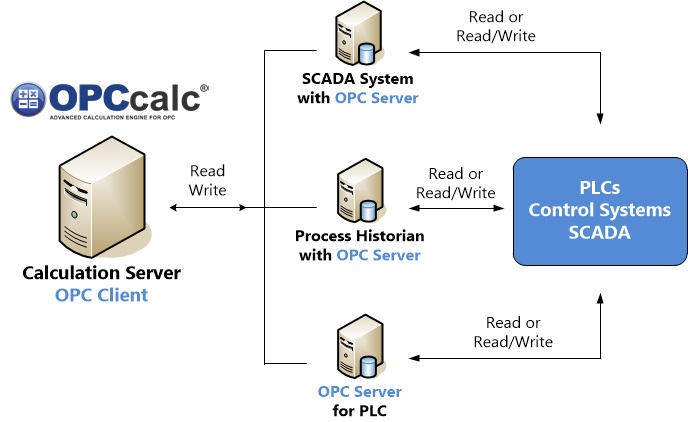
Programmers and non-programmers can easily use our Equation Editor to define the logic and arithmetic needed for their equations. OPCcalc will then build a compiled .Net programs that contains the necessary OPC calls, scheduling, and error handling required to execute your equations on a configured interval, outputting the results to other OPC tags.
Each equation library contains one or more equations (outputs) and can communicate with tags on multiple OPC Servers. Our Equation Scheduler allows you to configure, start, stop and monitor your equations. Once started, you can easily view the details of running equations (inputs, outputs, errors) with OPCcalc’s built-in Library Snapshot utility.
Example OPCcalc logic in the Equation Editor: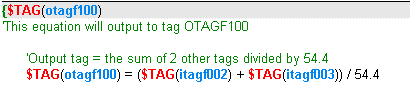
Visual Studio/Visual Basic.Net (optional)
OPCcalc uses the .Net Framework’s compiler “under the hood” to create the calculation executables.
Although Visual Basic.Net is not required for building OPCcalc equations, some features require that you have a version of Visual Basic.Net installed on the OPCcalc computer.
OPCcalc supports Visual Studio/Visual Basic.Net including the Express and Community versions (free from Microsoft).
Requirements
- Operating System: Windows XP, Server 2003, Vista, Windows 7, Server 2008, Windows 8, Server 2012/2016, Windows 10
Both 32 and 64-bit platforms are supported. - Compiler: .Net Framework
Optional, but recommended: Visual Basic.Net - OPC Server(s):
OPC DA Server (supporting Data Access version 2 or later)
OPC HDA Server, optional (supporting Historical Data Access version 1.1)
OPCcalc can communicate with OPC DA and HDA Servers located locally or across the network.
If your OPC Server supports DA, you can retrieve and output current values. If your OPC Server supports DA and HDA, you can retrieve and output current and historical values. If your OPC HDA Server supports aggregates (average, min, max), OPCcalc has a set of built-in functions for retrieving these values directly into your calculations.
OPCcalc allows you to read and write data to one or more OPC Servers with minimal effort. You simply enter the logic in a VB.Net-like syntax using the OPC tag names directly in your equations.
Normally, you would use a programming language (such as C, C++, C#, or Visual Basic) and underlying OPC calls to develop such equations. Using OPCcalc, you only need to provide minimal information for the equation including:
- Name of the OPC tag to receive the result of the equation
- Name of OPC tags, variables, functions and constants used in the equation
- Associations to be made between the OPC tags, variables functions and constants
The above information is stored in one or more text files called OPCcalc libraries. Once you have provided this information in a library, OPCcalc builds a compiled Visual Basic .NET executable that will perform the calculations and output the results to OPC tags on the OPC Server.
OPCcalc will dramatically cut your development time and easily allows non-programmers to create complex calculations that read and write OPC data.
Standardizing: OPCcalc gives you a standard method for
- Connecting to one or more OPC servers
- Accessing current (DA) and historical (HDA) values and aggregates
- Handling lost connections
- Retrieving tag values
- Writing tag values
- Providing application error handing
- Scheduling execution
- Performing aggregate function calls (average, min, max, …)
- Code documentation
Advantages: Using OPCcalc offers many advantages:
- Can significantly reduce the number of lines of code
- Accepts OPC tag names directly in logic
- Automatically handles equation run-intervals (down to 50 milliseconds)
- Generates uniform and easy to maintain program
- Multiple debug options including built-in snapshots of running equation inputs and outputs
- Built-in functions for current, historical and aggregate OPC tag values
- Support for user-defined functions and subroutines
- Local variables that retain their values between executions (allows you to reference values from previous runs)
- Order-of-execution control for all equations in a library
- Equation results can be tested over multiple executions before equations are deployed
- Ability to recalculate equations if logic or inputs have changed (requires OPC HDA)
- Built-in calculation diagnostics (latest completed execution and execution times)
- Remote monitoring, starting, and stopping of calculations (packaged Scheduler or custom code using our API)
- Access to the entire VB.Net language (math function, language structure,..).
Because you can easily move data into and out of one or more OPC Servers, OPCcalc can be used to quickly create interfaces to/from/between OPC Servers and other data sources (relational databases, etc).
OPCcalc and Visual Basic.NetExele’s calculation products do not require Visual Studio/Visual Basic.Net to build calculations, although certain functions may require it (i.e. creating user functions, Visual Studio debugging). If you require Visual Studio, we support most versions including the free “Express” versions available from Microsoft.
Because OPCcalc creates .Net calculation processes, you can take advantage of this rich framework within your equation logic.
This includes
- Access to the entire Visual Basic language and .Net Framework
- Support for user-defined functions and subroutines
- Ability to call external assemblies and Web Services
- Use of Visual Basic constructs (If..Then..Else, Arrays, Variables)
- Retrieval of values from relational databases (Oracle, SQL Server, Access, …)
- Outputting of data to relational databases
- Reading and writing of files