

AnsQuick - Hydrogeologist Workbench Calculator
Module AnsQuick can be used for aquifer test planning or mine dewatering. It does not have advanced graphical tools of AmWells or interpretation capabilities of AnsTest but it allows quick assesment of data. It also includes conversion tables for hydrogeology parameters and calculator for special functions.
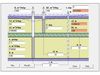
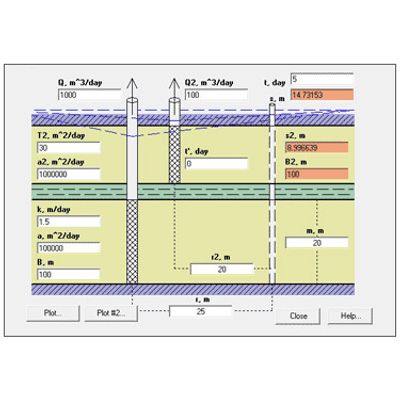
Calculates the radius of influence for aquifer tests or production boreholes. Radius of influence is determined either from drawdowns in two wells or hydraulic diffusivity and time. Calculations can be conducted for confined, unconfined and confined-unconfined aquifers.
The tool calculates groundwater mounding caused by local recharge. Groundwater mounding can be caused by either concentrated transient recharge in infinite aquifers or steady state recharge in circular or strip aquifers. Calculations can be used for prediction of groundwater level rise under infiltration basins or for assessing impact of recharge during aquifer tests.
Determination of hydraulic properties of the river bed based on monitoring of groundwater levels near a river or lake/pond. This solution requires monitoring of water levels in two wells near a river. The tool can also be used to calculate the impact of pond/river water level rise on groundwater levels.
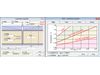
Calculations of inflow and drawdowns for open pits, underground mines, trenches and tunnels. Inflow to open pits and underground mine stopes is calculated using the “big well” approach, where a pit is approximated by a well with the effective radius of an open pit. Inflow to underground declines or horizontal wells is predicted using the drawdown superposition principle for a line of vertical wells (drains) with screen lengths that are equal to the dimensions of a decline or the radius of a horizontal well. Calculations can be conducted for several conceptual models and variety of boundary conditions.
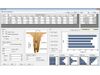
This tool facilitates interpretation of lugeon tests that are the most common aquifer tests with packers. Lugeon values are graphically presented on diagrams for each pressure step, and water injection rates are plotted against pressure values. These plots and diagrams allow to determine testing conditions (i.e. laminar flow, turbulent flow, opening of fractures, washing out fine material or filling in fractures). Hydraulic conductivity values are calculated by Moye, Thiem and Lugeon formulas.
Prediction of water level drawdown or recovery during slug tests using solutions of Cooper and Picking. The tool can be used for planning slug tests).