


CALINEpro - Traffic Emissions Dispersion Model
CALINEpro is based on steady-state Gaussian plume models specifically designed to calculate air quality impacts from vehicle emissions near highways. Given source strength, meteorology and site geometry, the model can predict pollutant concentrations for receptors located within 500 meters of the roadway. It also has special options for modelling air quality near intersections, bridge and parking facilities.
The model is based on CALINE3`s algorithm (See US EPA Alternative Models). It divides individual highway links into a series of elements from which incremental concentrations are computed and then summed to form a total concentration estimate for a particular receptor location. Downwind concentrations from the element are modelled using the crosswind FLS (Finite Line Source) Gaussian formulation, but σy and σz are modified to consider the mechanical turbulence created by moving vehicles and the thermal turbulence created by hot vehicle exhaust in the region directly over the highway, region considered as a zone of uniform emissions and turbulence.
- User friendly GUI
- Model mobile emission sources
- No limitation on numbers of link and receptor
- Define receptors on Cartesian and Linear grid for isopleth
- Customize averaging time
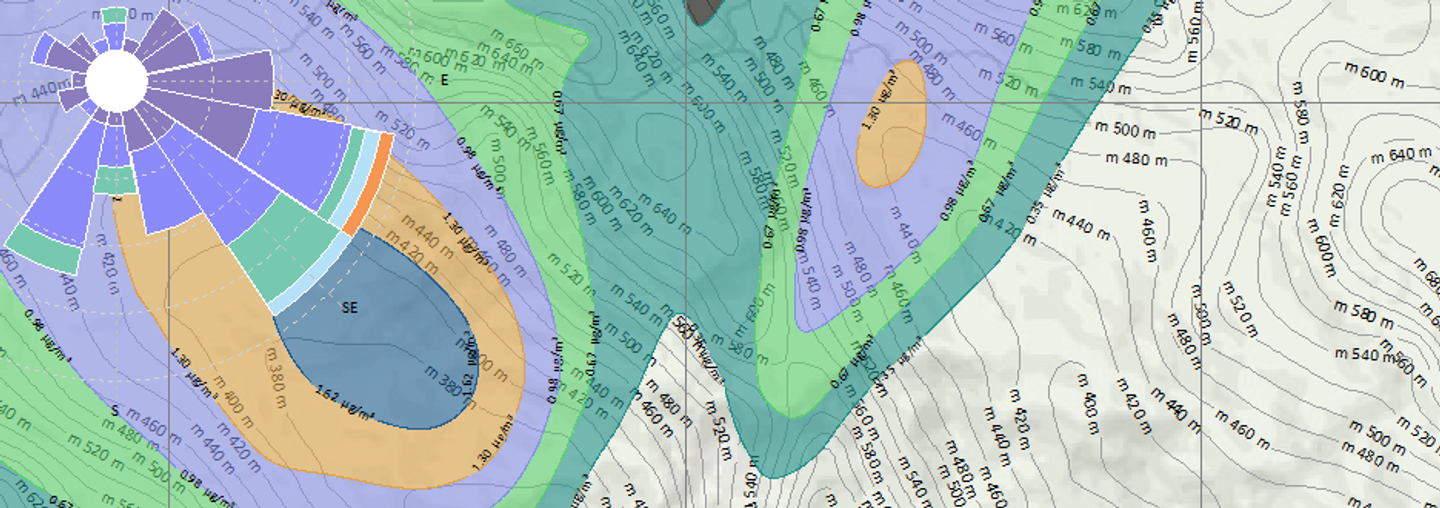
- Plot graphs and Isopleth
CALINEpro is an interface for the US EPA air dispersion models - CALINE3.
CALINE3 is a steady-state Gaussian dispersion model designed to determine air pollution concentrations at receptor locations downwind of highways located in relatively uncomplicated terrain. The followings are the technical specifications for these models:
Parameter: Description
- Model Name: CALINE3
- Version: 89219
- Developed By: US EPA
- Model Type: Steady-state Gaussian plume air dispersion model
- Range: Up to 500m from the source
- Wind Field: Homogeneous
- Release Types: Neutrally buoyant plumes
- Source Types: Road Link
- Averaging: 1 and 8 Hours
- Meteorology: Representative
- Terrain: Flat
- Receptors: Several types of grids (Cartesian and Linear) and discrete receptors