


- Home
- Companies
- Bioinformatics Solutions Inc.
- Software
- PEAKS - Version Studio 13 - Complete ...
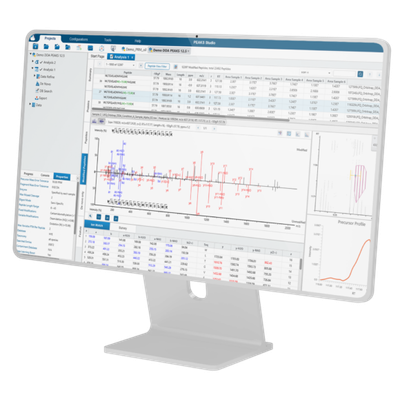
PEAKS - Version Studio 13 -Complete Solution for Bottom-Up Proteomics
PEAKS Studio 13 offers a complete bottom-up proteomics solution with increased accuracy, sensitivity, and speed. Updated workflows for a variety of applications, such as in depth canonical and non-canonical peptide and protein identifications, make PEAKS a unique solution. From DDA to DIA data support, PEAKS Studio 13 provides a comprehensive solution to bring your research to new heights!
Built for Discovery.
Optimised for Accuracy.
PEAKS Studio redefines proteomics analysis with unmatched depth, machine learning powered algorithms, and seamless support for all major vendors. PEAKS features a detailed and easy-to-use Graphical User Interface (GUI).
DDA and DIA Done Right: Multi-Engine Powerhouse
In PEAKS 13, the DDA and DIA workflows have been streamlined into two powerful options: Proteome and Peptidome.
The Proteome workflows support traditional protein identification and quantification, with results focused at the protein level. Meanwhile, the Peptidome workflows leverage DeepNovo’s deep learning-based de novo sequencing, combined with peptide database searches and sequence variant analysis, to deliver insights at the peptide level.
Users can customise their analysis workflows, selecting which steps to run and adding or modifying steps at any point. Results are organised into intuitive result nodes, making it easier to interpret, explore, and validate your data.
PEAKS 13 uses the latest PEAKS algorithm for all analyses, including data loading/refinement, identification and quantification. Deep learning-boosted identification workflows are available for both DDA and DIA analysis for increased identification rates of over 10%.
Streamlined Workflow with Direct Database search for DIA
PEAKS Studio 13 offers a unique DIA workflow to maximise identification of peptides by integrating four methods: spectral library search, direct database search, de novo sequencing, and sequence variant analysis with up to 20% increase in identification and quantification, and faster processing times for CPU and GPU resources.
- A library search is performed against a predefined spectral library. Peptide spectra without a library match can be directly searched against a protein database.
- A protein sequence database is directly searched with DIA data. Advanced machine learning algorithms allow improved accuracy and sensitivity of peptide identification. During this step of the pipeline, PEAKS 13 DIA workflow now supports the identification of any PTMs specified by the user. This will enable an increase in identification of modified peptides without requiring their entries in a spectral library.
- Unmatched spectra from the database search are de novo sequenced.
- High-scoring de novo peptides are mapped against the database to find sequence variants using the SPIDER algorithm.
- Identified peptides from both the spectrum library search and protein sequence database search can be used in a quantification analysis.
The library search and the database search methods are optional. Users can conduct only a library search, a library-free direct database search, or both steps in sequence.
Users can now easily visualise precursors, identifications with and without associated precursors, and de novo tags on the LC/MS map for improved result validation.
Additionally, the peptides tab and LC/MS map are more seamlessly integrated. Click on one or more identifications to show and compare the supporting fragment ions. This makes it easy to verify overlapping peptide identifications.
The supporting fragment ions are also shown in an LC/MS snapshot in the peptides tab. Users can also click to show the identification on the full LC/MS map.
- MS1 Feature-based Identification increases sensitivity and peptide ID efficiency.
- Designed for DDA technology to improve reproducibility.
- Integrate database search and de novo sequencing to extend in-depth analysis.
- Activate Deep learning-boost in PEAKS DDA workflows to maximise peptide ID efficiency.