


- Home
- Companies
- Datgel Asia Pte Ltd
- Software
- Datgel - Version CPT - Cone Penetration ...
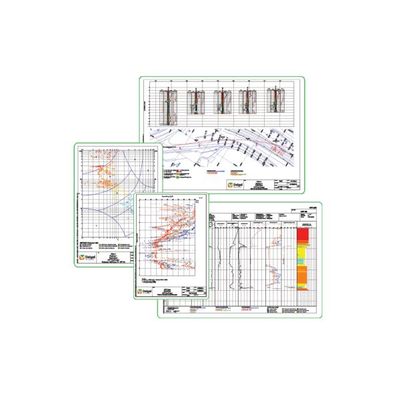
Datgel - Version CPT -Cone Penetration Testing Software
CPT Tool places advanced reporting directly in the hands of geotechnical engineers with code-free report definition and an array of formula configurations, analysis and report options unmatched in cone penetration testing. Speed up soil data interpretation with rich-data visualisation in any situation, adapting reporting output to changing requirements and conditions across projects.
Work without limits as you define which types of soil data to present in log, fence, cross-section and graph reports.
- Define correlation formulas and reports
- 200+ Preconfigured correlations and derivations
- 600+ customisable log, fence/cross-section and graph reports
Geotechnical features
- Import CPT data files in numerous formats
- Choose SI/Metric, English/Imperial, or configure the units to suit your needs
- Soil behaviour type correlations
- Liquefaction related correlations
- Pile axial capacity
- Shallow foundation settlement
- Dissipation test analysis
- Seismic cone presentation
- Magnetometer cone derivations and presentation
- Tools to summarise data into characteristic values and layers
- Comparison logs showing two PointIDs with your choice of parameters
- Environmental data presentation
- Ability to filter out rod changes
Performance and utility features
- Support for Access and SQL Server database formats (requires gINT Professional Plus)
- Multi-threaded calculation
- Data correction tool - adjust measured data after it`s imported
- Supports AGS 3.1, AGS 3.1 RTA 1.1, and AGS4 Formats
- User definable line colours, types and scales
Version 4.2 New Features
- Improved SQL Server update
- .NET 4.8
- More data file import options - Hogentogler (*.txt) file format, and Vertek/Hogentogler (*.cpt and *.dis)
- Single .exe installer
- Extended validation code signing certificate, to avoid windows warning during installation
Version 4.1 New Features
- Features of the Datgel Administrator Tools now included in CPT Tool: AGS Format Tool, Convert Projects Tool, Export Tool, Find and Set Property Tool, Import Correspondence File to Field Map Tool, Lookup List Check Tool, and SQL Tool
- GEF 1.1.3 CPT and Dissipation Test export - watch the webinar recording
Version 4.0 New Features
- Support for gINT 10 Connect Edition
- Revised database structure, with new table CPT_DATA_CORRELATION
- Specification calculation
- Calculation for 2 qc design lines
- Thermal Conductivity data tables and import
- Dissipation test report with qc graph below u graph
- More data file import options - Geomil Excel, Datum Thermal Conductivity, Fugro Uniplot
- Magnetometer cone derivations and presentation
- CPT Compaction Boxes
- Datgel Import Engine for SQL Server
- P-wave fields and reports
- Completed reporting options for all data columns
- Deep vibratory compaction weighted average calculation and reports
- Fill height now considered when calculating rd in CSR
- Hole Depth updated after inclination add-ins and CPT calculations
- Permeability / hydraulic conductivity 2010-Robertson
- Variable Stick width on Fence reports
Version 3.1 and 3.2 New FeaturesCPT Tool version 3.1/3.2 adds a range of moderate sized features.
- Soil Behaviour Type correlation from Begemann (1965)
- Begemann Mechanical CPT derivations from raw readings, and pre-population of CPT_DATA depth data to facilitate data entry
- Determination of allowable pile axial capacity
- Assessment of settlement for shallow foundations
- User definable fines content profile
- Ic and Stress Exponent n calculated with iterations
- Thin Layer Correction, calculated for reference, not used be other calculations
- Overburden Correction Factor CN and qc1N calculated with iterations
- Earthquake design groundwater depth and fill surcharge, resulting design effective stress profile
- Shear wave velocity liquefaction analysis to Kayen et al. (2013)
- Determination of the Liquefaction Potential Index
- Determination of the Liquefaction Severity Number
- Liquefaction analysis to Boulanger and Idriss (2014)
- Additional predefined unit systems with MPa for fs and u1, u2, u3, u0; and, kg/cm2 for qc, fs, total fs
- Complete reporting options for all CPT related data columns
- ISO/Eurocode support
- More dynamic log column header entities
- AGS4 option to use CPT_DATA table to generate SCPP
- Reports showing lab and other in situ test results for Undrained Shear Strength
- Dissipation test report with qc graph below u graph
- Magnetometer cone derivations and presentation
- CPT Compaction Boxes
- Datgel Import Engine, imports data into an SQL Server database in seconds instead of minutes to hours with gINT
- Fugro Uniplot data file import
- Datum Neptune Thermal Conductivity data file import
- Deep Vibratory Compaction ground improvement analysis calculations and reports
Version 3 New Features
CPT Tool version 3 adds liquefaction analysis, features to enable the Tool`s use with English units for the US market, along with significant enhancements requested by our existing users.
Processing
- Support for AGS4 Format
- Enhanced support for gINT Professional Plus with SQL Server
- Database schema restructure of project and point level parameters
- Import of more data file formats: Vertek (ECP), Gregg Drilling / ConeTec (COR) and Datem Neptune (CDF)
- Faster, multithread calculation. Now the batch calculation will calculate all strokes simultaneously. Using Access the update is queued, and using SQL server strokes are updated simultaneously. The result is the batch calculation is massively faster
Tools and Functions
- User definable units, allowing for the use of English/Imperial units
- Correlation summary command, which creates layers based on like properties and calculates average characteristic parameter values for the layers
Analysis
- Pile axial capacity
- Liquefaction factor of safety, cyclic softening of fine material, residual shear strength, lateral displacement and settlement
- Correlations for fines content, hydraulic conductivity and state parameter
- Soil Behaviour Types correlations by Begemann (1965), Eslami Fellenius (1997), Ramsey (2002) and Schmertmann (1978)
- Option to store site specific SBT definition in the project database
- Non-normalized Soil Behaviour Type Index, Robertson (2010)
- Soil Behaviour Type Index by Been and Jefferies (1992)
- Control minimum thickness of a SBT layer
- Option to average qc over sleeve range for Rf and Fr calculation
- Lower bound, best estimate, upper bound correlations calculations
Reports
- Enhanced dynamic log reports
- Log, fence and graph reports for new correlations
The Datgel CPT Tool natively supports a range of common CPT data file formats. Where applicable our Tool also imports dissipation test data.
Users can customise the gINT import correspondence files to control which field and table data imports to.
Choose to import 1 file, multiple files or a folder of files.
Supported import file formats include:
- A.P. van den Berg Gorilla!
- Access
- AGS 3.1, AGS 3.1 RTA 1.1, AGS4
- ConeTec (*.COR)
- Datem Neptune (*.CDF)
- Douglas Partners
- GEF 1.1.0 and 1.0.0
- Geomil PlotCPT (*.txx)
- Geo-Explorer (*.csv)
- Geo-Explorer v2 (*.001;*.101;*.D01;*.L01)
- gINT CSV
- gINT Excel
- Gregg Drilling (*.COR)
- Hogentogler (*.CPD)
- Hogentogler (*.txt)
- Pagani (*.CPT)
- Pagani (*.DAT)
- Pagani CPTU-ACQ (*.CPT)
- Pagani TGSA08 (*.CSV)
- ProbeDrill
- Simple delimited Depth qc fs u
- Swedish Geotechnical Data Format (SGF) - Geotech AB and Envi AB
- Vertek (*.ECP)
Upon request we will develop import functions for commonly used file formats.
Derived Parameters
|
The CPT Tool is supplied with seven Soil Behaviour Type (SBT) interpretation methods:
- Begemann (1965)
- Eslami and Fellenius (1997)
- Ramsey (2002)
- Robertson (1990)
- Robertson, Campanella, Gillespie and Greig (1986)
- Schmertmann (1978)
- Schneider, Randolph, Mayne and Ramsey (2008)
The following Soil Behaviour Type Index (Ic) correlations are defined in the Formula Tool:
- Been and Jefferies (1992)
- Jefferies and Davies (1993)
- Robertson and Wride (1998)
- Robertson (2010) - Non-normalized Soil Behaviour Type Index, ISBT
Additional polygon based methods and formula based methods may be defined by users, and stored in both the library and project.
The SBT can be summarised on to your existing borehole description lithology/stratigraphy table. Your existing material graphic code can be associated with each SBT number, geotechnically insignificant layers may be excluded, and thin layers of the same type (fine/coarse) can be appended together.
- More than 100 preconfigured correlations included
- Users can edit and create formulas
Preconfigured correlations
- Relative Density Index, Dr
- Undrained shear Strength, su
- SPT N60 and stepped average
- Shear wave velocity, Vs
- Unit Weight, γ
- Small strain shear modulus, G0
- Young`s modulus, E
- Constrained Modulus, M
- Compression Index, Cc
- Coefficient of volume, mv
- Preconsolidation stress, σp`
- Over consolidation ratio, OCR
- Friction angle, φ`
- Effective cohesion, c`
- Sensitivity, St
- Coefficient of lateral earth pressure, K0
- Rigidity index, Ir
- Hydraulic conductivity (permeability), K
- State parameter, Ψ
- Fines Content, FC
User Definable Correlation Formulas
The Datgel Formula Tool is the first way for a user to write a formula in gINT without writing complex VBA code. Simply define the referenced fields, and write your correlation formula in a standard formula syntax.
- Reference any related field in the database
- Built in mathematical and statistical functions
- Define result format, i.e. decimal places or significant figures
- Results may be numbers or string/text
- Store your common formulas in the library, and project specific formulas in the project
The Datgel CPT Tool is designed to assess liquefaction related correlations based on these primary references:
- Boulanger, R.W. and Idriss, I.M. (2014), CPT and SPT Based Liquefaction Triggering Procedures, Report No. UCD/CGM-14/01
- Idriss, I.M. and Boulanger, R.W. (2008). Soil liquefaction during earthquakes, Earthquake Engineering Research Institute, MNO-12
- Jefferies, M.G. and Been K (2006). Soil liquefaction - A critical state approach, Taylor & Francis
- Kayen, R., Moss, R.E.S., Thompson, E.M., Seed, R.B., Cetin, K.O., Der Kiureghian, A., Tanaka, Y. and Tokimatsu, K. Shear-Wave Velocity–Based Probabilistic and Deterministic Assessment of Seismic Soil Liquefaction Potential
- Robertson, P.K. and Wride, C.E. (1998). Evaluating cyclic liquefaction potential using the cone penetration test (also known as NCEER 2001)
Our tool supports the procedure defined by New Zealand Department of Building and Housing, Interim guidance for repairing and rebuilding foundations in Technical Category 3, Appendix C to the Guidance Document: Revised guidance on repairing and rebuilding houses affected by the Canterbury earthquake sequence (December 2012)
Calculated Parameters
- Earthquake design groundwater depth and fill surcharge, resulting design effective stress profile
- State Parameter
- Fines Content, and user definable fines content profile
- Ic and Stress Exponent n calculated with iterations
- Clean-Sand Equivalent Normalised Cone Resistance
- Cyclic Resistance Ratio (CRR)
- Cyclic Stress Ratio (CSR)
- Factor of Safety (FoS)
- Liquefaction Potential Index
- Liquefaction Severity Number
- Overburden Correction Factor CN and qc1N calculated with iterations
- Residual Shear Strength (Sr)
- Maximum Shear Strain
- Lateral Displacement Index, LDI
- Post Liquefaction Volumetric Strain
- Post Liquefaction Reconsolidation Settlement, S
- Thin Layer Correction, calculated for reference