

GEMS - Deep Foundation Geotechnical Software
Piles are used to provide foundation support to wide ranging structures such as buildings, bridges, wharves, jetties and towers. The GEMS Comprehensive Pile Foundation Analysis software supports analysis of land, bridges and water front piles.
The loading on the pile can be in axial direction (compressive or tensile) and in lateral direction (shear and moment). Application can analyze bored piles - cast-insitu concrete, driven piles - precast concrete, cast-insitu concrete, steel piles of various cross-sections. Various soil types (clay, sand, rock) and soil conditions (ground water table, scour) can be taken into account in the analysis.
The software includes modules for a) pile capacity estimation, b) axial load analysis and c) lateral load analysis. The software includes both linear and non-linear methods of analysis. Various common procedures for analysis used in practice are included.
The choice of the pile type is governed by sub-soil strata, ground water conditions, its chemical composition, facility of construction, local experience, available technology and cost.
The loading on piles can be in axial direction (compressive or tensile) and in lateral direction (shear and moment). The loading may be due to self-weight of structures, live loads, wind and earthquake forces. In water front-structures forces due to ship impact and mooring forces will require consideration. In bridge piles, scour around piers needs to be taken in to account. Abutment piles will also be subject to lateral earth pressure. In many instances axial and lateral forces will act above the ground level requiring consideration of beam column action. In all cases the piles designed should meet the serviceability and safety requirements under all loading conditions.
The pile analysis software is developed keeping in view all the above requirements. This pile analysis software can be used in several ways towards achieving design requirements:
- Based on sub-soil properties and pile parameters, analyse the pile for different loading scenarios.
- Perform analysis towards optimizing pile length and size.
- Evaluating performance of different types of piles in making a choice.
- It may be used in comparing results of load tests with the results of analysis and in fine tuning pile design parameters.
TheComprehensive Pile Foundation Analysis (Land, Bridge & Waterfront Structures)software of GEMS provides feature rich & easy-to-use program modules for the all the above analysis. There are three modules available.
- Pile Capacity Estimation
- Axial Pile Analysis
- Lateral Pile Analysis
The pile analysis software is developed keeping in view all the above requirements. This pile analysis software can be used in several ways towards achieving design requirements:
The ultimate axial capacity under compressive or tensile load is computed based on the soil layer properties. The software gives the pile capacity at various depths of soil and also breaks it down to its contributing factors viz. shaft friction and base capacity. The pile capacity estimation is based on the sub-soil layer properties and different methods for assessment of shaft friction and base capacity.
In addition to common procedures used in practice, procedures based on API-2011, ‘α method’ (IS-2911), ‘Semple & Rigden (1984) method’, ‘Kolk & Van der Velde (1996) method’ for clay soil and ‘β method’ (API-2011), ‘k-δ–flim method’ (API-2000), ‘k-δ -Zc method’, ‘Meyerhoff SPT method’, ‘Nq-qlim method’ (API2011,API-2000), ‘Nq-Zc method’ (IS-2911), ‘Nq-Berezantsev-Zc method’ for sandy soil are also included along with ability to include user prescribed parameters. A distance of 3D is used for developing full base resistance in strong layers. A safe distance of from pile tip of 3D is adopted to preclude punch through underlying weak layers. For rock layers an approach based on unconfined strength is adopted.
This module has two independent sub modules:
(a) Axial pile deformation analysis
Pile is modelled as an elastic structural member having the cross section of the pile and the elastic properties of the pile material. The soil support providing the shaft friction is modelled by a set of side springs based on t-z curves. The tip resistance provided by the pile base the base is modelled by a spring based on q-z curve.
The software supports both ‘Elastic Bi-linear’ and ‘Non-Linear’ approaches for modelling and any one of them can be selected for analysis.
In the ‘Non-Linear’ approach, for the soil layer, based on the tmax and qmax values calculated , non-linear t-z curves (interface shear stress- vertical pile movement at that point) and q-z curve (bearing stress and toe displacement) are developed based on API-2011 guidelines. In the case of rock layers, using the tmax and qmax values, t-z and q-z relationships are modelled by a bilinear elastic – plastic curve based on the elastic modulus and Poisson ratio of the rock layer.
In the ‘Elastic Bi-linear’ approach, for the soil layer, t-z and q-z relationships are modelled by bilinear elastic – plastic curves based on the elastic modulus, Poisson ratio ,tmax and qmaxfor the layer.The axial pile analysis follows a non-linear finite element model using the axial rigidity of the pile and the nonlinear soil support based on the t-z curves and q-z curve. . The analysis uses an Iterative approach to achieve convergence.
The analysis provides displacement of the pile head under a given load on the pile head, variation of axial load along the pile length, and the load carried by the pile base. Different loads applied on the pile head and the corresponding head displacements provide the load displacement curve.
(b) Generation of t-z and q-z curves
Development of a set of t-z curves along the shaft length and q-z curve at the pile base for compressive loading. Multiple t-z curves are generated for each soil layer. The curves can be based on ‘API-2000 RP’, ‘API-2011 RP GEO’ or ‘Elastic Method’ for sand and clay layers. API based methods, also account for reduction in post peak adhesion in clay layers through a factor R.
This module has two independent sub modules.
Commonly used linear models based horizontal subgrade modulus kh for clay and rock and linearly varying subgrade modulus with depth nh for soft clay and sand can also be chosen.
(a) Lateral pile deflection analysis.
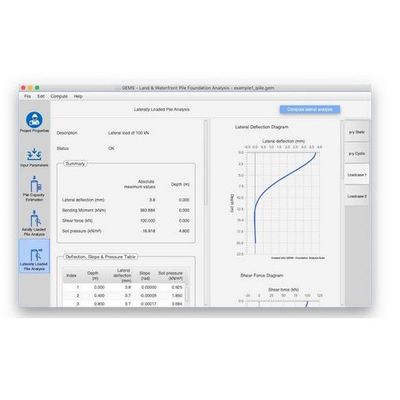
Analysis of a pile subjected to lateral load and moment is carried out in this module. Finite element based approach is adopted to model the pile and the soil support in which the pile is divided in to a number of elastic beam bending elements. The method allows consideration of inhomogeneous and non-linear modelling of soil support. The lateral soil support for the pile is modelled by the well-known p-y springs.
The following boundary conditions may be given at the pile head.
(a) prescribed lateral displacement(b) prescribed rotation
(c) prescribed rotational stiffness.
For pile having free head condition both lateral load and moment can be prescribed at the pile head. With other conditions only lateral load can be prescribed and pile head moment will be determined from the analysis. The method can consider the effect of axial loading due to beam column action in lateral pile analysis. The pile head can project above the ground.
The finite element discretisation not only takes in to account the specified pile make-up but is also optimized for better accuracy by adopting a graded mesh along the pile length. An iterative procedure based on secant modulus approach is used for convergence.
(b) Generation of p-y curves.
In this module p-y curves are generated for the soil layers based on their properties. Multiple p-y curves are generated for each layer. API-2011 RP-Geo can be used for clay and sand layers. For stiff clay the procedure outlined in ‘L. C. Reese and W. R. Cox, (1975) can also be adopted. For ‘weak rock’ Reese(1997) method is available while for ‘hard rock’ Turner(2006) method is available.
One Click Computation
One click computation and analysis for all load cases and modules
Analysis Modules
Axial pile capacity estimation
Analysis of the pile foundation under lateral and axial loads
Pile Cross Section
Piles of circular, square, rectangular, circular-tubular & I or H cross sections can be analysed.
Multiple Load Cases
Multiple load cases
Linear & Non-linear analysis models
Pile & Loading Diagram
Pictorial representation of the pile and soil layers
Graphical representation of loading diagrams for each load case
System of Units
Data can be input in either SI units or ‘Commonly used American units’ (Kips for force and foot for length)
Loads & Moments
The loading may consist of axial load, lateral load and lateral moment
Static and cyclic loadings can be incorporated for lateral analysis
Pile Head Properties
Facility of prescribing lateral displacement, rotation & rotational spring at the pile head
Site Condition
Local scour and ground water table consideration
Clay, sand, rock layers can be specified
Pile Group Effect
Consideration of group effect by user prescribed p-multiplier, y-multiplier & z-multiplier
Self Weight
Self-weight of pile may be included if required
p-y, t-z and q-z curves
Generation of p-y, t-z and q-z curves based on soil properties.
Export
Export results to Microsoft Word & Excel
OS Support
Support for Windows & Mac
Cloud
Available on cloud using a browser