

- Home
- Companies
- SoftExpert
- Software
- Environment, Health and Safety ...
Environment, Health and Safety Management [EHSM]
In a complex global business environment, improving performance and assuring compliance with all Environmental, Health and Safety (EHS) obligations, commitments and constraints is a challenge. Moreover, social-environmental management has earned increasing interest among organizations that want to establish an ethical and transparent relationship with all interested parties - shareholders, customers, community, suppliers and employees.
While the EHS needs will vary from one organization to the next, the primary objective is often the same - to reduce overall risk, comply with state and federal regulations, and enable the company to operate efficiently while maintaining a safe and environmentally healthy workplace. Standards and initiatives such as ISO 14001 and OHSAS 18001 serve as the framework that enables companies to comply with all environmental, health, and safety standards.
SoftExpert EHS Management helps organizations comply with these standards and best practices through integration, automation, and collaboration. The software offers unparalleled efficiency and effectiveness in supporting initiatives, efforts and controls to increase worker safety, comply with regulatory requirements, quantify sustainability and lower exposure to risk.
SoftExpert EHSM manages and measures environmental, health, and safety processes, and executes organizational change through a flexible workflow platform that adapts to changing business processes. The software centrally monitors all elements of EHS program including KPIs, aspects/impacts, compliance, policies and procedures, inspection records, violations notices, incidents, audits, corrective actions, waste and more.
Global companies are using SE EHSM solutions worldwide to improve the reporting and management of their EHSM performance, better manage their risks, reduce costs and streamline business processes.
SoftExpert EHSM Suite is the most comprehensive compliance management software platform of its kind, providing customers with the following benefits:
- Customer self-service – secure Web-based operations.
- Enhances collaboration skills by providing real-time access to information.
- Eliminates risky and costly spreadsheet errors by deploying a consistent, reliable and standardized database management solution across your EHS organization.
- Maintains a central repository that collects and stores data once and reports it multiple times – saving time and reducing costs and associated risks.
- Deploys verifiable and transparent data collection, ensuring the reliability of the data and information reported to key stakeholders.
- Easily connects with other information systems, reducing the inefficiency associated with manual transcription and aggregation.
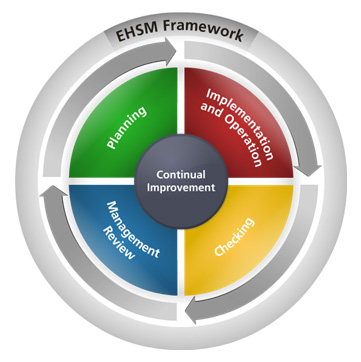
From 1850 to around 1975, the sustainable competitive advantage of industrial organizations was related exclusively to the benefit of economies of scale and scope, rapid allocation of technology, fixed assets and excellence in the management of financial assets and liabilities in an economy dominated by tangible assets. This economy was based solely on financial indicators for performance management, no longer applicable today because organizations have transferred their assets to tangible assets, as shown in the figure below:
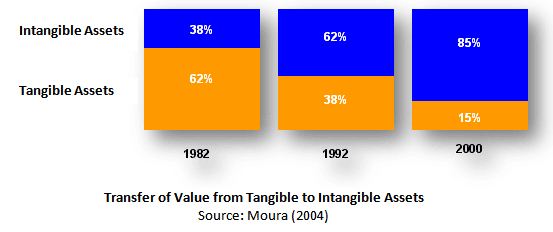
For Kaplan and Norton (1997), financial measures are designed to compare previous periods based on internal standards of performance. While such measures may present this information in a fairly consistent fashion, the financial outlook is no longer able to predict the future and also prevents the first signs of relationship problems, quality and new opportunities. This is because the speed with which information technology is evolving prompts major changes that demand a larger amount of information and new skills to manage organizational processes in order to guarantee competitive advantages in terms of making operational and strategic decisions on time.
Experts call attention to the fact that, in the current scenario, the use of traditional financial measures alone is no longer appropriate, since the probability of failure is too high. This leads organizations to develop new methods and tools for supporting the measurement of overall performance, balancing not only the tangible assets, but also the intangible ones that will assist with short and long term decisions.
In this sense, SE EHSM Suite offers a wide range of natively integrated tools (components) to fully assist all phases of management process, supporting performance management, balance between tangible and intangible assets, transparency of processes and improvement of stakeholder confidence, with the following main advantages:
- Lowered TCO through increased reliability and scalability leading to greater administrative productivity.
- Increased user productivity with the ability to communicate whenever and wherever needed with collaboration tools.
- Streamlined solution operations and reduced risk by leveraging a full range of capabilities.
- Compliance with major regulations.
- Reduced ongoing costs with flexible financing and support options.
- Allows for modular and incremental implementation, with worldwide services and support.
Financial ROI:
Savings
- Reduction of costs related to EHS risks.
- Reduction of costs related to fines and penalties due to the disregard of legal issues.
- Reduction of general expenses to complete activities demanded by applicable norms.
- Reduction of management system costs.
- Elimination of delays and inefficiencies that usually occur in manual activities.
- Collaboration skill enhancement through real-time access to information.
- Increased efficiency in maintenance system planning and activities.
- Optimization of financial resources invested in management programs.
Investment
- Investment in SoftExpert ECM will depend upon the business unit size and implementation approach.
Return on Investment (%)
- ((((Total Annual Savings) x n years) - Initial Investment) / Initial Investment) x 100.
Payback Period (years)
- Initial Investment / Total Annual Savings.
Non Financial ROI:
- Improvement of company`s image and reputation in the society.
- Improved relationship with shareholders, customers, community, suppliers and employees.
- EHS risk identification, assessment and determination of controls.
- Consistent, reliable and standardized information.
- Accurate identification of regulatory requirements and issues affecting management system performance.
- Monitoring occurrences, such as: best practices, opportunities for improvement, comments, nonconformities, etc.