


ESI Group
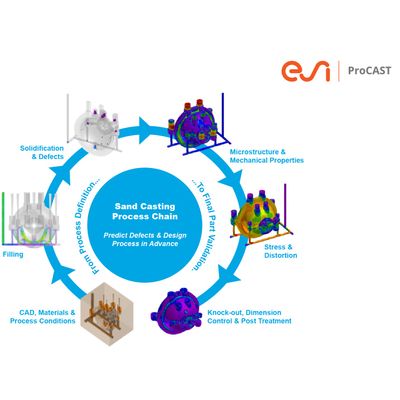
ESI ProCAST - Simulate Sand Casting Processes Software
FromESI Group
Leveraging over 30 years of experience, ProCAST is a best-in-class casting simulation software, enabling foundries to evaluate, validate and master their casting processes, down to fine-tuning multiple process variations. Leading OEMs and several foundries have embraced ESI’s casting simulation solution to minimize trials, improve yields and maximise their margins.
Most popular related searches
- ProCAST integrates advanced physics yet delivers accurate results in a very short time.
- Extensive Material Database spanning most alloys (Cast Iron, Steel, Al, Cu, Mg, Ni) and molding materials (Molds, Cores, Ceramics, Filters, Insulation & Exothermic Sleeves) to best support the specific needs of sand & shell casting processes.
- Intuitive User Environment with dedicated Foundry Application Oriented Workflows.
Estimate castability risks early by facilitating `Design for Manufacturing`, and bridging the gap between OEMs and their suppliers
- Enable co-design to achieve the best castability
- Evaluate numerous design alternatives at an early stage (including materials influencing quality specification)
- Assess critical areas to achieve specific mechanical characteristics
- Reduce process development time to produce sound casting with optimal costs and lead-time
Enable simulation-based design for manufacturing processes
- Find the optimum molding layout, maximizing metal-to-sand ratios
- Design the right feeding and gating systems maximizing the yield
- Assess new materials thanks to integrated Thermodynamic Databases computing material properties based on the user-defined chemical composition
Achieve desired part integrity from the first produced part
- Simulate filling sequences
- Prevent mold erosion risks, enable inclusion tracking
- Reduce scrap rates by avoiding defects, including porosity defects
- Predict the effect of expansion on porosity for cast iron
- Determine the right production process window
- Track residual stresses, control dimensional tolerances
- Assess critical areas to achieve specific mechanical characteristics
Predict part performance down to its microstructure
- Use dedicated micro-models for grey iron, CGI, guctile iron, and Ni-resist alloy grades
- Simulate expansion depending on the grade of cast iron (chemical composition), metal treatment (inoculation), and cooling rates (microstructure evolution)
- Investigate mechanical properties
- Anticipate the effects of heat treatment