

- Home
- Companies
- Enviroware S.r.l.
- Software
- Enviroware - EW_LAPMOD
Enviroware - EW_LAPMOD
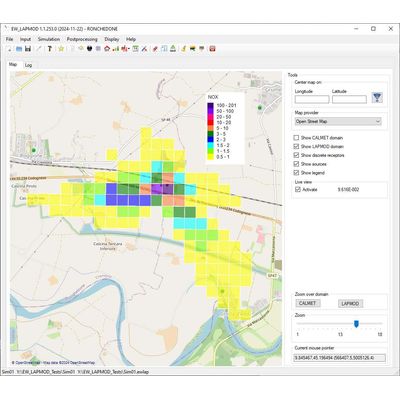
EW_LAPMOD is the official Graphical User Interface (GUI) to the open source Lagrangian particle model LAPMOD. EW_LAPMOD includes the model LAPMOD and its postprocessor LAPOST. It works under Windows and facilitates the insertion and the verification of the input data, and helps with the processing and visualization of the results.- Helps inserting and checking the correctness LAPMOD input data
- Allows to specify sources with constant rates, regular time trends and arbitrary time trends
- Automatically merges all the sources in a unique emission file (as needed by LAPMOD)
- Meteorological data at any point can be extracted from CALMET and visualized
- Concentrations at discrete receptors may be plotted soon after the simulation
- Postprocessing to get the desired statistics is very easy
- Gridded concentrations can be visualized over the embedded base map
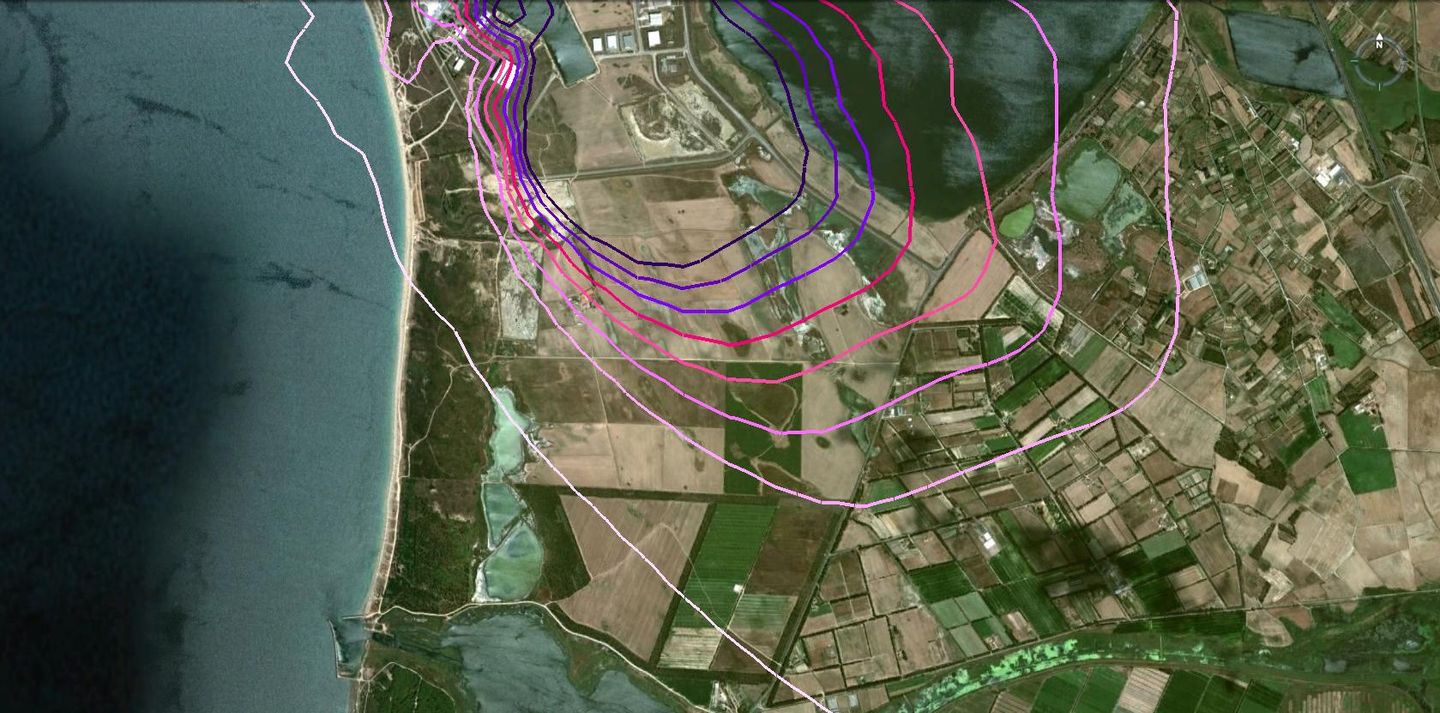
- Concentration contours can be exported in KML format for Google Earth
LAPMOD is an open source Lagrangian particle model directly coupled with CALMET, the same meteorological processor of CALPUFF. Some of its features are:
- Suitable for complex terrain
- Sub-hourly time steps
- Point, area, volume and line sources
- Rain capped, horizontal, arbitrary slope stacks
- 3D non-stationary meteorology
- Dynamic peak-to-mean factor for odor
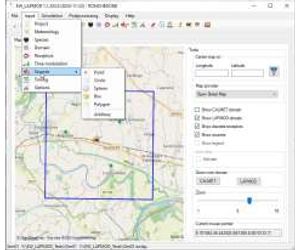
LAPMOD can simulate different kinds of sources: point, circular, spherical, parallelepipedal and polygonal. The emissions can be constant, regularly variable or arbitrarily variable.
Point sources (stacks) may be vertical unobstructed, vertical with rain cap, or with any horizontal orientation and vertical slope. Gooseneck sources can also be simulated.
The geometry of a polygonal source is described in EW_LAPMOD by loading a KML file.
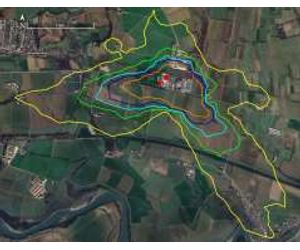
All the geometrical entities (domains, sources and receptors) are automatically exported in KML format for Google Earth. Concentration contours can also be exported in KML format.
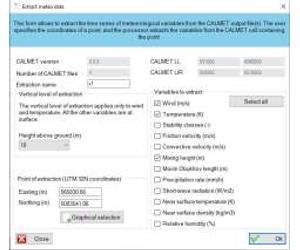
Meteorological data stored in the CALMET output files can be extracted from a specific point and represented as time series. The vertical level of the extraction may be one of the CALMET vertical levels. The user selects what variables must be extracted (e.g., wind, temperature, mixing height, stability class, ...). The charts can be copied or saved and used in technical reports.
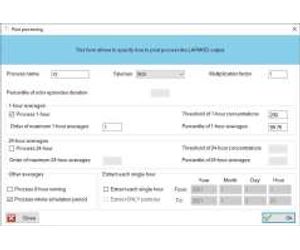
LAPMOD results are stored in one or more binary files and must be postprocessed with LAPOST to extract useful information. EW_LAPMOD allows to insert and verify the input of LAPOST and to launch it. Typical postprocessing operations may be the calculation of the annual averages, the 8-hour running averages, the maximum 1-hour or 24-hour averages and their percentiles. It is also possible to extract all the concentrations fields or the positions of the computational particles within a specific time interval. Concentration fields can be represented as grid maps within the GUI, or exported in KML format for Google Earth. Particles are saved in CSV files that can be dragged into Google Earth.
The log file can be copied or saved in RTF format. It contains many useful information to use in technical reports.
Forecast is available to the users that have subscribed the service. These users can get the forecast data for a domain within a wider area of their interest. Through EW_LAPMOD the user specifies the center of the domain and its amplitude, then the simulation starts on an Enviroware remote server, at the end, a link is provided to download the output data in CALMET format. The time needed to get the forecast data is of the order of few minutes. Forecast data may be useful for simulating accidental releases, or to evaluate the impact of a specific industrial plants in the future 24/48 hours.
EW_LAPMOD is a Microsoft Windows-based program. Minimum suggested requirements are:
- A modern and powerful CPU
- Windows 10 or higher
- At least 1 GB of RAM