


- Home
- Companies
- TANIQ B.V.
- Software
- FEA Toolbox for Reinforced Rubber ...
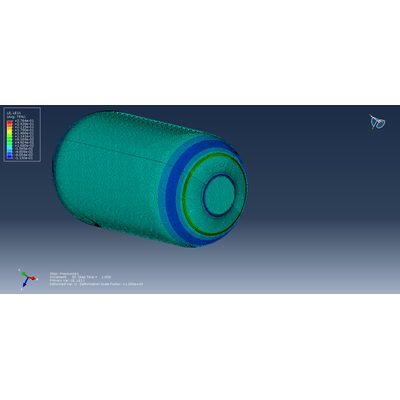
FEA Toolbox for Reinforced Rubber Products
TANIQ's Technology enables Finite Element Analysis with the exact geometry of the designed products. This is achieved through a direct coupling of the design made with the Design Software and commercial FEA Software such as Abaqus, using TANIQ’s FEA Toolbox. To complete the circle, the exact same design is also uploaded to the robotic equipment for production, such that the final product matches the product design and the FEA model. The obtained consistency between design, FEA model and final product is truly unique for mandrel-built reinforced rubber products.
Using TANIQ’s FEA Toolbox analysis of individual fibres and their interaction with the rubber elements is possible. Significant R&D was done on material model definitions, and interaction between different material elements. The high quality of the model representing the final product makes it possible to make accurate predictions of product performance for different load cases. The FEA can be used for analysing product behaviour (e.g. burst failure, maximum movements, etc.) and for comparison of design alternatives without building and testing of prototypes. Using FEA instead of, or before developing and testing of prototypes saves significant R&D costs. Ultimately, this creates new possibilities to improve your product performance and quality. An additional benefit is that you can automatically create accurate and reliable FEA-reports.
Simulate your product performance and optimise the design using Finite Element Analysis
First a design is made with the Design Software and exported to the FEA Toolbox. In the FEA Toolbox the user can define load cases and generate input files for Abaqus. Typical results are:
-
Burst pressure prediction (maximum fibre tensile strength)
-
Analysis of (local) stress concentrations
-
Stiffness responses/ load displacement curves
-
Failure mode prediction
-
Maximum movement capacity (axial compression/elongation, lateral deformation)