


- Home
- Companies
- GAEA Technologies Ltd.
- Software
- GAEA - Version POLLUTEv7 - Migration ...
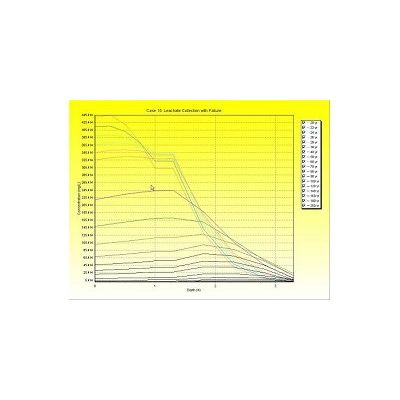
GAEA - Version POLLUTEv7 -Migration Analysis Program
The POLLUTEv7 program provides fast, accurate, and comprehensive contaminant migration analysis capabilities. This program implements a one and a half dimensional solution to the advection-dispersion equation. Unlike finite element and finite difference formulations, POLLUTEv7 does not require a time-marching procedure, and thus involves relatively little computational effort while also avoiding the numerical problems of alternate approaches.
With more then fifteen years utilization in industry, POLLUTEv7 is a well tested contaminant migration analysis program which is widely used in landfill design and remediation. Landfill designs that can be considered range from simple systems on a natural clayey aquitard to composite liners, multiple barriers and multiple aquifers.
In addition to advective-dispersive transport, POLLUTEv7 can model:
- non-linear sorption
- radioactive and biological decay
- transport through fractures
- passive sinks
- phase changes
- time-varying properties
Models can be created from scratch, using the program Wizard or by selecting one of the many pre-created models: such as, Primary Liner Landfill, Primary and Secondary Liner Landfill, Vertical Migration, and Horizontal Migration.
- New models can be easily created using either a blank model, the wizard, or a quick entry model.
- A graphical diagram of the model is displayed as it is created.
- Models can contain up to 200 layers.
- Layers can contain 1, 2, or 3 dimensional fractures.
- The diffusion coefficient, distribution coefficient, and phase change parameter can be specified for each layer.
- The top boundary condition can be zero flux, constant concentration, or finite mass.
- The bottom boundary condition can be zero flux, constant concentration, fixed outflow, or infinite thickness.
- The subsurface concentrations can be calculated at specified times or the time of the maximum concentration can be automatically found by the program.
- Radioactive or biological decay of the contaminant can be modeled.
- An initial concentration profile at specified depths can be specified.
- Freundlich and Langmuir non-linear sorption can be modeled.
- Source, velocities, and layer properties can be varied with time (can be used model changes in the source, barriers, or flow patterns).
- One or more passive sinks can be specified to model horizontal velocities in layers and the removal of contaminants.
- Monte Carlo simulation can be used to evaluate the effects of uncertainty of model parameters.
- Sensitivity analysis can be used to predict the expected range of concentration when parameter values are not known accurately.