


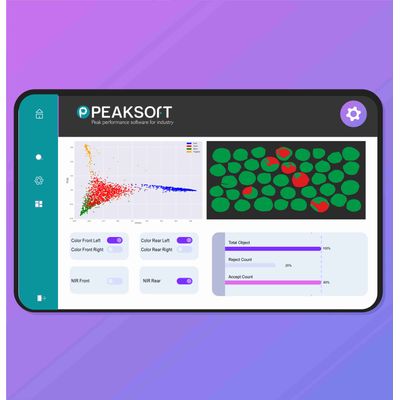
Peaksort - NIR and Color Shape Image Processing Software
Our software has been developed using machine learning algorithms to detect color, shape, and foreign materials. The images obtained from an industrial NIR (Near Infrared) single-channel camera and an RGB 3-channel camera are combined to generate a 4-channel spectral image within the range of 400-950 nm. These camera images are processed through machine learning algorithms such as PCA, LDA, SVM, etc.
Our software, supported by camera technologies, enhances available information by presenting higher detailed aspects of stains, bruises, deformations, and imperfections - both visible and invisible - on food products. This facilitates product analysis and sorting processes. Furthermore, object detection algorithms have been developed to identify shape irregularities in the products.
With the software and machinery developed, products falling freely at a speed of approximately 3 m/s are entirely scanned at a scanning rate of approximately 2000-3500 fps. This ensures the physical separation of products identified with foreign materials inside or on them, and with shape irregularities, achieving a separation success rate of approximately 98%.