IDEA Bio-Medical Ltd.
  1. Companies
  2. IDEA Bio-Medical Ltd.
  3. Software
  4. WiSoft - Push-Button Image Analysis ...

WiSoft - Push-Button Image Analysis Software

SHARE

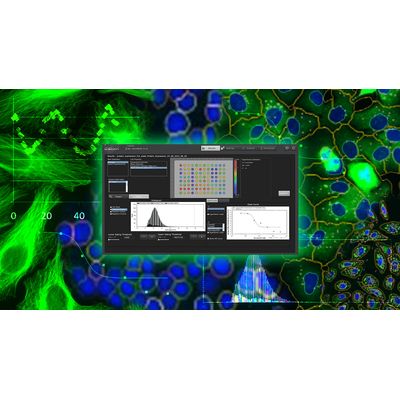
Athena is a rich and simple application-based image analysis software for easy and quick evaluation of cell biology experimental results.Athena performs common and advanced cell biology applications at the push-of-a-button. WiScan Athena is a software tool for application-derived analysis and visualization of image-based experiments. The software incorporates embedded analysis algorithms, statistical evaluation tools and sub-population analysis tools, based on advanced cell quantification tools for measuring fluorescence intensity and morphological features. It consists of a library of pre-built analysis modules applied to data sets of both labeled and non-labeled cells, thus Athena is capable of analyzing images acquired in bright field and fluorescence illumination microscopy.


Most popular related searches
Easy to use, push-button operation

All level users can be easily trained and use this platform simply and independently. Athena offers a bank of ready-made applications which are loaded by the push of a button and allow the user to start analysis within a few minutes, after performing mild parameter calibrations. The UI and UX are optimized for analyzing image-based cell biology experiments. New comers to high content image analysis can get productive right away using Athena’s pre-configured templates for the most common cell biology applications.

Analysis can be performed on a cell-by-cell basis and at population level.

Individual cells can be measured & quantified both for single cell analysis and for subpopulation analysis. Athena contains a population tool which in similarity with cytometry experiments, can be used to define sub-populations of cells in each well and quantify properties of this sub-population based on cellular phenotypes.

Image acquisition and image analysis can be done simultaneously, independently & at separate locations.

View and analyze data from any computer that has an installation of the Athena software, freeing up the Hermes imager for others to use. Experiment time is significantly reduced as images acquired in Hermes system are being uploaded in real-time to a shared storage, from which Athena software extracts data for analysis, in parallel to the image acquisition process. Experiment metadata, such as filters, objectives, plate type, fields & coverage, time points, z-stack or exposure, are stored in the database for future reference.

Straightforward, simple visual results display.

Athena software offers various visualization tools to display the analysis results. At the end of each analysis process, the user can quickly & easily create a summary report summarizing the analysis parameters and presenting the results. Raw data can be easily exported as an excel file to external sources if necessary.


 

Technical specs of Athen software:

  • Windows 7 or Windows 10 required
  • Athena Software runs under 32-bit and 64-bit operating systems.
  • Results report produced in PDF format
  • Raw data can be exported in CSV format to Excel
  • Supported image formats: TIFF, OME, JPEG and more

    Athena software supports loading images with, and without their Metadata. Metadata supported formats include OME format and Hermes format. Most common microscope formats are convertible to OME using BIO-Formats converter which is included in Fiji, and can be added to ImageJ. Click here for further info. Without metadata, supported types are: *.tif, *.tiff, *.png, *.bmp, *.jpg, *.jpeg.

    Users can manually define pixel size, group images by textual filter to different wavelengths, and define stacks as Z or T stacks.

    When loading a dataset with its metadata, Athena can read the following main key features, among others:

    1. Dimensions of each image: well, in well field, wavelength, time index, Z stack index. Note – Plate index isn’t supported yet. If you need it please contact us.
    2. Pixel size
    3. Plate info
    4. Objective