


- The solution computes intraday, day-ahead and long-term forecasts with 5-60 mins resolution. Forecast frequency is every 5-10 mins, 24/7. Upper and lower uncertainty forecast bands.
- Cost effective solution. You pay one single annual subscription license fee whether used as a service or implemented on the cloud or on-site.
- Next-generation universal AI platform designed for the most stringent requirements of load, demand, price (energy and reserves) and solar & renewable generation forecasting in all electricity markets.
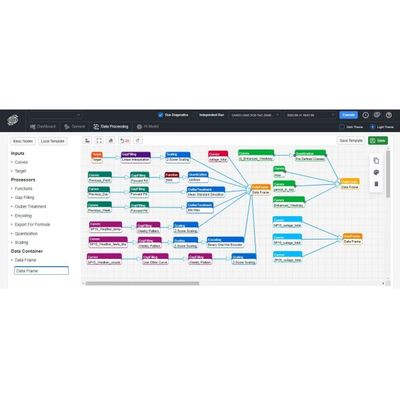
- No-coding AI platform allowing users to drag and drop and combine various Deep Learning AI and Machine Learning methods to create their own custom forecast models. The data flow and parameters of each AI model are configured on the screen in a user-friendly dashboard, without coding.
- AutoML forecasting platform. AI models can typically have 20+ parameters, and identifying the best combination by trial and error is very time-consuming. QR AI Model Optimization toolbox automatically tries the equivalent of 100,000+ models to identify the best model for each data set by selecting the combination of model parameters and predictors that minimizes the forecast error using genetic computing. This considerably shortens implementation and maintenance efforts.
- Build, fine-tune, optimize and deploy AI forecast models and set them for automatic execution in record time.
- QR Data Hub is a no-coding data warehouse platform that can be quickly configured to fetch, cleans, insert and manage clients’ data. QR Data Hub offers many tools to manipulate data, e.g., roll load data from 5 min to 15, 30 and 60 min resolutions, or aggregates load data by any desired criteria, e.g., total utility load or retail consumption, before passing the data to the AI machine for forecasting.
- The following chain is executed automatically 24/7 and each step triggers the next: data fetching and insertion from various sources (ISOs, RTOs, meter, SCADA, weather, etc.), training and execution of AI models, and publication of the forecast results via API.
- Flexible delivery options. Forecast as a Data Service where our platform does everything, and you receive the forecasts every 5-10 minutes 24/7. Software as a Service implemented on a private cloud or on-site. The cloud solution requires no software installation, hardware and IT resources, all you need is just a browser.
- Leverage our automated platform & expert team. The AI models self-calibrate, learn & adapt with each new data. Our data science team regularly fine tunes and optimizes your AI models.
- To reduce project risk you can start with a Proof of Concept (POC) or trial period. The fee is scaled to the implementation efforts needed by the POC. Contact us for more details.
Two flexible delivery options:
- Data Service where our expert team and Al platform do everything, and you receive, via API and electronic means, intraday and DA forecasts every 5-10 minutes 24/7. Software as a Service (SaaS) where we implement QR Al platform on a private cloud of your choosing, or on-site, and you control the data & the Al models.
- QR Al Forecaster is a universal Al platform whose state-of-the-art architecture allows the creation of very precise load, price (energy and reserves) and solar generation forecasts.The underlying Al and machine learning engines can be configured with different parameters and predictor data frames to create different types of forecast models. Al models self-calibrate, learn and adapt as new data arrive, before any execution.
- Cost effective pricing. You pay one single annual subscription license fee for QR Al Forecaster, whether used as a service or implemented on the cloud or on-site. The fee comprises the license, maintenance and upgrade releases Your system is upgraded regularly so that you always have access to the latest release. Your Al forecast models are regularly visited by our data science team, fine-tuned and optimized when needed.
- Model Optimization. Al forecasts are notoriously sensitive to model fine-tuning to select the best set of parameters and predictors. Leaving this to manual adjustments leads to a myriad of instabilities and poor forecast quality. QR Al Platform offers built-in toolboxes that automate the optimization of Al models, increase efficiency while leaving nothing to chance.
- QR AI Forecaster is a universal forecasting platform that is agnostic to specific usage, and offers vast configuration capabilities for any type of forecasting. This no-coding AI platform allows users to drag, drop and connect various AI and Machine Learning methods, sequentially or in parallel, in a user-friendly dashboard to create their own custom forecast model.
- Deep Learning models from Keras library are available: Long Short Term Memory Networks (LSTM), 1D/2D Convolutional Neural Networks (CNN), Recurrent Neural Networks (RNN), and Gated Recurrent Unit (GRU).
- Machine Learning ensemble models are highly efficient, flexible and portable. The following distributed gradient boosting libraries are available: XGBoost, Random Forest, Catboost, ADABoost and LightGBM.
- Single Models: MLP (neural networks), decision tree, SVM, KNN and ElasticNet.
- The algorithms are designed to perform regression (forecast), classification and clustering. These can be simultaneously put together to create hybrid AI models for specific tasks. E.g., we have created a hybrid model that can be trained to learn trading ancillaries, by deciding with high degree of accuracy, whether or not to participate in a DA reserve market versus the energy market.
- To ensure the highest degree of accuracy and stability, model optimization is automated with 3 specialized built-in tool-boxes, QR Feature Extractor, QR AI Back-tester and QR AI Model Fine-tuner. These considerably lessen the need and workload of data scientists and analysts.
- The platform execution time is in the order of minutes to produce intraday and day ahead forecasts. Computing lower resolution forecasts, e.g., 10 minutes, takes longer than higher resolution, e.g., hourly.
- All data is managed (fetched, inserted, validated, stored) by our modern datahub using Apache NIFI and Timescale DB.
- All data is distributed via a flexible Spring Boot API microservice. This allows real-time data integration with reporting and your internal systems, e.g., trading optimization.
- High-performance computing and microservice architectures achieve unparalleled scalable performance.
- Technologies used in QR AI Platform: Python Django, SciPy, NumPy, Pandas, Keras, Tensorflow, Java Spring Boot, NGINX, Tomcat, PostgreSQL, Apache NiFi, Angular, Grafana, Dramatiq, Highcharts.
- QR AI Forecaster can be used for all your forecast needs in electricity markets: load, energy and ancillary prices, offer stack, and solar generation. Libraries of premade models are available.
- QR AI Forecaster is a no-coding AI platform. Users can drag-and-drop and combine various Deep Learning and Machine Learning methods, in a user-friendly dashboard, to create custom forecast models.
- Analytics Governance is built in: each AI model and its parameters are visible and auditable. Each execution of an AI run is sand-boxed and parameters, input data and output results are saved individually.
- The data frame of predictors, and the parameters of each AI model are configured on the screen in a user-friendly dashboard, without scripting or coding. No prior knowledge of AI, statistics and programming are needed to use QR AI Forecaster platform.
- When forecasting load or price, many other time series can be added to the AI model as predictors. These can be multiple weather indicators, demand and supply side data, generation by fuel type including renewables, outages, ISO published hour and day ahead forecasts, consumer load or SCADA. Our AI models make a judicious use of predictors depending on the forecast type. Post-training, the system ranks the predictors by relevance, to help optimize the model.
- A different calendar can be assigned to each AI forecast model to replace intra-week holidays’ data with nearest Sunday’s data, both for training and prediction.
- You can create AI forecasting models for short term, intraday, up to 7 day ahead, and long term forecast. Forecast resolutions are 5 to 60 minutes. The frequency of short term forecast and publication is every 10 minutes, 24/7.
- Each forecast can have upper and lower uncertainty bands computed via quantiles or standard deviation.
- You can set the date range for model training, and the forecast horizon.
This no-coding platform allows users to drag and drop various data (time series), apply the desired mathematical operations and prepare and aggregate the outputs in a “Data Frame” to be used as the predictor input for the AI model.
Multiple time series with different timescales can be used (e.g., weather can be hourly and prices 15 minutes). The Data Processor will load data with the finest timescale and use empty fillers for missing data, awaiting the selected gap-filling method for each data type.
To enact data processing you can drag and drop from the menu a mathematical method to apply to a predictor. These are: simple functions (e.g., logarithm, exponential, averages, etc.), gap-filling, outlier detection and replacement, scaling, quantization, encoding methods. The parameters of each method appear in a popup window for editing upon clicking on the method icon.
You can set the date range for model training, and the forecast horizon.
Feature Extraction
5 categories of predictors are available:
- Internal: a shifted version of the main time series, e.g., previous period/hour/day same-period.
- External: multiple external data sets can be loaded as predictors to improve an AI forecast, by using the hidden relationships across the data sets. These can be external forecasts provided by other sources, e.g., weather, outages, hour/day-ahead forecasts from the ISO, supply side information, fuel type prices and generation. They can also be forecasts generated by our system. E.g., our own ISO system load forecast can be used as a predictor in nodal price forecasts.
- Formula: a mathematical expression to combine different predictors to create a new one.
- Built-in: derived from time index of time series, e.g. hour of day, day of week.
- 30+ Technical indicators from stock market. We often use MA & EMA to smooth excessive noise.