


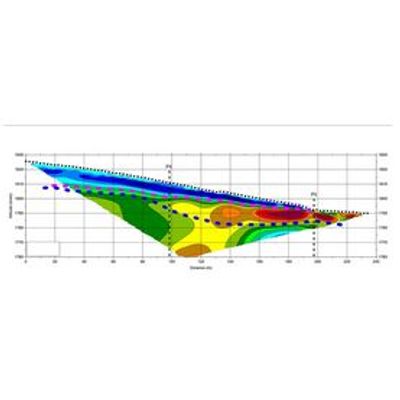
Refraction Seismology Software
Refraction seismology investigates refracted wave seismic velocities. The analysis is based on precise measurement of the propagation time between an energy source and vibration captors called geophones. Refraction seismology sections allow us to define the present lithologies as well as their geometry and velocity variations within.
A prior evaluation of the targeted depth allows an adequate choice for the size of the seismic spread and acquisition geometry. The seismic source choice must be optimized as a function of the targeted depth. Ambient noise and terrain accessibility affects this choice. Most seismic spreads are acquired with a seismic gun or sledgehammer, but more powerful sources can be implemented.
Refraction seismology acquisition with low frequency geophones in grants MASW (surface wave analysis) processing for the same data. Therefore, S-wave velocity sections can be made. Creating VP and VS profiles allows the calculation of common geotechnical parameters.
- Geological structures
- Bedrock geometry
- Landslides
- Alteration / faulting
- Geotechnical parameter distribution
- Simplified procedures (time intercepts, ABC, plus-minus)
- 2D tomographic inversion
- 2D layer inversion
- 3D Visualization
- Advanced interpretation