


- Home
- Companies
- Quantopticon Ltd.
- Software
- Quantopticon - Version Quantillion - ...
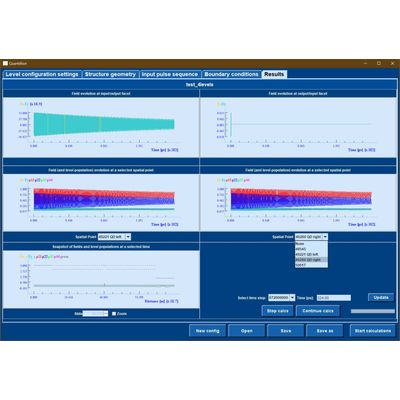
Quantopticon - Version Quantillion -Software Suite for Dynamical Modelling and Design of Quantum Nanophotonic Systems and Devices
The Quantillion software suite simulates the injection of an electromagnetic pulse (or train of pulses) in a semiconductor photonic structure with an embedded quantum system and calculates the propagation and interaction of the pulse with the quantum system and the evolution of its level populations and polarisation (i.e., decoherence). The integrated Finite Difference Time Domain engine enables solving of the vector Maxwell-pseudospin equations in the time domain, thus directly obtaining the spatiotemporal dynamics of the light-matter interactions within an extended, realistic device. By letting you construct your design from within the software, Quantillion provides engineers with the essential tools for virtual prototyping of quantum-photonic systems.
- Quantum-photonic memories
- Quantum light sources
- Quantum-photonic logic
- VCSEL dynamics
- Rapid virtual prototyping
- Built-in constructor of complex quantum-optical systems with arbitrary geometry
- Library of driving pulses, ranging from CW down to femtosecond and few-cycle pulses
- Accurate simulation of virtually any quantum system, including semiconductor quantum dots, diamond colour defects, hexagonal boron nitride, transition metal di-chalcogenides and dopant atoms in silicon
- Advanced geometry, optimisation, tolerancing, analysis and graphics tools
- No limit on type of materials
- Cost-effective package: designed specifically for engineering professionals who face real-world quantum-photonic problems
Today, we are on the verge of a second quantum revolution that promises to bring us incredibly powerful and fast quantum computers, inherently secure communications, customised medical care and many other life-enhancing benefits.
However, designing and optimizing these components requires multiple trial-and-error experiments.
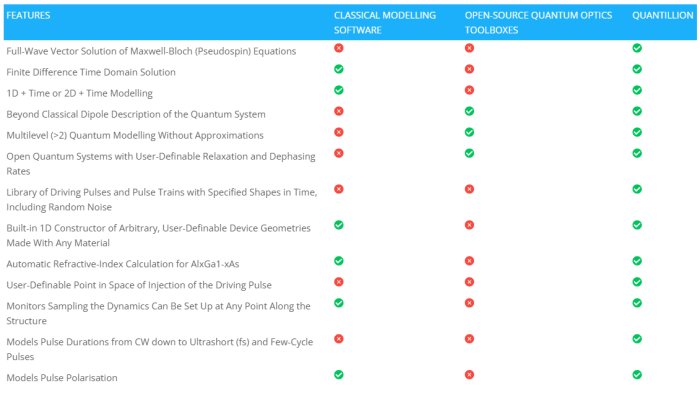
Classical photonics design software provides some assistance in this regard by, for instance, predicting the optical modes in a given system; however, such software is unable to describe the quantum-mechanical aspect of light-matter interactions and thus cannot be used to provide a design solution for the desired quantum-optical performance of the component. For this reason, a manufacturer has no choice but to rely on little more than a hunch to conceive a plausible design, and it often takes many design iterations before finally arriving at a quality, high-performance component. This process is therefore extremely time-consuming, expensive and labour intensive.
Performing fundamental modelling improves one’s understanding of the underlying physical processes. It is a ‘computational screening’ of ideas for new device configurations, new operating conditions, new materials – before they are tried in an actual physical lab.
If you come up with, say, a hundred new ideas, you won’t be able to try all of them – mostly due to cost reasons. But you can reduce that number to perhaps a couple of most promising candidates by performing a virtual experiment on a computer. The usefulness of this computational filter depends on the accuracy of the computational method you use. The workhorse computational methods used in quantum optics today are based on finite-difference time-domain (FDTD)-implemented classical electromagnetic vector field theory and, on the atomistic level, the Jaynes-Cummings model. These are widely applicable and comparatively fast, but their accuracy is fundamentally capped. You maybe lucky, and due to cancellation of errors, your result may be just about correct. But you have to rely on luck…
The methods we are developing in the framework of quantum photonics simulation are, in contrast to the above, comprehensive and free of approximations, thereby reflecting the true physical state and behaviour of the system over time. So our simulations always converge to accurate solutions. Put another way, our quantum-enabled electromagnetic computations can bring rigour and accuracy into practical device design, which at the moment is very much heuristic.
Our software can be a real asset to companies looking to scale up their products and get ready for full-scale commercialisation. We can accomplish this through systematically investigating and optimising the quantum performance of your devices. Generally, device optimisation up to now has tended to be passed down from people in the know, without their ever having spent much time truly optimising the process. Using our software should allow you to cut down on time involved, substantially reduce lab running costs and human effort, and result in a cheaper, high-quality and better product for the end-user.