


Thermo Scientific - Version SampleManager LIMS -Software Suite for Laboratory Operations
The Thermo Scientific SampleManager LIMS Software Suite is a comprehensive solution designed to streamline laboratory operations through effective management of laboratory information, documents, and processes. The suite, comprising LIMS, SDMS, ELN, and LES, seamlessly integrates with existing enterprise systems and laboratory instruments to enhance compliance and productivity. Tailored for enterprise customers, its modular design allows for customized adaptation to meet varied laboratory demands across industries. The software supports multilingual operations and accommodates multiple time zones, making it ideal for laboratories with a large user base. It digitizes workflows by automating data transfer, centralized resources management, and effective order handling, thus boosting overall operational efficiency. By integrating with ERP systems and offering capabilities such as lab automation, sample management, document control, and stock management, it minimizes manual input, ensures data integrity, and enhances laboratory decision-making processes.
SampleManager LIMS™ offers a nearly identical range of functions to up2LIMS, but is also tailored to the specific needs of enterprise customers. Its modular design allows for customized adaptation to the diverse requirements of large laboratories in a wide range of industries. As a scalable and flexible platform, SampleManager LIMS™ increases efficiency and quality in every laboratory.
Laboratory
Management
SampleManager LIMS™ takes holistic laboratory management to a new level. The digitized laboratory optimizes workflows through automated data transfer, centralized resource management, and efficient order management. Improved system connectivity increases overall efficiency, reduces manual input, and supports data-driven decision-making for optimized laboratory processes and increased productivity.
Lab
Automation
Lab automation enables the configuration of specific workflows and the automation of decision-making processes. Workflows simplify system implementation and facilitate the introduction of new procedures. This technology increases efficiency, reduces manual intervention, and improves the reproducibility of results in the laboratory. Flexible integration with third-party systems (e.g., ERP) eliminates media disruption and ensures a continuous flow of data.
Sample
Management
The Sample Management module automates the entire sample management process, from test order registration to report generation. It optimizes complex workflows, increases efficiency, and ensures complete traceability. Integrated workflows and digital documentation minimize manual errors and facilitate compliance with regulatory requirements.
Order
Management
Integrated order management optimizes the administration of laboratory orders from internal and external customers. From quote reviews and sample registrations to invoicing, the order portal offers a comprehensive workflow. It enables label printing and result verification, and simplifies holistic order management for increased efficiency in everyday laboratory operations.
Document
Management
The document management module enables versioned and controlled management of work instructions, SOPs, and standards. Additional features such as keyword searches, controlled document editing, and electronic signatures optimize workflows. Direct integration eliminates interfaces, ensures data security, and simplifies the updating of important documents in the digital laboratory environment.
Stock
Management
The integrated stock management module enables comprehensive recording and management of laboratory resources. It provides a constantly updated overview of reagent, standard, and consumable stocks. Through precise inventory management, it optimizes resource planning, minimizes bottlenecks, and supports efficient laboratory management in everyday life.
Retention sample
management
The retention sample management integrated into SampleManager LIMS™ allows for both manual and automated generation of retention samples. Storage locations and withdrawals for planned or ad-hoc testing can be seamlessly documented. By defining retention periods, the LIMS can support outsourcing and disposal.
Storage Location
Administration
Storage locations are managed in SampleManager LIMS™ in a configurable, hierarchical structure. This allows everything from buildings, climate chambers, laboratories, and even refrigerator boxes to be represented in the LIMS and assigned to samples, reagents, or instruments, among other things. Samples can be relocated using barcode masks and documented in the LIMS with a corresponding timestamp and user name, allowing a sample's path through the laboratory to be fully traced.
Device management
This module combines instrument and interface management for optimal device management and integration. It includes maintenance and calibration planning, structured documentation, and seamless device integration. It also supports various interfaces (RS232, USB, and web services), automates data acquisition, minimizes downtime and transmission errors, and ensures device availability, regulatory compliance, and optimizes cross-device data integration in the laboratory.
ELN
The integrated Electronic Lab Notebook (ELN) digitizes lab notebooks, enables diverse data integration (rich text, spreadsheets, PDFs, molecular structures), and seamless team collaboration. Existing Microsoft Office templates can be imported. Users create free text, tables, and diagrams, and insert images and comments. This comprehensive digitization optimizes documentation, data exchange, and workflow efficiency in the modern laboratory environment. Since the ELN functionality is integrated into SampleManager LIMS™, data such as samples and instruments can be referenced, and results can be imported via the instrument interface. This enables comprehensive research across LIMS and ELN data.
LES
The Laboratory Execution System (LES) guides laboratory technicians step-by-step through laboratory procedures, ensures SOP compliance, and documents the entire process flow. It increases quality and regulatory compliance through repeatable procedure execution. Guided, precise execution reduces labor and error rates, optimizes workflows, and ensures seamless process documentation for increased consistency and traceability in the laboratory. The seamlessly integrated Lab Execution System allows data such as samples and instruments to be referenced, and results to be imported via the instrument interface.
SQC charts
SQC Charts offers advanced statistical process control for statistical quality assurance. It generates real-time control charts (mean, range, standard deviation, individual values) for visualizing process data and trends. Automatic calculation of control limits, capability indices (Cp, Cpk), and process performance supports proactive quality management. Configurable trend rules (Western Electric, Nelson) enable early trend detection. Customizable displays and reporting options facilitate data-driven decision-making for continuous process improvement.
Stability module
The stability module automates GxP- and ICH-compliant stability studies for pharmaceuticals and medical devices. It offers flexible study designs, automated sample generation, real-time monitoring, and trend analysis. Through seamless documentation, audit trails, and comprehensive reporting, it ensures regulatory compliance and enables proactive study management.
SDMS
The SDMS (Scientific Data Management System) ensures the legally compliant, secure storage and accessibility of raw data and metadata throughout the entire data lifecycle. It enables device-independent data access and supports data integrity and traceability. Through centralized data management, automated archiving, and intelligent search functions, it optimizes data utilization, facilitates audits, and promotes regulatory compliance in the laboratory environment.
CAPA
Incident Management (CAPA) automates the process for corrective and preventive actions. It enables the systematic recording, investigation, and tracking of deviations, complaints, and quality incidents. Workflow-driven root cause analyses, action planning, and effectiveness reviews support continuous improvement. Integrated escalation mechanisms, deadline monitoring, and detailed reporting ensure efficient quality management and regulatory compliance.
Reporting module
The reporting module for statistical analysis supports configurable reports, interactive dashboards, and automated report generation. For complex data analysis and visualization, it offers an integrated interface to the statistical and graphics package 'R'. Advanced statistical analysis, predictive analytics, and flexible data export options reduce data analysis and facilitate the communication of laboratory results. There are also machine learning and AI extensions for searches, forecasts, data migration, and lookalikes.
SAP Interface
The SAP Interface module provides a standard interface between SampleManager LIMS™ and SAP QM, enabling flexible integration into global IT infrastructures. It automates data exchange between LIMS and SAP, optimizes quality management processes, reduces duplicate data entry, and minimizes errors. Bidirectional communication ensures real-time data synchronization, improves reporting, and supports company-wide quality control.
PIMS module
The PIMS (Process Information Management System) module extends SampleManager LIMS™ with real-time acquisition and analysis of manufacturing process data. It links laboratory data from SampleManager LIMS™ with production information, enabling holistic process monitoring. Customizable dashboards visualize combined KPIs from the laboratory and production. Trend analyses and automatic alerts for deviations support proactive quality management. Seamless integration optimizes decision-making through context-rich data correlation between laboratory results and production parameters.
Mobile App
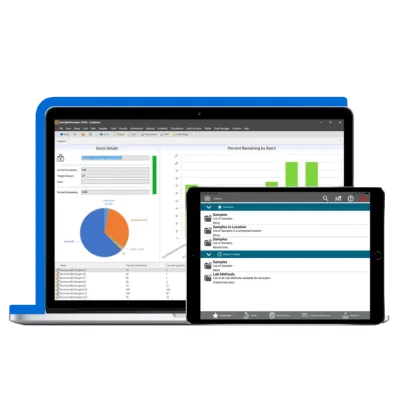
SampleManager LIMS™ includes a mobile app (iOS/Android/Windows) that enables flexible access to LIMS and LES functions via tablet. Laboratory staff can perform methods, acquire, and process samples – regardless of location. Direct data entry at the point of origin reduces transcription errors. Immediate availability of analysis results accelerates the approval process. Mobile barcode scanning and image capture optimize sample identification and documentation.
Labeling
Flexible labeling and label creation enable the on-demand creation and printing of labels according to your requirements. It supports, for example, GHS-compliant hazardous substance labeling, sample labels with barcodes/QR codes, and device labeling. Label data is retrieved directly from the LIMS, minimizing transcription errors. Flexible template design, automatic serialization, and batch tracking optimize sample traceability.
Chromeleon™
The Chromeleon™ interface enables seamless access to the Thermo Scientific™ Chromatography Data System in SampleManager LIMS™ without switching applications. Analysis orders can be automatically transferred to Chromeleon™, and results can be imported directly into the LIMS. Method and instrument settings can be managed centrally. This automated data exchange between LIMS and CDS reduces manual data entry, accelerates approval processes, and ensures seamless audit trails for GxP compliance.
Dashboards
Configurable dashboards offer templates and interactive visualizations for key indicators of laboratory and business operations. They present real-time data on resource availability, inventory levels, site status, and laboratory performance. Customizable widgets enable individual KPI monitoring. With a click of a mouse, users can navigate to detailed data views, such as overall utilization or the status of individual devices. Automatic updates and alarm functions support proactive management and data-driven decision-making for optimized laboratory efficiency.
Deployment
SampleManager LIMS™ can be operated in a variety of environments: either as an on-premises installation on your server or as a cloud deployment with a provider of your choice. Optimized data storage, backup, and recovery reduce operating costs, increase data security, and meet regulatory requirements. Cross-site data availability supports global collaboration.
Compliance
SampleManager LIMS™ can be configured for compliance with critical industry standards such as GMP, ISO 17025, and FDA 21 CFR Part 11. This includes secure system access, electronic signatures, and comprehensive audit trails. Training verification, role-based access controls, automated data integrity checks, and version-controlled document management ensure maximum transparency. The integrated logging function enables traceability of all system activities and eliminates compliance risks.