- Home
- Companies
- Hottinger Bruel & Kjær A/S
- Software
- Version Type 7702 - Order Analysis ...
Version Type 7702 -Order Analysis Software
Analyses imperfections in the moving parts of rotating and reciprocating machinery that cause unwanted noise and vibration. Relating measurements to revolutions of a rotating part improves knowledge about machinery such as aircraft and automotive engines, powertrains, pumps, compressors and electric motors.
- Separation of rotational and structural noise and vibration phenomena
- Identification of noise generated by rotational vibrations
- Determination of critical speeds and resonances
- Investigation of instabilities in rotating machinery
- Order analysis with high-speed tracking
- Run-up/down testing with or without tracking
- Tachometers based on tacho pulses and/or a voltage proportional to the RPM
- Tachometer based on autotrackers to extract the fundamental frequency from the measured vibration signals, instead of using a dedicated tacho signal
- Tacho, speed, and speed interval triggers
- Order analyzers with individual tracking references
- Run-up and coast-down in a single test session
- Synchronous averaging through tacho gearing
- Simultaneous noise and vibration analysis
- Slice mode for data reduction, rapid processing and fast display of slices during measurement
- Real-time calculation of average RPM
- Interpolation of slices to `round` values allowing averaging of slices
- RPM scaling to velocity
Order Analysis Type 7702 provides three instruments, namely, an order analyzer, a tachometer and an autotracker, plus related post-processing functions and a wide range of display facilities. There are also three additional trigger types: tacho, speed, and speed interval. These supplement the tools available in FFT and CPB Analysis Type 7700 to provide a complete diagnostic toolbox for both order tracking and general noise and vibration measurements. Type 7702 can also be used with FFT Analysis Type 7770.
Order analysis can be made with or without tracking:
- Without tracking - for analysis of lower orders and moderate RPM slew rates
- With tracking - for analysis of higher orders or higher RPM slew rates
To obtain the fundamental frequency for the order analysis, a tachometer or autotracker is used.
Order Analysis Type 7702 comes along with predefined application projects that allow you to perform order analyses quickly and easily. You can also easily customise the application projects for other measurement tasks. The predefined PULSE projects supplied can be used for the following applications:
- Run-up/down vibration diagnostics – a number of projects for the determination of critical speeds, resonances and instabilities from measurements performed with and without tracking
- Run-up/down acoustic performance test – projects for performing, for example, cabin noise or exhaust noise tests using octave analysis and orders vs. engine RPM
Run-up/down tests without tracking
To perform a run-up/down test without tracking, use a tachometer, or autotracker, and an FFT analyzer (requires Type 7700 or Type 7770). The tachometer, or autotracker, supplies triggers that allow FFT measurements to be made and stored in a multi-buffer when specified conditions relative to the change in speed of a shaft occur.
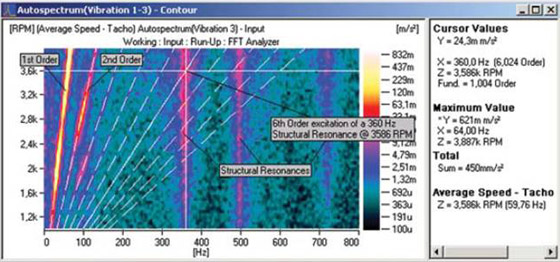
Displaying these stored FFT spectra allows the identification and extraction of orders and/or frequency bands (structural resonances). The amplitude and/or phase of the various orders as a function of RPM are obtained by cutting and extracting oblique slices from contour plots showing frequency spectra versus RPM.
Run-up/down tests without tracking are useful where frequency smearing is insignificant. This can, for example, be the case when analysing lower order components. One of the main benefits of this method is the real-time enhancement (see FFT page). A further advantage is that it shows structural resonances at fixed frequencies parallel to the RPM axis.
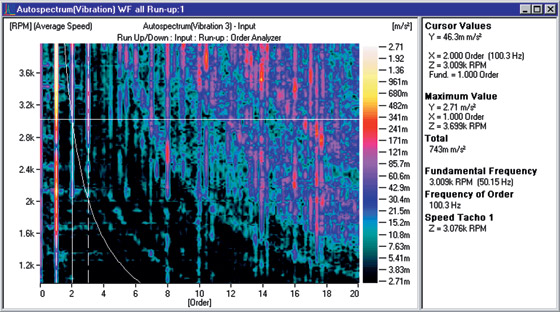
Order analysis using tracking is beneficial if frequency smearing is significant due to, for example, fast run-up or run-down or when analysing higher order components. The order components remain in the same analysis line, independent of the machine speed, and orders are easily identified for diagnostic purposes.
An order analyzer and a tachometer (or an autotracker) are used to measure order spectra. The tachometer provides a tracking reference in cases where there is a dedicated tacho signal. The autotracker provides the tracking reference in cases where there is no tacho signal directly available. In this case, the fundamental frequency can be extracted indirectly from the measured vibration or acoustic signal. The order analyzer, which consists of a tracking mechanism followed by an FFT analyzer, tracks the data and then performs an FFT on it to provide an order spectrum.
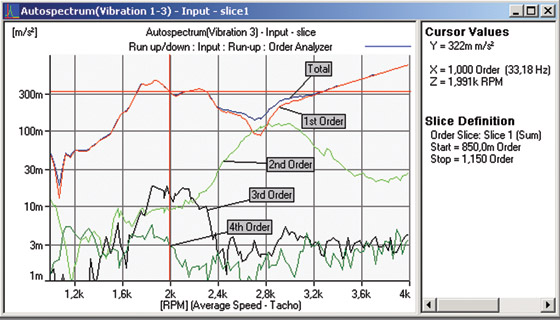
The amplitude and/or phase of the various orders as a function of (average) RPM/Hz is obtained by extracting slices parallel to the RPM/Hz axis from contour plots showing order spectra (see below).