


- Home
- Companies
- Hottinger Bruel & Kjær A/S
- Software
- Version Type 7770 - Multi-Channel FFT ...
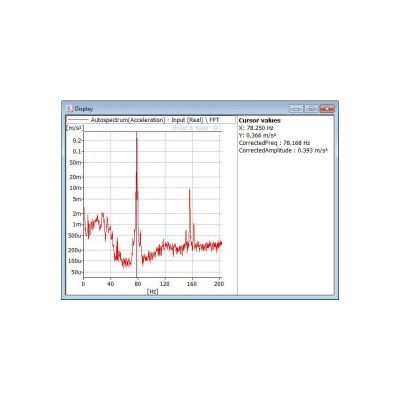
Version Type 7770 -Multi-Channel FFT Spectrum Analysis Software
Allows real-time, multi-channel FFT spectrum analysis, whether you want to perform mobility measurements, vibration diagnostics, or narrow-band analysis of acoustic signals.
- Auto spectrum and cross-spectrum
- Waterfall spectrum
- Resonance and damping estimation
- Harmonic and side-bands detection
- Pure tone detection
- Zoom FFT
- Cepstrum analysis
- Smart Start – a quick, three-step start-up guide
- FFT resolution up to 6400 lines – higher resolution using Time Capture Type 7705
- FFT analysis bandwidth up to 200kHz
- Multi-buffer spectrum logging
- Triggered FFT analysis
- Exponential and linear averaging
- Time-averaging signal enhancement
- Frequency weighting: A, B, C, and D
- Integration and differentiation
FFT and overall level analyzers
The FFT analyzer allows real-time, multi-channel FFT spectrum analysis, whether you want to perform mobility measurements, vibration diagnostics, or narrow-band analysis of acoustic signals.
For characterising your noise or vibration signals, there is an overall level analyzer, which performs a broadband analysis. When measuring sound, this analyzer is equivalent to a sound level meter and fulfils selected, relevant requirements of IEC 651, IEC 61672 and IEC 60804 for a class 1 instrument.
Powerful analysis capabilities
- Real-time measurements on over 200 channels (recordings and post-analysis on over 300)
- Multi-analysis allows multiple analyses of the same input data, reduces test and reporting time, and ensures consistency of data, for example:
– Simultaneous FFT and overall analysis of the same data
– Simultaneous analysis using several FFT analyzers with different properties such as frequency span, zoom, etc. - Real-time signal analysis using the PC’s CPU:
– FFT analysis on 16 channels to 25.6 kHz bandwidth (0% overlap, 6400 lines) (1 GHz PC) - Powerful signal generator, providing a host of sine, random and user-definable waveforms (requires hardware module with generator support, see BP2215 or BU0228)
- Tonality and prominence ratio calculations according to ECMA 74 and ISO 7779
Smart Start
Now it is easier than ever to start and operate PULSE. With Smart Start, PULSE configuration and project setup is performed in just a few steps.
- Quick three-step start-up for new projects: select the default new project template, click start and start measuring
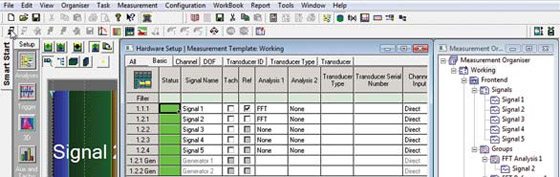
If a more advanced setup is required, the user interface’s various organiser windows provide access to all analysis and function properties available in PULSE.
Post-processing
The following post-processing functions can be applied to measured data:
- Complex time (Hilbert transform)
- Monitor time
- Fourier spectrum
- Phase-assigned autospectrum (PAS)
- Ratio-based PAS
- Frequency response function (H1, H2, H3)
- 1/Frequency response function (1/H1, 1/H2, 1/H3)
- Coherence
- Signal-to-noise ratio
- Coherent/non-coherent power
- Auto-correlation
- Cross-correlation
- Impulse response (h1, h2, h3)
- Calculated intensity
- Calculated complex intensity
- Calculated mean pressure spectrum
- Calculated velocity spectrum
- pI index
- Cepstrum
- Liftered spectrum
- CPB (1/nth octave) synthesise
- Orbit
Type 7700 is PULSE’s base software for FFT, CPB (1/n-octave) and overall level analysis with simultaneous measurement of exponential, linear, impulse and peak levels.
FFT Analysis Type 7770 is intended for users who only require FFT and overall analysis.
Both Type 7700 and Type 7770 provide general noise and vibration testing using real-time multi-channel analysis, as well as general R&D, noise and vibration analysis using several analyzers, and multiple frequency spans simultaneously.
With user-definable measurement solutions, all basic requirements, including data acquisition, calibration, measurement, analysis, post-processing and reporting, are convenient and manageable.