


- Home
- Companies
- Hottinger Bruel & Kjær A/S
- Software
- Version Type 7773 - Envelope Analysis ...
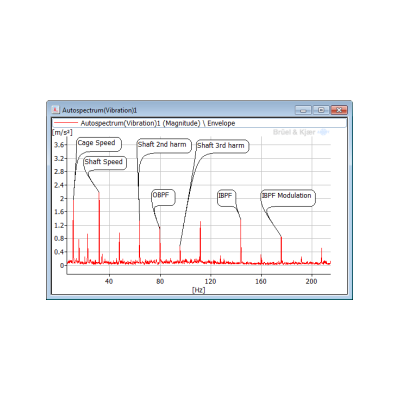
Version Type 7773 -Envelope Analysis Software
Used for diagnostics/investigation of machinery where faults have an amplitude-modulating effect on the characteristic frequencies of the machinery, envelope analysis can be used for investigation of faults in gearboxes, turbines and induction motors. Envelope analysis is also an excellent tool for diagnostics on local faults like cracks and spallings in rolling element bearings (REB).
- Amplitude demodulation - detection of the spectral and temporal representation of the modulating signal
- Identifying the frequency (spectral) and cycle-stage (temporal) of impulsive events in rotating machinery
- Roller-bearing elements - identification of cracks in inner race, outer race or roller defects
- Gearboxes - identification of cracked or broken teeth from impulsive modulation of the tooth-meshing frequency
- Turbine blades - identification of broken or distorted blades from modulation of the blade-passing frequency
- Induction motors - identification of broken or cracked rotor bars, or bad soldering from modulation of slot harmonics by twice the slip frequency
- Reciprocating machinery - determination of precise point (in time) in the cycle of impulsive events like valve openings/closings or combustion
Any machine in operation includes moving machine components that naturally generate vibrations. Upcoming faults of such machine components will cause a change of the normal machine vibration.
Very often machine faults generate shock impulses, like defects of bearings, gearbox, etc., and they result in higher vibration levels. Small faults are usually not audible and they are often only heard when the fault has reached excessive and critical vibration levels. For slow moving machinery, it is sometimes possible to hear variations in the vibration-induced sound caused by changes of load over one machine cycle. The vibration level is modulated by the machine component speed. For machines at higher operational speeds, uprising faults can only be detected by advanced analysis techniques.
Envelope Analysis Type 7773 is implemented as one of three ‘modes’ in PULSE’s FFT analyzer (base-band, zoom, envelope). It can be used for diagnostics/investigation of machinery where faults have an amplitude modulating effect on the characteristic frequencies of the machinery.
Envelope detection or amplitude demodulation is the technique of extracting the modulating signal from an amplitude-modulated signal. The result is the time history of the modulating signal. This signal may be studied/interpreted as it is in the time domain, or it may be subjected to a subsequent frequency analysis. Envelope analysis is the FFT (Fast Fourier Transform) frequency spectrum of the modulating signal.
Envelope analysis is used in following applications
Roller-bearing elements
Detection of faults on roller-bearing elements including identification of cracks in inner race, outer race or roller defects. Cracks moving around with the shaft will result in vibration levels modulated by the shaft`s speed.
Rollers, or balls rolling over a local fault in the bearing, produce a series of force impacts. If the rotational speed of the races is constant, the repetition rate of the impact is determined solely by the geometry of the bearing. The repetition rates are denoted as bearing frequencies, and they are as follows:
- BPFO, ball passing frequency outer race, local fault on outer race
- BPFI, ball passing frequency inner race, local fault on inner race
- BFF, ball fault frequency = 2 BSF, ball spin frequency, local fault on rolling element
- FTF, fundamental train frequency, fault on the cage or mechanical looseness
Gearboxes
Some machines produce shock impulses even if there is no damage, like gearboxes generating shock impulses by tooth-meshing. Faults on the gear wheel will cause change in the shock impulses.
Envelope detection is used for identification of cracked or broken teeth from impulsive modulation of the tooth-meshing frequency.
Turbine blades
Faults in turbine blades caused by, for example, ventilation rotors will result in noticeably higher vibration levels. As visual inspection during operation is usually impossible, envelope analysis can be used for identification of broken or distorted blades from modulation of the blade-passing frequency
Induction motors
Envelope analysis is applicable on induction motors for identification of broken or cracked rotor bars, or bad soldering from modulation of slot harmonics by twice the slip frequency.
Reciprocating machinery
In reciprocating machinery with machine parts moving back and forward, envelope detection can be used for determination of the precise point (in time) in the cycle of impulsive events like valve openings/closings or combustion.