


- Home
- Companies
- Hottinger Bruel & Kjær A/S
- Software
- Version Type 7799 - Sound Power ...
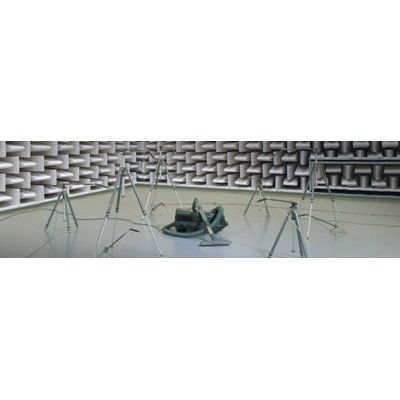
Version Type 7799 -Sound Power Software
- To determine whether a product complies with noise specifications (legislation, voluntary awards)
- To compare the noise emissions of machinery and equipment of the same and different types (for example, when benchmarking, or in engineering work, when developing quieter products)
- To analyse product sound in terms of identification and evaluation of prominent discrete tones and impulsive noise
- Comprehensive solution for determining noise emission quantities such as sound power levels and emission sound pressure levels
- Measurement procedures and calculations in essentially free-field environments based on International Standards ISO 3744, ISO 3745 and ISO 3746
- Measurements for the noise emission of out-door equipment according to EU Directive 2000-14-EC
- Measurements according to noise test codes for information technology and telecommunications equipment ISO 7779, ECMA 74 and ISO 11201
- Measurement procedures and calculations based on International Standard IEC 60704-2-4:2001 Household and similar electrical appliances. Test code for the determination of airborne acoustical noise. Particular requirements for washing machines and spin extractors (identical to European Standard EN 60704-2-4:2001)
- Interactive measurement setup and information windows guide you through the measurement process
- Measurement data and results can be conveniently saved to familiar Microsoft® Excel® workbooks for customised reporting and further post-processing
- PULSE platform ensures exceptional measurement accuracy
- Scalable solution
Free-field: for sound power determination in a free or essentially free sound field
This solution provides measurement and calculation procedures based on ISO 3744, ISO 3745 and ISO 3746 for determining the sound power of noise sources operating in a free (or essentially free) sound field.
Sound pressure levels have to be measured at a number of microphone positions over a measurement surface enveloping the noise source. Depending on the number of microphones, measurements can be made simultaneously at all microphone positions, or in several steps. If the number of microphone positions required by the selected standard is greater than the available number of microphones, the microphones or test object can be moved between measurements.
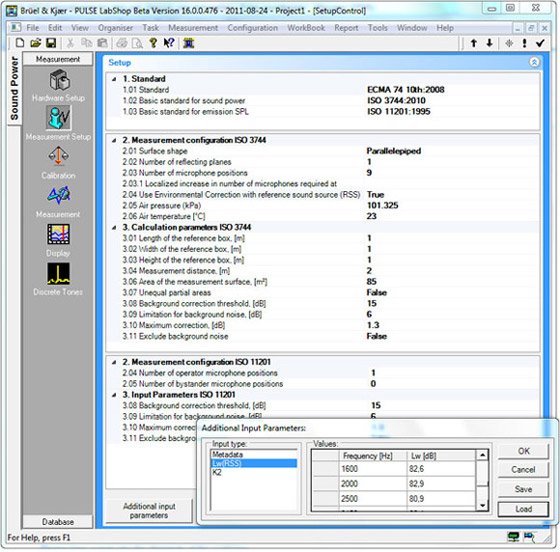
Additional microphones and additional localised microphones can to be added to the setup. Different stages of the measurement can be accessed to optimise the process and to avoid unnecessary time-consuming repetitions (for example, background noise measurements). An interactive setup table guides the user through the measurement setup (e.g. see Fig. 1). Measurement setup, calibration values and background noise measurements can be stored in PULSE projects for future use.
Calibrations can be performed before and after the measurements to check the reproducibility of the process.
An interactive setup table, shown in Fig.1 for the Free-field template, assists with the measurement setup phase.
Measurement data and results can be saved to Microsoft Excel workbooks where they are clearly organised in a series of worksheets.
In addition to archiving using Excel workbooks, data can be stored in a dedicated database for easy search/retrieve. Using PULSE Data Manager Type 7767, statistical quantities can be calculated on batch measurements stored in the database (such as mean and standard deviation).
Free-field with Emission SPL: for sound power and emission sound pressure determination in a free or essentially free sound field
This solution combines the determination of sound power levels based on ISO 3744, ISO 3745, ISO 3746 and the measurement of emission sound pressure levels (at specified positions in the vicinity of the machinery, in an essentially free-field) based on ISO 11201.
Depending on the number of microphones, measurements can be carried out simultaneously at all microphone positions over a measurement surface enveloping the noise source, and at all operator and/or bystander positions.
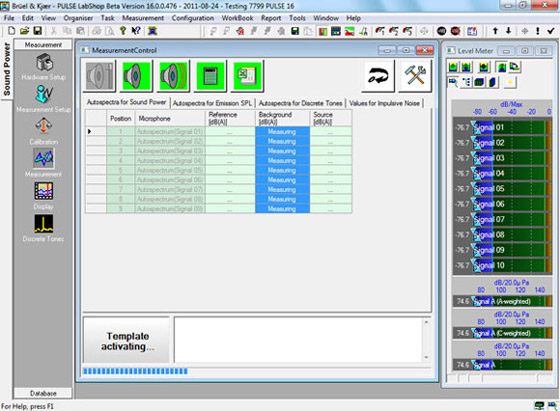
Graphic user interface is seamlessly integrated into PULSE Labshop.
Along with the emission sound pressure levels, the Tone-to-Noise Ratio and Prominence Ratio are also calculated to identify and evaluate prominent discrete tones. Quantities used to identify impulsive noise are also measured.
This solution provides measurement and calculation procedures for the determination of the sound power in accordance with provisions of the EU Directive 2000/14/EC relating to the noise emission in the environment by equipment for use outdoors.
A predefined Excel workbook containing Visual Basic for Applications macros serves to enter measurement setup parameters, to control PULSE during the measurement process, to store data and to make the report.
For those types of equipment where measurements at different operating conditions are required, formulas are used to calculate the total sound power levels from measurements at each operating condition. The required weighting factor for each operating condition can be adjusted accordingly in the Excel workbook.
This solution, based on IEC 60704-2-4 (identical to EN60704-2-4) provides measurement and calculation procedures for determination of the sound power of washing machines in accordance with the EU Directive 2009/125/EC related to the ecodesign of washing machines. It is primarily based on the free-field methods described in ISO 3744 but with additional procedures to take into account the increase in noise during the spinning phase and also the measurement of the maximum rpm. The report provides the sound power for the washing period and the sound power for the region of the rinsing and final spin extraction period where the highest A-weighted 50 seconds time-averaged level occurs.
Making a complex process simpleGraphical features, such as pop-up text, colour coding and warnings, allow quick updates on measurement status, determination of pending actions, and validation of specific parameters within the standard. The flexibility of the program allows you to skip repetitive tasks.
Customisable reportsMeasurement data and results can be exported to pre-defined Microsoft Excel workbooks where they are clearly organised in a series of worksheets, including a predefined report. Using Excel, the report can be easily adapted to accommodate corporate styles and personal touches.
Scalable solution, common platformPULSE Sound Power Type 7799 software runs with various configurations of microphones and geometries, making the solution scalable to match current budgets and requirements. Built on the powerful PULSE platform, it is quite feasible to combine Type 7799 with other PULSE sound and vibration measurement applications for a complete and flexible product testing program aimed at standards compliance and nonconformance problem resolution.