

Ocean Governance Training Programme
Training is a key activity of the IOI global network. The Institute`s flagship interdisciplinary training programme has been conducted at Dalhousie University in Halifax, Nova Scotia each summer since the initiation of the course by Elisabeth Mann Borgese in 1981.
- Offered by IOI in Canada at Dalhousie University in Halifax, Nova Scotia
- Two-month residential programme in May-July, held annually since 1981
- Global coverage of ocean governance issues with emphasis on viewing the ocean as a complex system with varied users and multiple, often competing and conflicting, uses.
- More than 680 alumni from over 100 countries
- Designed primarily for developing country mid-career professionals with responsibility for some aspect of coastal or ocean governance and an eagerness to step outside their area of specialisation and into an international, interdisciplinary forum where diverse participants learn together, share different perspectives and examine issues from different viewpoints.
- Over 200 hours of lectures, interactive discussions, field trips, simulations and exercises, individual participant presentations, and a concluding Round Table of ocean specialists. This intensive programme of study challenges participants to:
o deepen their understanding of the complexity and role of ocean-related issues in sustainable development;
o strengthen and update their academic knowledge, while also being exposed to practical lessons drawn from actual experience in integrated coastal and ocean management;
o develop relevant skills, leadership abilities and networks to help them apply their new knowledge on their return home; and,
o assist their countries towards maximising benefits to be derived from the UN Convention on the Law of the Sea, through the proper integration of coastal and ocean management into national and international development strategies.
- Approximately 90 speakers, including local and international experts and practitioners.
- Organised thematically:
o Module 1: Orientation and Introduction to the Training Programme
o Module 2: Ocean Sciences
o Module 3: Integrated Coastal and Ocean Management
o Module 4: Law of the Sea and Principled Ocean Governance
o Module 5: Fisheries and Aquaculture
o Module 6: Communication and Negotiation
o Module 7: Maritime Security
o Module 8: Marine Transportation
o Module 9: Energy
o Module 10: International Round Table and Conclusion of Training Programme
- Modules are linked by a course-long simulation to help consolidate, reinforce and integrate the wide range of information and ideas presented during the course. This learning tool also requires participants to address the challenges of translating facts and theory into policy, and provides practice in leadership, teamwork, negotiation, communication and presentation skills.
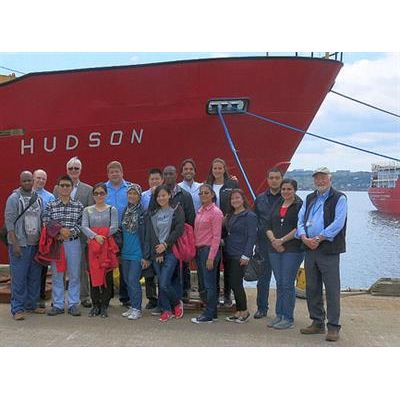
- Field trips reflect many of the module themes and showcase a unique variety of marine organisations and industries. These include the Bedford Institute of Oceanography, Northwest Atlantic Fisheries Organisation (an RFMO), Port of Halifax, land and sea-based aquaculture companies, tidal power, seaweed product development, clam depuration facility, oil spill remediation and emergency management operations.
OI-Canada’s 37th annual training programme on Ocean Governance: Policy, Law and Management was conducted at Dalhousie University, Halifax, Nova Scotia from the 24th May to 21st July 2017. This interdisciplinary course was attended by 17 participants from Africa, Asia, the Caribbean, South America and the South Pacific. This year`s group brought the total of IOI-Canada participants to 700 from more than 100 countries.
The eight-week programme was organised thematically in ten Modules: Orientation and Introduction to the Training Programme; Ocean Sciences; Law of the Sea and Principled Ocean Governance; Maritime Security; Communication and Negotiation; Fisheries and Aquaculture; Integrated Coastal and Ocean Management; Marine Transportation; Energy; and the Round Table and Conclusion of Training Programme. Lectures and presentations were delivered by approximately 100 speakers, including local and international experts and practitioners. While it was primarily lecture-based, the classroom component also included lively discussions, presentations by each participant, skills sessions, video footage, exercises and a course-long simulation involving both individual and group work, culminating in the round table at the end of the programme.
The 2018 training programme on Ocean Governance: Policy, Law and Management is scheduled to be held from the 23rd May to 20th July 2018 (subject to final confirmation). The programme is aimed primarily at developing country professionals aged 25-45 with at least one degree, relevant experience, strong English language skills and a desire to step outside their own field of work and explore interdisciplinary issues around coastal and ocean management.