


- Home
- Companies
- Explorer Company
- Applications
- Fiberglass Mesh Filter Bags for Molten ...
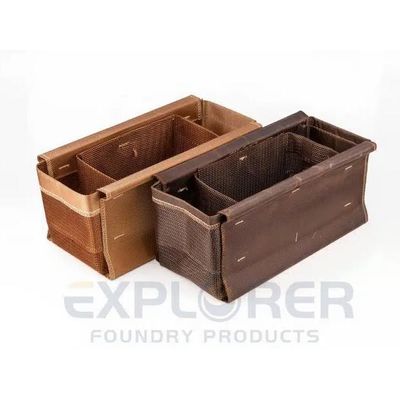
Fiberglass Mesh Filter Bags for Molten Metal Filtration - Air and Climate - Air Filtration
The purity of molten aluminum is paramount in casting. Each cubic meter of aluminum melt can harbor over 5 million micron-sized inclusions. These impurities are a primary source of defects in the final cast product. Our specialized fiberglass mesh filter bags are engineered to drastically reduce defect rates by an impressive 90%. They achieve this through a sophisticated triple purification mechanism:
- Mechanical Sieving: Physically blocking larger impurities.
- Deep-Bed Adsorption: Capturing finer particles within the filter matrix.
- Electrostatic Capture: Attracting and holding even the most minute charged contaminants.
This multi-layered approach significantly outperforms traditional molten aluminum filters, ensuring a cleaner, higher-quality melt.
Q2: How do fiberglass mesh filter bags withstand extreme molten aluminum conditions?
A: The extreme temperatures and corrosive nature of molten aluminum demand filters with exceptional resilience. Our fiberglass mesh filter bags are designed with an advanced core material: 96% SiO2 high-silica fiberglass. This high-performance material boasts remarkable properties:
- Exceptional Heat Resistance: Capable of continuous operation at 1000°C, with an astounding softening point of 1700°C. This ensures structural integrity and performance stability in even the hottest molten metal environments.
- Optimized Thermal Expansion: With a thermal expansion coefficient of 0.55×10?6/°C, our filters exhibit thermal expansion characteristics that closely match those of molten aluminum. This minimizes stress and cracking, even during rapid temperature changes.
- Proven Durability: Rigorous testing includes 12-hour continuous pouring trials with zero deformation, showcasing their robust performance and reliability. This includes built-in thermal shock protection, crucial for dynamic casting processes.
Q3: What precision grades do aluminum casting filters offer?
A: Our fiberglass mesh filter bags provide tiered filtration capabilities to meet diverse purity requirements, from general industrial applications to highly specialized aerospace components:
- Coarse Filtration (3.0mm mesh): Primarily designed for capturing >500μm slag and larger impurities, serving as a crucial primary cleaning stage to protect subsequent filtration steps and enhance initial melt quality.
- Precision Filtration (0.8mm mesh): Engineered to trap 5-50μm Al2O3 clusters, which are notoriously difficult to remove. This level of precision is essential for aerospace castings and other applications where microscopic defect prevention is critical for material integrity and performance.
- Custom Weaving: Beyond standard grades, we offer custom weaving solutions for molten metal filtration, allowing us to tailor filter precision to your exact specifications and most demanding applications.
Q4: How does electrostatic capture enhance filtration efficiency?
A: Innovative technology synergy:
- F-5 resin coating generates negative charge
- Attracts positively charged Al2O3 particles (isoelectric point pH 9.1)
- ↑40% nano-oxide film capture rate (AES-verified)
Q5: Why are specialized filters mandatory for VDC slab casting?
A: Solving two industry pain points:
- Butt curl defects: Side-window design balances metal flow → ↓73% curl (15mm→4mm)
- Segregation control: Surface composition deviation Saves $480,000/year in crop loss per production line
Q6: How is deep impurity removal achieved in recycled aluminum filtration?
A: Dual-technology approach:
- Closed-weave patches (12 meshes/cm²) → Physically traps Fe/Si impurities
- F100/M zero-smoke coating → Eliminates secondary contamination
Verified results: - Iron content: 0.25% → 0.08% (↓68%)
- Silicon content: 0.18% → 0.05% (↓72%)
Q7: How do fiberglass mesh filter bags deliver economic value?
A: Three-tier cost reduction model:
- Base investment: $5/ton aluminum (high-temperature filter cost)
- Defect control:↓18% scrap rate → Saves $18/ton
- Energy efficiency:
- ↓15% energy consumption (laminar flow reduces holding needs)
Composite savings: - Cost per ton aluminum: $100 → $77 (↓$23)
- Annual savings for 50K-ton foundry: $1.15 million
- ↓15% energy consumption (laminar flow reduces holding needs)