

- Home
- Companies
- CORME s.r.l.
- Applications
- Hyde depoulveration solutions for shoes ...
Hyde depoulveration solutions for shoes manufacturing industry - Air and Climate - Air Pollution Treatment
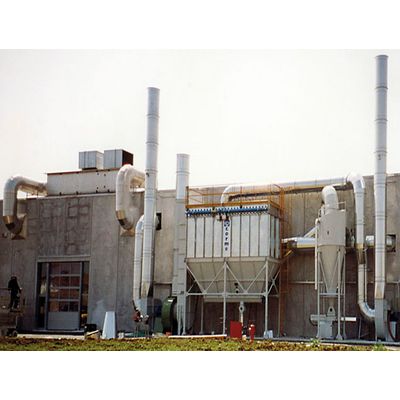
Plants for dust collection and the extraction of sparks and solvent fumes from carding machines, rasps, brushing and buffing machines, solvent application benches and conveyor tunnels. In this sector our company has already installed and is operating various plants all over the world, with excellent results. Our long experience in sectors with a high fire risk has led to the design of a plant suitable for the footwear industry. The dust extracted by the various machines is conveyed by a single collector to the centrifugal separator (cyclone); 90% of the dust is compressed by the vortex created internally, before entering the compactor in the lower part of the separator.
The dust and sparks fall into the compactor and are pressed at 180 bar pressure. This produces a 6/7 times reduction in volume and above all the fire risk is stemmed. The remaining 10% of the dust not captured in the cyclone moves on to a dry sleeve filter (in anti-spark polyester felt), where it is abated with jets of compressed air at 7 bar pressure. The dust falls into the hopper under the filter where a blower reintroduces the material into the cyclone. By this method there is only one discharge unit: the compactor.
- Dust collection capacity is 99,9%
- It is possible to recycle air extracted in the workplace (in compliance with regulations) with a notable fuel saving in winter and higher machine extraction efficiency.
- Dust collection in our filters and final compression is dry, with absolute zero consumption of water or any other type of liquid.
- Plants are easy to install, practical, require no maintenance, are long lasting, and costs are reasonable.
- Dust recovery is in compact, pressed briquettes, automatically propelled into an appropriate container, with a 6/7 times reduction in volume; a notable saving in transport costs, waste material and operating workforce, and increasing storage space.