- Home
- Companies
- Geotomographie GmbH
- Applications
- Seismic borehole and surface solutions ...

Seismic borehole and surface solutions for crosshole/downhole - Water and Wastewater
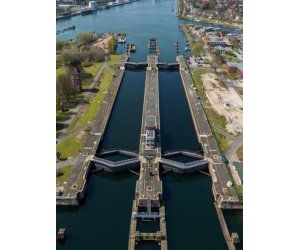
Ship locks and lifts: A ship lock is an engineering structure which enables ships to overcome the level difference between two waterways. Water level is raised or lowered by filling or emptying the lock chambers. Filling and emptying a lock chamber is a central process of the ship lock which causes high cyclical loads on the underground. therefore, an a-priori estimate of the soil behaviour under loads is crucial for geotechnical engineers to select the best design parameters and to avoid undesired deformations on the construction.
Dynamic soil parameters at small strains govern the soil-structure interaction at the interface between ground and foundation. Borehole tests like seismic crosshole and downhole tests can provide in-situ seismic velocities in a straight forward fashion and enable the calculation of dynamic soil parameters.
Earthquakes can lead to fatal damages of buildings and other important infrastructure if the seismic energy is higher than anticipated. The design load for buildings caused by earthquakes must be quantified to ensure the stability of the structure against fatal collapse and to protect human lives.
In earthquake engineering the site characterization is usually based on measuring near surface shear wave velocity values. The shear wave velocity is essential for evaluating the dynamic behaviour of soils in the shallow subsurface in order to evaluate seismic hazards. Most often the average shear wave velocity for the top 30 m of soil is used to classify sites according to the soil type (Eurocode 8 - EC8). Based on the classification certain design features, such as flexible foundation beams, are standard. This directly affects the costs of a building. Costs and risk can be reduced if a correct soil classification is made.
To measure the S-wave velocity with depth the downhole test is a valuable and facile method. This geophysical test provides a direct measurement of the shear wave velocity and hence is widely accepted for seismic site characterization purpose.