
- Home
- Companies
- Samyang Corporation
- Applications
- Trilite - Ion Exchange Resin for Food - ...
Trilite - Ion Exchange Resin for Food - Food and Beverage - Food
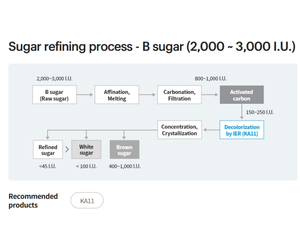
- Sugar: The general process of cane sugar production can be divided into two stages: first, the production of raw sugar from sugarcane, and second, the refining of raw sugar to produce refined sugar. Generally, ion exchange resins are not used during the production of raw sugar, but they are essential in the production of refined sugar.
Starch sugar
When refining starch sugar and sugar alcohols, ion exchange resins optimized for each process are suitable because the raw material has a high organic content or viscosity, and the ability of certain substances to adsorb can have a significant impact on the yield. When refining starch sugar and sugar alcohols, ion exchange resins optimized for each process are suitable because the raw material has a high organic content or viscosity, and the ability of certain substances to adsorb can have a significant impact on the yield.
Nucleic acid
Nucleic acid, which is a representative food additive, is used as a flavoring and seasoning ingredient. Ion exchange resins are used in the adsorption, separation, and concentration processes of nucleic acids.
MSG
MSG, along with nucleic acid, is a representative flavoring and seasoning ingredient. Ion exchange resins are required for the purification and decolorization of MSG produced through fermentation processes. Depending on the customer`s operating conditions such as fermentation broth purity and absorption capacity, and regeneration method, WBA or SBA exchange resins are used.
Lysine
Lysine, which is used as a nutritional additive in animal feed, is the most commercially active amino acid, and cation exchange resin. It is used in the process of lysine separation/purification.
Arginine
Arginine is a type of natural amino acid that is widely used in pharmaceuticals, food, and other animal feeds. The fermentation broth, cultured through microorganisms, is separated by centrifugation to remove microbial cells, and then passed through SAC exchange resin to adsorb arginine. After that, the product undergoes purification and bleaching process through SBA exchange resin.