


AQMIS – Air Quality Management and Risk Prioritization - Case Study
Background:
To manage and monitor air quality more effectively, a regional air quality management district, located in Southern California, implemented Lakes Environmental’s Ambient Quality Management Information System (AQMIS) starting in 2017. The system was designed to streamline the calculation of emissions, conduct risk prioritization studies, and meet all state regulatory reporting while providing tools for both government staff and small business owners to participate in emission-related data management.
Implementing AQMIS for Enhanced Air Quality Management and Risk Prioritization
The implementation of AQMIS has transformed the district’s approach to air quality management, yielding the following benefits:
- Cost Savings: Lowers operational costs by reducing manual data collection, processing, and reporting efforts.
- Enhanced Risk Management: With the risk prioritization feature, staff can focus resources on high-priority areas, improving response times and optimizing regulatory interventions.
- Streamlined Data Submission for Businesses: By providing an accessible portal for businesses to submit emissions data, AQMIS facilitates compliance among smaller emitters, reducing barriers to data submission and ensuring more accurate emissions monitoring.
- Informed Decision-Making: The mapping, ticketing, and dashboard functionalities provide a holistic view of emissions data, helping staff make informed decisions to address air quality challenges.
- Regulatory Compliance and Reporting: Through its CEIDARS-compatible format, AQMIS ensures that emissions data aligns with state-level standards, simplifying regulatory submissions and enhancing transparency.
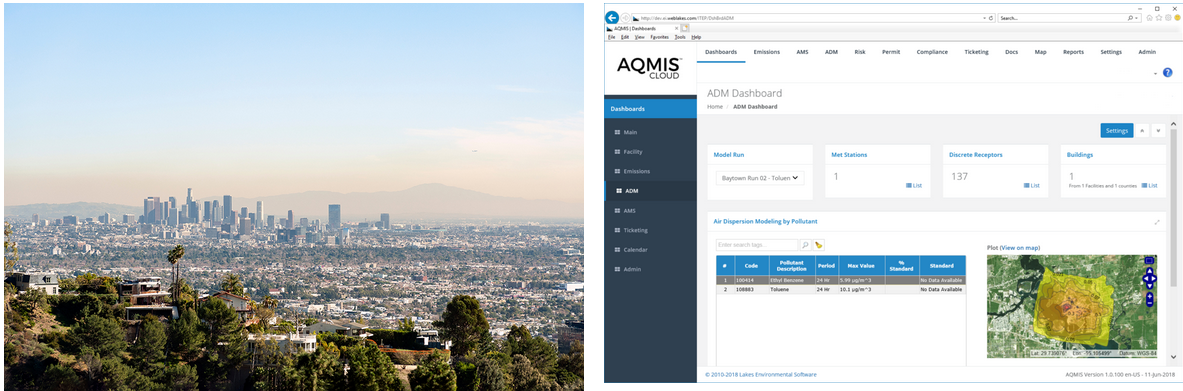
AQMIS is a cloud hosted information system composed of various modules that cater to specific functions within air quality management including emisions inventory, risk assessment, mapping/GIS, data analytics, and reporting. AQMIS provides a structured approach to track emissions, assess risks, and ensure compliance with regulatory requirements. This system provided two distinct access portals:
- Main Access (Government Use): This secure access point allows government officials to monitor, calculate, and prioritize emissions and risk data across the region.
- Public Access (Business Use): An easy-to-use portal was created for business and industrial owners, allowing them to submit their industrial activity data online. This ensures that emissions from large industrial customers and smaller businesses are accounted for, facilitating comprehensive data collection and ensuring that all potential risks to the community are evaluated.
The AQMIS solution includes the following specialized modules for the regulatory client:
AQMIS has proven to be a valuable tool for the district, integrating risk management, data tracking, and regulatory compliance into a single web platform. By catering to both agency staff and regulated businesses, AQMIS supports a more inclusive and accurate approach to emissions monitoring and air quality management, ultimately reducing costs for the agency and benefiting the community by enhancing public health and environmental standards.