


Bio-Augmentation Product Eliminates Odor and Removes Sludge from Waste Lagoons
Cabo San Lucus Mexico is known for its deep-water fishing, beautiful beaches, luxurious hotels, and as an overall vacation destination for travelers from around the world. About one and a quarter miles north of the town is a golf course, located next to the town`s municipal wastewater lagoons. The location of the golf course was specifically to utilize treated lagoon water for irrigation. The very arid position of Cabo does not lend itself to the rainfall required to keep a golf course naturally irrigated.
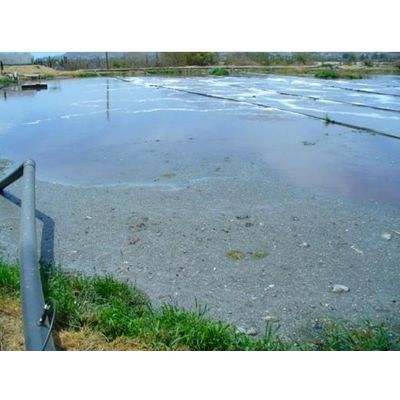
The segmented lagoon system for the waste facility is over 20 years old and utilizes a linear fine bubble aeration system. Over the years some of the diffusion hose and aeration equipment quit working for various reasons and sludge built up on the outside edges of the lagoons, resulting in short circuiting. The ensuing sludge buildup eventually broke the surface of the water, causing intense odor problems. Due to the proximity of the golf course to the lagoons, the odor made a round of golf somewhat of a challenge, but, more seriously, a north wind would carry those odors into the town and its hotels.
Figure 1 - Short circuited lagoon with exposed sludge buildup around the edges
The town`s administration and the golf club management company decided on a multi-phase program of sludge reduction with an upgraded diffused aeration system. A Mexican contractor, CIASA Engineering and Construction, was brought into the waste lagoon operation to determine the extent of the sludge problem and to provide possible solutions. Extensive investigation identified that the sludge buildup in many areas of the lagoon`s outside edges was as deep as 7.7 feet (Figure 2). While dredging was considered, the price was too high for the budget of the project. So, CIASA management, based on previous experiences, proposed a bio-augmentation remedy to the problem. Reliant Water Technologies in the U.S. was contacted and their price, along with ClASA`s labor costs for the bio-augmentation solution, came in well below Vi of the dredging option.
Figure 2 - A sludge measurement approximately five feet from the shore of the lagoon measured over 7 feet of sludge depth. This depth was very consistent around the edges of most of the lagoon.
The product proposed by Reliant Water Technologies was a poly-microbial blend of bacteria that has proven successful in wastewater treatment facilities and lagoons all over the world. The product has proven to eliminate over 80% of the organic sludge in the normal waste activated sludge process. Sewper Rx is a granulated, dry product that could be injected into the sludge at different depths. The bacteria used in the Sewper Rx blend are facultative, so the lack of dissolved oxygen in the solids at various depths would not be a problem. This proposal was accepted and CIASA technicians began to prepare an injection system for the bacteria while Reliant Water Technologies got the bacteria blend to the site.
CIASA utilized a 25,000 gallon flow stabilization tank for the inoculation of the Sewper Rx bacteria. The granular blend was poured into the tank that was filled with normal tap water, and mixed. It was allowed to `activate` for several hours, and the next morning technicians began pressure injecting the bacteria into the sludge at a number of depths. (Figures 3 & 4) Sludge injection for each lagoon took approximately 375 pounds of Sewper Rx and it took approximately 7 days to complete the injection of each lagoon.
Figure 3 - Premixing of the granular Sewper Rx sludge digestion product was performed in a 25,000 tank prior to pressure injection of the hydrated bacterial solution into the sludge.
Figure 4-Pressure injection at many depths into the sludge was performed by technicians. Each lagoon took
approximately 7 days for complete inoculation.
Within 72 hours of treating each lagoon, sludge odors were notably reduced. Odors remained abated. Within 60 days the sludge above the normal water line of the lagoons had dropped to below the water. (Figure 5) At the 90 day mark the sludge reduction was measured around the shoreline of each lagoon and an average of 1.8 feet of reduction in sludge depth was realized. It should be noted that the lagoons remained active and on-line throughout this treatment process.
Figure 5 - A photo from the exact same location as Figure 1, taken approximately 70 days following treatment of the raw sludge by the Sewper Rx bio-augmentation blend of bacteria.
Following the success of the Sewper Rx bio-augmentation blend of bacteria, a new aeration package was installed with a goal of eliminating the short circuiting that had initially taken place in the lagoons. Although these upgrades were successful, it was not long before the growth of the Cabo San Lucas population required the consideration of a new 5 MGD extended aeration plant. Such a plant is now in the design stages, and one of its goals will be to supply irrigation water to the golf complex.