


- Home
- Companies
- Cypher Environmental Ltd.
- Articles
- Building Strong and Stable Clay Roads
Building Strong and Stable Clay Roads
Traditionally, unpaved clay roads have a bad reputation when it comes to overall stability and durability and are known to cause many costly challenges such as:
- Swelling and deterioration when wet, often causing road closures and shutdowns
- Dust generated from traffic, causing air quality and visibility concerns
- Safety issues due to ruts, potholes, and loose uneven surfaces
- Continuous maintenance and monitoring due to the unstable nature of clay
ROAD//STABILIZR has been developed over the last ten years to address the problems most commonly associated with clay road materials. Through years of research and engineering, we have discovered the BEST solution for treating unstable clay roads, with absolutely zero impact on the environment!
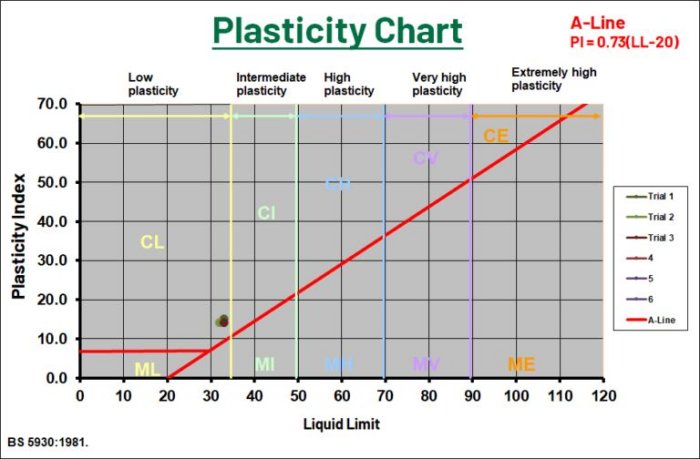
ROAD//STABILIZR requires clay road materials that contain between 20-90% fines, have a plasticity index of at least 8, and plot above the A-line on the Casagrande Plasticity Chart. Fines are defined as anything measuring 75 microns or less or can pass through the No. 200 sieve. A particle size analysis and Atterberg limits tests are used to determine road material suitability. The clay content is important as it is the clay particles that do the work of binding the road together once treated with ROAD//STABILIZR.
One of the biggest challenges with clay soils is that they are expansive in nature. They swell as much as ten percent or more when exposed to water and lose strength. The water content in clay soils can also freeze during the winter months worsening the swelling problem with frost heave issues.
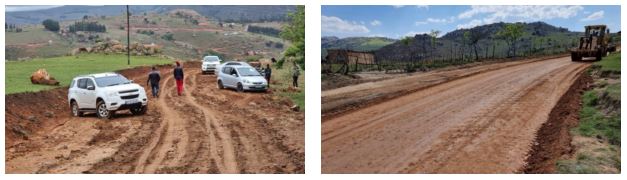
The combination of organic catalysts, electrolytes, and surfactants in ROAD//STABILIZR® causes clay particles to release adsorbed water and permanently manipulates them to bind stronger together, increasing the strength, wear resistance, and durability of the road. After applying ROAD//STABILIZR®, the swell potential and permeability of the clay soil is significantly reduced up to 96%.
Under dry conditions, clay soils generate a significant amount of dust causing road surface deterioration and material loss. “Every time a car passes on a dusty road, the surface material is disturbed and becomes airborne. When you see clouds of dust on a road, that’s actually part of the road floating away! Not only does this cause damage to the road in the form of ruts, potholes, and washboarding that constantly need to be repaired, but you are also losing material that will need to be replaced in the future,” explains Director of Engineering, Diana Nicholson.
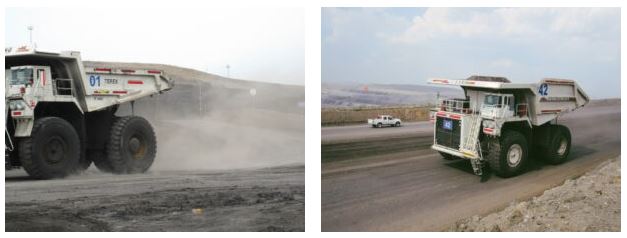
Because of the stronger binding properties of the clay after treatment, you will get up to 50-60% less dust by using ROAD//STABILIZR and increased road strength which keeps the road smooth and without defects for years. Dust can be further reduced up to 90% with a topical application of DUST/BLOKR. A stabilized road will have drastically reduced maintenance requirements including grading and re-sheeting (the addition of new aggregate).
Cypher technology for clay-based roads stands up in the field. In 2015, Cypher Environmental took on a joint project with Brandon University under the direction of Dr. Hamid Mumin to improve the engineering properties of clay soils using ROAD//STABILIZR.
The test road is a haul road servicing six gravel pits, with 300+ loaded trucks per day. Imagine the wear and tear this road endures! The results show significant reductions on maintenance and operational costs:
- Grading reduced from 2-3 times per week prior 2015 to once every year or every second year
- No need to re-sheet since 2015
- Eliminates annual water costs of $40,000 for dust control
“This is a far superior way of building roads. It reduces maintenance costs dramatically, it reduces input costs, almost entirely eliminates any environmental impacts,” concluded Dr. Mumin.
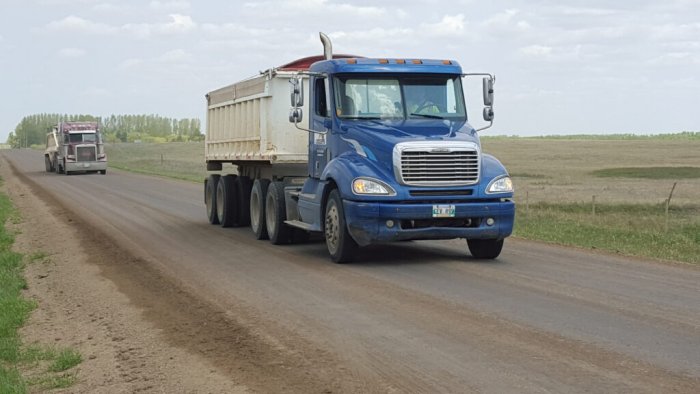
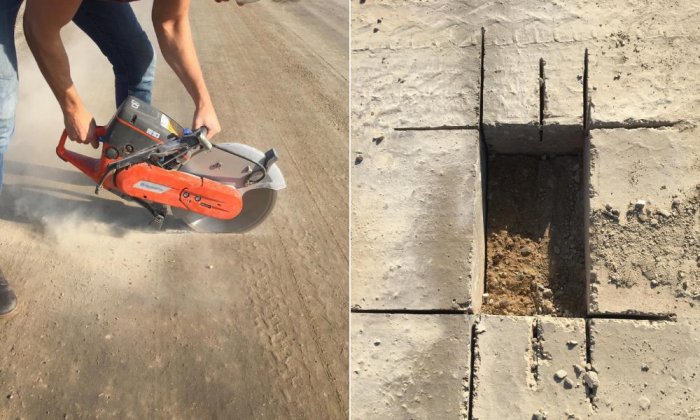
One of our Geotechnical Specialists, Riley Cram, even completed his Master of Science thesis by working alongside Dr. Mumin on the test road which saw significant decreases in dust generation and aggregate loss from traffic, major reductions in potholes, wash boarding and rutting. Most impressive was the increase in CBR – up to 340%. “The road was so strong that when we went back to take a sample, we had to cut it with a concrete saw!”, recounts Riley.
Through our understanding and study of clay road materials, many pilot projects and successful projects in over 40 countries, we have become known for turning costly unstable clay roads into strong, durable, high-performance road systems. ROAD//STABILIZR consistently yields superior results to improve roadway infrastructure for industry and communities around the world. Here are a few project examples:
- The African country of Eswatini which was plagued with deteriorating roads now has access to essential services and medical facilities thanks to ROAD//STABILIZR.
- The Shenhua mine in China was able to reduce its fuel consumption by 17.4% and saved millions of dollars in fuel – while also reducing greenhouse gas emissions
- In Guinea, Société Minière de Boké (SMB) Bauxite chose ROAD//STABILIZR to reduce the impact of increased road traffic from their operation on the local community.
We have transformed the perception that clay is a bad thing for roads, and use its geotechnical properties to our advantage to make better performing infrastructure. Once treated with ROAD//STABILIZR roads become stable, strong and have enhanced engineering properties. The truth about clay roads is that they can be made BETTER when the correct products are used to stabilize them.