
- Home
- Companies
- Particle Measuring Systems (PMS)
- Articles
- Calibration and Spectrum ...
Calibration and Spectrum Troubleshooting: IMS Spectrum Introduction, Measurement and Calibration (Series Part 1 of 4)
Introduction
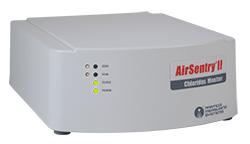
The AirSentry II AMC Analyzer detects airborne molecular contamination (AMCs) in cleanroom manufacturing environments. AMCs cause defect loss and product degradation and its reduction is critical for manufacturers to stay competitive.
AMC measurement techniques must allow for accurate, reliable event detection in real-time. The AirSentry II analyzer uses Ion Mobility Spectrometry (IMS) to facilitate sub-ppb concentration detection in as little as 5 seconds per reading. The software has built-in diagnostic tools for the evaluation of analyzer performance and to rule out any inaccurate readings. Functionality is assessed both visually with the Ion Mobility Spectrum curve, and quantitatively with key operating parameters.
Measurement
All ionically-charged molecular species are measured once they reach an ion collector plate inside the IMS drift chamber. However, only properly functionally drift chambers will attenuate detection to both:
- Ionized dopant or “reactant” molecules
- Ionized AMC or “target” molecules
These two types of molecules appear as two defined peaks on the IMS spectrum. They also add a current charge to the ion collector plate. The software first measures the location and height of these two peaks. Then, it uses the data for the calculation of AMC abundance in sampled air in real-time.
Calibration
It is critical to perform calibrations of any AMC analyzer at the location of the final point of use. This ensures accurate and stable AMC concentration detection. This includes zero and span calibrations:
- Zero calibrations: Performed to ensure that when zero AMCs are present, the only peak in the IMS spectrum is from the dopant.
- Span calibrations: Performed to ensure there is a second peak that results from the presence of 25 ppb of a calibrant AMC span gas.
Zero and span calibration factors depend on local atmospheric conditions. The software continuously uses these factors to tune the ASII AMC algorithm calculation for all subsequent real-time AMC measurements.