

Choosing a Centrifuge Over a Belt Press: Considerations
In many industries belt presses are the “safe bet”. Because the technology is older, it’s more likely that operators have experience with it. The start-up costs can seem quite reasonable. And the open design makes the filtration process seem extremely straightforward. In essence, it’s no different from a coffee filter. And, like a coffee filter, it’s a good technology for handling fairly small batches of liquid with an extremely high solids concentration.
But the comfort of sticking with a familiar old technology has its limitations.
Belt presses have the potential to be extremely annoying.
First and foremost, they are slow. Because the belt press separation is entirely gravity driven, it can only work as quickly and efficiently as nature allows. Unfortunately, even though “nature is at the wheel,” belt presses still require a fair bit of monitoring and babysitting (making them expensive to operate). On top of all of that, they are not capable of true continuous operation, as you need to periodically stop and backwash or replace the filters.
Even with frequent backwashing, separation is inconsistent over the course of each run. After each belt cleaning you start out filtering just through the filter material. But over the course of the run, solids accumulate. You are now filtering through both your filter material (which was carefully engineered and selected for its filtration characteristics) and an unpredictable cake of filtered particulate. Efficiency steadily drops off. The longer you continue the run, the slower it goes, and the more you risk overflows, spills, and other messes.
Even without spills, this is an inherently dirty operation. Belt presses are open to the atmosphere. That translates into misting and particulate in the air (as well as new contaminants possibly infiltrating the liquid you just filtered).
And it’s a wasteful process. In addition to disposing of the sludge you filter out, you are wasting fresh water to backwash your filters, and ultimately going to throw those filters away (creating more waste). And bound up in all that waste are possibly valuable materials (like useful oils trapped in the filter cake). Instead of an additional revenue stream, you are literally throwing money away.
Finally, belt press filtration is only capable of liquid-solid separation. If it is the case that your cake might contain valuable oil, there is no way to recover it during this filtration step.
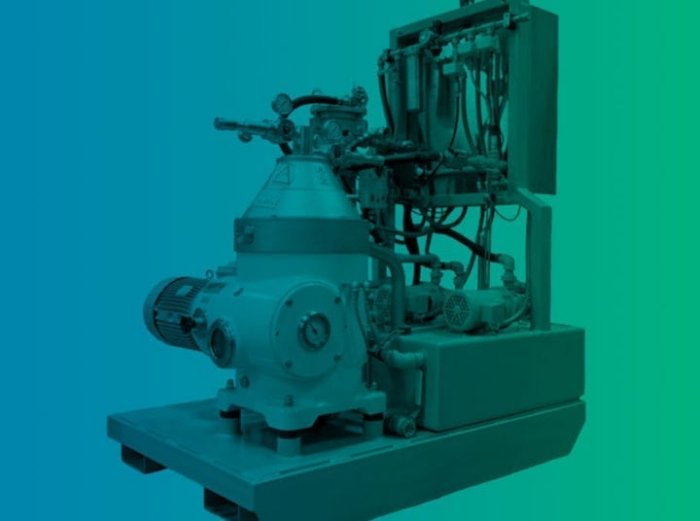
Industrial centrifuge technology has improved tremendously in recent years. Not only are modern high-speed centrifuges more reliable than they were in the past, they are also a great deal easier to program and control, with less monitoring. If something goes wrong, the machine alarms and shuts down. Otherwise, the operator is free to pursue other tasks during most of the operation. Because these are closed-bowl designs, the operator environment is going to be less impacted by mist and particulate. There are no consumables (like filters) and no water backwash. Overall, centrifugation is a greener process.
Most importantly, the right centrifuge-based separation system is capable of continuous three-phase operation. That means that in a single pass it can separate particulate, oil, and water into three distinct streams. Not only are you cleaning up your water, but you can also capture any coproducts (like valuable oils) that might otherwise be lost in the cake.