

- Home
- Companies
- Particle Measuring Systems (PMS)
- Articles
- Classification and Qualification ...
Classification and Qualification Commonly Asked Questions
Welcome to our Cleanroom Classification and Qualification questions and answers blog, where Particle Measuring Systems answers commonly asked questions about the latest changes to regulation. Listen to this useful webinar to learn more about how classification limits are made for expected cleanliness levels in a cleanroom manufacturing environment.
During cleanroom classification, is it mandatory to monitor viable and non-viable counts simultaneously?
Cleanroom classification is based solely on inert particle counts. For “in operation” qualification, viable and “non viables” need to be sampled. There is no need to do this concurrently, but “non viables” are in effect already sampled continuously, so they are likely monitored at the same time.
Is cleanroom qualification required every 6 months? What is the minimum number of sites to be sampled?
Correct, every 6 months. The minimum number of locations is found using Table A.1 in ISO 14644-1:2015.
Is there a disadvantage to monitoring the full number of sites used for qualification during routine environmental monitoring?
The qualification activity is different and separate from the monitoring activity. Qualification is based on ISO 14644, while monitoring is based on a risk assessment.
Can you choose not to use one of the microbiological sampling methods for qualification of a classified area?
Yes, but this will be very difficult to do for microbiological qualification of the room, as all contamination conduits (i.e., air, surface and personnel) contribute to overall cleanroom contamination. Consider using validated alternative methods where possible instead, which will vary based on the parameters of the sampling point and be left up to the manufacturer. Afterwards, when determining the monitoring strategy of the sampling point, choose the method that provides the most scientifically reliable data with actionable results.
In regards to the requalification requirement, is that only applicable to Grade A and B areas, or does that include grade C and D as well?
Grade C and D areas should be requalified annually.
Does the removal of the 5 micron particle size from ISO 14644 mean the qualification time for Grade A and B will be vastly reduced?
According to the ISO 14644-1 sample volume formula calculation methodology, the 5 micron removal means qualification time for Grade A and B cleanrooms will indeed be reduced. However, the new annex draft includes this statement:
“For initial classification the minimum number of sampling locations can be found in ISO 14644-1. However, a higher number of samples and sample volume is typically required for the aseptic processing room and the immediately adjacent environment (Grade A/B).”
EU GMP Annex 1 Draft: Manufacture of Sterile Medicinal Products, Dec. 2017
Does having different limits for monitoring and qualification justify an increase of limits during monitoring?
Monitoring limits should be based on the “in operation” qualification data, scientific understanding and risk assessment. Therefore, it is almost impossible to justify higher monitoring limits, other than during the qualification. Monitoring limits might be higher than classification limits as these are generated “at rest”.
How is a microbiological laboratory qualified for sterility testing performed according to the new Annex 1?
Section 10 in Annex 1 describes quality control of sterile products. The sterility test should be performed under aseptic conditions, making a Grade A environment necessary. It then depends on which testing environment (cleanroom, laminar flow hood, isolator) you have chosen for background classification.
Are there any differences between monitoring during aseptic operations and terminal sterilization operations? Does 1 CFU need to be identified for Grade A operations of terminally sterilized products?
There is no differentiation between aseptic operation and terminal sterilization manufacturing. If products are processed in a Grade A environment, they are considered at-risk and need to be treated identically in terms of cleanroom classification, qualification and monitoring. In this respect, all microorganisms should be considered for Identification.
When the viable trend has been evaluated, can the limits be set at a higher level than those defined in the validation table?
No, the monitoring limits/levels should be equal to or below those defined in the validation table.
If dynamic activity during setup is to be tested during qualification, would a separate setup be needed for static activity?
Yes, dynamic and static activity involve two separate conditions and studies.
Is it acceptable to re-qualify Grade A and B with every 6 months +/- 1 month?
Yes, it is acceptable.
If we do not define alert and action limits for particulates based on classification limits, does that mean we base them on trend data? If yes, what length of trend data is sufficient?
Classification limits are typically only used as a baseline during data collection for a new facility and EM program. After 6 months, it is a good time to do your data analysis and determine how to adjust alert and action based on your actual data. Your EM program should establish procedures for periodic data analysis and trending review. Some companies will do this quarterly, some every 6 months, and others every year.
How does the difference in particle counter flowrate and laminar air flow (LAF) velocity affect particle count?
Particle counter performance is not affected by flowrate or LAF cabinet velocity, assuming the particle counter is properly used and equipped with the correct isokinetic probe (ISP). The ISP provided with new instruments is designed to “harmonize” the instrument’s flowrate with the surrounding environment’s air flow (0.45 m/s nominal), independent of using a 28.3, 50 or 100 LPM particle counter.
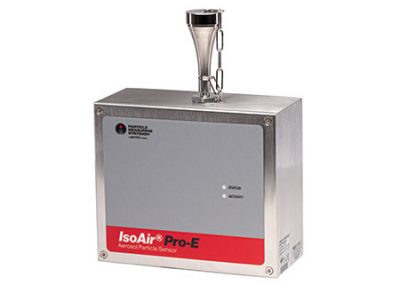
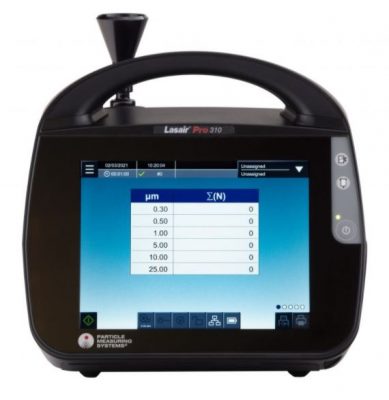
Interested in aerosol particle counting with harmonious flow? Check out Particle Measuring System’s latest offerings:
Have a question that wasn’t answered? Ask our experts and learn more about how we can best advise you on your cleanroom process.