


- Home
- Companies
- Elvatech Ltd.
- Articles
- Copper Cable Recycling: Instant Alloy ...
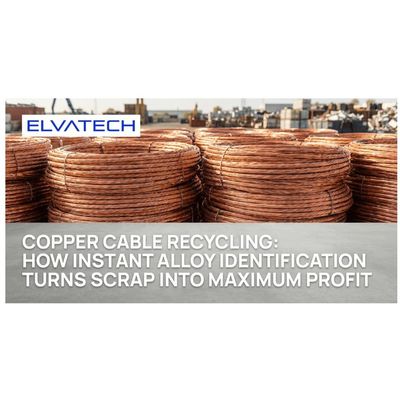
Copper Cable Recycling: Instant Alloy Identification Drives Profit
A Houston scrap yard that processes about 40 tons of mixed cables per week shifted from weight- and appearance-based sorting to alloy-level identification. A misidentified load revealed by XRF showed 70% copper and 30% nickel, delivering about three times the value of pure copper scrap and illustrating the potential profit from instant alloy identification. The owner calculated a lost profit of roughly $8,000 from that single load and subsequently invested in a handheld alloy analyzer to prevent recurrence.
Cable recycling operates on thin margins. The difference between correctly identifying alloys such as pure copper, brass, bronze, and copper-nickel can produce 2-3x price differences at the refiner. Visual inspection struggles because many alloys look similar, weight-based sorting misses composition, and chemical spot tests are slow and messy. Without accurate differentiation, recyclers risk underpricing high-value material or receiving penalties for contaminated lots.
Instant alloy analysis using portable X-ray fluorescence (XRF) transforms cable recycling economics. Point the analyzer at a cable, obtain the exact composition in seconds, and sort accordingly. No guesswork, no losses. This approach has been shown to improve cable processing margins by 15-30% for yards implementing XRF-based sorting.
Why Cable Composition Matters: The Hidden Value in Your Scrap Pile
Not all copper cables are created equal. The industry uses dozens of copper alloys tailored for electrical, mechanical, and corrosion requirements. At end of life, they resemble generic scrap visually, but their value varies significantly.
Common Cable Alloys and Their Scrap Values (approximate market prices, Feb 2026)
- Pure Copper (C11000, 99.9% Cu): Scrap value ~ $3.80/lb; easy to identify when clean; oxidized copper can resemble brass.
- Brass (C26000, 70% Cu, 30% Zn): ~ $2.00/lb; golden when fresh, brown when oxidized; oxidized copper and brass can look alike.
- Phosphor Bronze (C51000, 95% Cu, 5% Sn + P): ~ $3.50/lb; pinkish when clean; over time may visually resemble copper.
- Copper-Nickel Alloys (C70600, 90% Cu, 10% Ni): ~ $5.50/lb; silver-white when polished; under dirt/oxidation may resemble other cables.
- Beryllium Copper (C17200, 98% Cu, 1.9% Be): ~ $4.20/lb; visually indistinguishable from pure copper; rare and often mixed into copper scrap.
The Profit Gap: Consider a yard processing 1,000 lb of mixed cable daily. Without alloy identification, material is sorted visually as copper scrap and sold at an average copper price of $3.00/lb, generating about $3,000 per day. With XRF identification, the breakdown might yield 70% pure copper at $3.80/lb, 5% copper-nickel at $5.50/lb, 15% brass at $2.00/lb, and 10% bronze/other at $3.50/lb. Resulting daily revenue could rise to $3,585, a $585 daily increase, or about $152,100 yearly on the same volume. Contamination penalties are avoided as well, since clean lots command premium prices.
How XRF Analyzers Identify Cable Alloys in Seconds
The Physics: X-ray fluorescence excites atoms so they emit characteristic X-rays. Copper yields signals around 8.04 keV, zinc around 8.63 keV, and nickel around 7.47 keV. The analyzer translates these signatures into elemental percentages and alloy grades in a few seconds.
The Readout includes alloy grade labels such as C11000 copper or C26000 brass, elemental composition, and any match to standards. It can also flag contaminants such as stainless steel in copper loads and provide pass/fail indications against specifications.
Testing Process (cable recycling):
- Surface prep (about 30 seconds): Remove insulation to expose clean metal. Dirt and oil block X-rays; a clean surface yields accurate readings.
- Position the analyzer window against the metal (about 5 seconds).
- Trigger test (3-5 seconds): X-rays induce fluorescence; the instrument calculates composition.
- Read result (instant): alloy grade and composition displayed; example reads: C11000 with Cu near 99.9% indicates pure copper; C26000 showing Cu 70% and Zn 30% indicates brass.
- Sort accordingly (about 5 seconds): Place material into the dedicated bin.
Total time per cable is roughly 15-20 seconds, including surface prep. A trained operator can test 150-200 cables per hour, making the time investment negligible for large yards while delivering substantial profit gains.
Advantages Over Other Methods
- Visual inspection: 2 seconds, but accuracy 60-70% and fails on oxidized/dirty metals.
- Magnet test: 3 seconds, distinguishes ferrous vs non-ferrous but does not identify alloys.
- Chemical spot test: 2-3 minutes, ~80% accuracy; messy and consumable-heavy.
- XRF analyzer: 5 seconds, 99%+ accuracy; higher equipment cost but fast, non-destructive testing.
- Lab assay: 1-3 days, ~99.9% accuracy; slow and impractical for sorting.
For yards with substantial throughput, XRF provides laboratory-like accuracy at inspection speed. What XRF Cannot Do: XRF analyzes only surface composition (top 10-100 microns). If a cable carries heavy plating over a steel core, testing the plating may misrepresent the core. In such cases, testing multiple spots or cross-section samples is advisable, and cleaning the surface improves accuracy.
Where the Money Hides: High-Value Cables to Watch For
Experienced recyclers identify patterns where premium alloys are common. XRF testing reveals these quickly and reliably.
- Marine and shipboard cables: Copper-nickel alloys (C70600, C71500) are prevalent for corrosion resistance; these can be 2-3x the value of pure copper when 10-30% nickel is present.
- Telecommunications infrastructure: Older telecom cables may use phosphor bronze or beryllium copper in connectors, which can be high-value finds on a single pallet.
- Industrial motor windings: Pure copper windings are valuable, but terminals may be brass/bronze; separating terminals can unlock additional value.
- Military surplus: Cables and harnesses often incorporate copper-nickel, phosphor bronze, or copper-beryllium alloys with high premium potential.
- HVAC and refrigeration: Copper tubing is high-value; brass fittings and bronze components also contribute significantly when separated.
- Automotive wiring harnesses: Sorting brass and copper separately can raise recovery from about $1.50/lb to roughly $2.20/lb on certain lots; even more if premium alloys are captured.
- Hidden jackpot: Instances of copper-nickel, silver solder, or other premium alloys appear occasionally; XRF helps ensure these are captured rather than sold at copper prices.
The ROI of XRF sorting is driven by capturing premium alloys and avoiding penalties for contaminated lots, which strengthens supplier relationships and buyer confidence.
Setting Up an XRF-Based Cable Sorting Operation
This shift can be incremental and affordable rather than a full-yard overhaul.
Equipment you need
- Handheld XRF Analyzer 20,000–50,000 USD: models designed for copper alloys and containment of impurities; battery life 8–10 hours; 1,000+ alloy libraries; data logging via Bluetooth.
- Sample preparation tools 500 USD: angle grinder with wire wheel, wire strippers, safety gear, cleaning solvents.
- Sorting bins 1,000–2,000 USD: clearly labeled bins for Pure Copper, Brass, Bronze, Cu-Ni, Mixed, Steel/Other; multiple bins by alloy preferred.
- Documentation system variable: basic tally sheets, tablet-based logging, or yard-management software for traceability.
Workflow
- Receiving: incoming cable from demolition, electrical, or plant shutdown; pre-sort visually; unknown or high-value material tested with XRF; price based on actual composition.
- Processing: strip insulation if needed; cut to manageable lengths; test representative samples; sort into alloy-specific bins.
- Quality control: spot-check sorted material; test brass bin for copper contamination; monitor for refiner penalties.
- Shipping: sell pure alloys at premium; provide XRF test reports for buyers; build a reputation for clean, graded material.
Staffing and training: A single operator with an XRF can test 150–200 cable samples per hour. For a yard processing 5–10 tons daily, 2–4 hours of XRF testing suffices. Training typically takes 1–2 days and focuses on surface preparation, reading results, and safety; most operators learn in less than a day for practical use.
ROI: When Does XRF Testing Pay For Itself?
Consider a mid-sized operation processing 20,000 lb of mixed cable per month and currently earning $60,000 monthly by selling mixed copper scrap at $3.00/lb. An XRF setup costing about $42,000 changes the composition of revenue as testing identifies premium alloys more accurately.
Scenario after implementing XRF (composition breakdown from actual data):
- Pure copper (C11000): 65% = 13,000 lb at $3.80/lb = $49,400
- Brass (C26000): 20% = 4,000 lb at $2.00/lb = $8,000
- Copper-nickel alloys: 8% = 1,600 lb at $5.50/lb = $8,800
- Bronze and other: 7% = 1,400 lb at $3.50/lb = $4,900
Total revenue: $71,100/month (vs. $60,000 before) – an $11,100 monthly improvement. After accounting for operator time (50 hours/month @ $25/hr = $1,250) and consumables (~$200/month), net monthly gain is about $9,650. Payback period is roughly 4.4 months, implying an annual incremental profit of about $116,000 once payback is met.
Sensitivity: If processing 5,000 lb/month, payback extends to ~17 months; at 50,000 lb/month, payback shortens to ~2 months. If premium alloy share rises to 15–20%, monthly gains could reach $15,000–$20,000, reducing payback to 2–3 months. The broader benefit is improved feedstock quality and access to premium buyers who pay top dollar for well-graded material.
Common Mistakes Cable Recyclers Make (And How to Avoid Them)
- Testing through insulation: Insulation blocks X-rays; strip 1–2 inches and clean the metal for accurate readings.
- Assuming visual means composition: Oxidation, dirt, and age can disguise alloys; test first, sort second.
- Single-spot testing on composite cables: Core and terminals may differ; test multiple locations and base sorting on dominant composition.
- Ignoring contamination: A brass contaminant in a copper bin downgrades the entire lot; spot-check bins and test random samples before shipping.
- Neglecting calibration checks: Regular verification with known standards ensures accuracy; calibrations drift over time and with window cleanliness.
- Underpricing high-value material: Establish relationships with specialized buyers for copper-nickel and other premium alloys to avoid selling at copper prices unnecessarily.
Choosing the Right XRF Analyzer for Cable Recycling
Key features for scrap yard use include rugged construction, fast analysis, comprehensive alloy libraries, data management, extended battery life, and ease of use.
- : IP54+ rating, rubberized housing, drop-tested, designed for outdoor or dirty environments.
- 2. Fast analysis: Grade ID mode typically 2–5 seconds; quantitative mode 10–30 seconds; some models claim substantially faster performance than competitors.
- 3. Copper alloy library: Pre-loaded grades for common copper and non-copper alloys, including C11000, C26000, C70600, C17200, and related standards.
- 4. Data management: Built-in storage, Bluetooth/WiFi transfer, customer/refiner reporting, and traceability.
- 5. Battery life: 8–10 hours per charge; spare battery recommended for continuous operation.
- 6. Ease of use: Trigger-and-read operation with a readable display in bright light; minimal training required.
Budget considerations: Entry-level handhelds run roughly $20k–$25k; mid-range portable devices around $25k–$35k; premium handhelds typically $35k–$50k; benchtop models range $30k–$80k. For cable recycling, a high-quality handheld in the $35k–$50k range balances speed, accuracy, durability, and comprehensive alloy coverage. Avoid sub-$15k units, which often have slow analysis, limited libraries, poor durability, and questionable reliability in demanding scrap yard environments.
FAQ: XRF Analysis for Cable Recycling
- How accurate is XRF for copper alloys? Modern XRF systems offer roughly ±0.1–0.2% accuracy on major elements; this enables reliable distinction among copper, brass, and copper-nickel alloys for sorting purposes.
- Can XRF test through insulation? No. Test requires exposed metal; stripping insulation adds roughly 15–30 seconds per sample but yields reliable data.
- What if the cable has copper plating over steel? XRF reads surface copper; if plating conceals the core, test multiple locations or expose a cross-section to reveal core composition.
- How long do XRF analyzers last in scrap yards? Quality models can deliver 10+ years with proper care; X-ray tubes are a wear component rated for tens of thousands of hours.
- Is certification required to operate handheld XRF? No formal certification is required in the US for scrap-yard use; basic safety and operational training suffices.
- What is the testing cost per cable sample? Approximately $1.50–$2.50 per test when accounting for amortization, operator time, and consumables; misidentifying a single load can cost hundreds of dollars, making ROI favorable.
- Can XRF detect fake or adulterated materials? Yes. XRF quickly flags copper-plated aluminum, brass-plated steel, or zinc die-cast misrepresented as brass, protecting against scrap fraud.
Conclusion: Stop Leaving Money on the Sorting Table
Accurate alloy identification is the primary driver of cable recycling profitability. Visual guesses, weight-based sorting, and slow chemical tests fail to capture premium alloys or prevent contamination penalties. XRF-based sorting delivers decisive results in seconds, translating into tangible profit gains.
The Numbers don’t lie: a mid-sized yard processing 20,000 lb of cable per month can realize about $133,200 in annual incremental profit after paying back a $20,000–$50,000 XRF investment, with a typical payback in 4–8 months and ongoing margin improvements of 15–25% on cable processing. Beyond ROI, XRF sorting enhances material credibility with buyers, attracts higher-quality feedstock from suppliers, and increases the likelihood of capturing premium alloys that competitors miss.
Ready to maximize cable recycling profits? Contact Elvatech to discuss portable XRF solutions designed for high-throughput sorting. Our ProSpector 3 analyzers offer rapid analysis with laboratory-grade accuracy, ideal for cable recyclers who cannot afford to guess composition.
Original: https://elvatech.com/copper-cable-recycling-how-instant-alloy-identification-turns-scrap-into-maximum-profit/