


- Home
- Companies
- Elvatech Ltd.
- Articles
Elvatech Ltd. articles
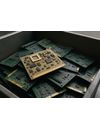
A real-world example demonstrates the value of precise metals grading in e-waste. An aggregate facility processed 40 tons of circuit boards and sold them to a bulk buyer for $32,000 at $800 per ton. By testing incoming material, the operations team estimated composition by device category—20% telecom infrastructure gear and 30% enterprise servers—and projected substantially higher values if the premium metals were recovered. An XRF analyzer was deployed to test material before sale, revea
A scrap yard in Houston processes 40 tons of mixed cables every week. For years, they sorted by weight and appearance: thick cables went in one pile, thin in another, shiny copper here, dull brass there. The operation made money, but the owner knew he was leaving cash on the table. Then one day, a customer brought in what looked like standard copper wire. Visual inspection said copper. The scale said copper weight. But an XRF test revealed it was actually 70% copper, 30% nickel—worth 3x
A Houston scrap yard that processes about 40 tons of mixed cables per week shifted from weight- and appearance-based sorting to alloy-level identification. A misidentified load revealed by XRF showed 70% copper and 30% nickel, delivering about three times the value of pure copper scrap and illustrating the potential profit from instant alloy identification. The owner calculated a lost profit of roughly $8,000 from that single load and subsequently invested in a handheld alloy analyzer to prev

When a $2.3 million aerospace component fails catastrophic testing, investigators often trace the problem back to a single moment: the loading dock where the wrong alloy entered the facility. A batch of 316L stainless steel arrives with paperwork certifying its composition. It looks identical to 304 stainless. The receiving team checks the documentation, signs off, and sends it to production. Six months later, that material is in a critical aircraft hydraulic system—and it`s corroding.
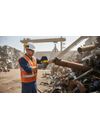
Owners and managers of scrap recycling companies know that profit is not made at the baler or the scale, but at the sorting stage. A single mistake in identifying metal grades during scrap intake can wipe out the entire margin on a batch of material. Misclassify high-grade alloy scrap as something cheaper (or vice versa), and you either overpay your suppliers or undercharge your buyers – in both cases, money is lost. In short, turning a c

Rare earth elements (REEs) are often a target of rapid analysis in geology, mining, and processing: the goal is to quickly determine whether enrichment is present, how composition changes across zones, and which streams or lots look promising. XRF (X-ray fluorescence) is well suited for these tasks, but when working with REEs it is important to understand the method’s limitations. In practice, the main difficulties are not due to XRF being “incapable,” but to a combination o

For most of human history, the materials behind great artifacts were a matter of educated guesswork. Was that dagger really made from a fallen star? How did a Roman glass cup change color from green to red? What alloys did ancient mints and silversmiths actually use?
X-ray fluorescence (XRF) has quietly become one of the main tools for answering these questions. It lets scientists determine what an object is made of—element by element—without taking samples or damaging the
Owners and managers of scrap-recycling companies know very well: profit is born not at the shear or the weighbridge, but at the sorting stage. Mix up stainless grades, let a nickel alloy slip into “heavy melt,” or miss lead in aluminum – and all your margin goes negative together with a claim from the steel mill.
At the same time, visual inspection, a magnet, spark testing and even an experienced operator are no longer enough. Modern scrap is a mix of stainless steel
In the production of galvanized rolled steel products, it is critically important to strictly control the composition of metallic coatings. Modern protective coatings on steel – from traditional zinc to complex zinc-aluminum-magnesium alloys – contain alloying elements (additions) such as aluminum (Al), magnesium (Mg) and silicon (Si). These additions have a strong influence on the structure of the coating&nbs
In modern electronics manufacturing, precise control of solder alloy composition is critical for assembly quality and reliability. Electronic manufacturing services (EMS) and surface-mount technology (SMT) lines consume kilograms of tin-based solders every day—both lead-free alloys (e.g., Sn-Ag-Cu or Sn-Bi) and classic tin-lead (Sn-Pb) for specialized tasks. Even small deviations in alloying elements (Ag, Cu, Bi) or unwanted impurities (e.g., Pb in a lead-free solder) can lead to solder