


- Home
- Companies
- Elvatech Ltd.
- Articles
- E-Waste Gold Rush: XRF Analyzers ...
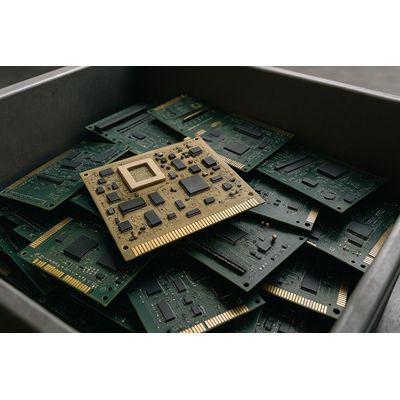
E-Waste Gold Rush: XRF Analyzers Maximize Precious Metals Recovery from Electronics
A real-world example demonstrates the value of precise metals grading in e-waste. An aggregate facility processed 40 tons of circuit boards and sold them to a bulk buyer for $32,000 at $800 per ton. By testing incoming material, the operations team estimated composition by device category—20% telecom infrastructure gear and 30% enterprise servers—and projected substantially higher values if the premium metals were recovered. An XRF analyzer was deployed to test material before sale, revealing substantial premium fractions: telecom boards averaged 1,200 ppm gold, equating to about $3,500 per ton for refiners; server motherboards at 600 ppm gold (~$2,200/ton); and standard computer boards at 350 ppm (~$1,500/ton) when sold as clean, graded lots. The facility subsequently acquired its own analyzer within two weeks.
Visual inspection cannot reveal precious metal content; boards with identical appearances can have markedly different gold concentrations. For example, a beige board from a 1998 telecom switch may test near 1,200 ppm gold, while a 2020 consumer router board may test around 250–350 ppm, despite a similar exterior. Sorting everything as mixed scrap undervalues premium material and erodes potential margins.
High-value e-waste processors consistently outperform by testing before sale. XRF analysis is the practical method for high-volume precious metals grading in electronics, enabling rapid identification of gold, silver, palladium, and platinum content in 1–10 seconds depending on precision. Facilities implementing XRF-based sorting regularly outperform blind processing operations.
The Hidden Treasure in Electronic Waste
Electronics use precious metals to address engineering challenges such as corrosion resistance and high conductivity. When devices reach end-of-life, these metals remain, but concentration varies by device type.
- Standard consumer electronics: 200–300 ppm gold
- Telecommunications boards: 500–1,500 ppm gold
- Military/aerospace boards: 1,000–3,000 ppm gold
- Vintage mainframe boards (1970s–1990s): 2,000–5,000 ppm gold
Using current gold prices (approximately $2,000 per troy ounce), these concentrations map to notable per-kilogram values across device types. For example, standard PC boards yield roughly $257 per kilogram in gold value, telecom boards about $515 per kilogram, and premium military avionics boards around $643 per kilogram. Adding silver ($24/oz), palladium ($1,000/oz), and platinum ($900/oz) increases premium board value to well over $600 per kilogram in many cases. Selling mixed e-waste at $0.80/kg leaves a substantial portion of recoverable metals unrealized.
Why Visual Sorting Fails
Visual inspection cannot reveal metal concentration. Boards look similar on the surface, but commercial and premium-grade boards contain substantially more gold and other noble metals in edge connectors, bonding wires, solder joints, and ceramic capacitors. The same-looking board from different eras or manufacturers can have orders of magnitude different metal content, making blind sorting a high-value leakage risk.
Where Metals Hide in Practice
- Circuits on PCBs: edge connectors and CPU sockets often carry gold plating of 10–50 microns; gold bonding wires inside ICs; silver in solder joints; palladium in ceramic capacitors (100–500 ppm typical, higher on premium boards).
- Components: gold-plated CPUs, RAM modules, and connectors; platinum in select high-end components; some hard drives and graphics cards include premium metals.
- Telecom equipment: cell tower boards and dense telecom switches use high-grade gold for reliability and corrosion resistance.
- Medical devices: imaging systems and high-reliability boards employ precious metals for sensors and connectors.
- Aerospace and MIL-SPEC: boards with thick gold plating and exotic metals command premium pricing.
- Vintage computing: older ceramic CPUs and mainframe boards often contain substantially more gold than modern equivalents.
In practice, a kilogram of high-grade telecom boards can contain around 8 g of gold, 40 g of silver, and 2 g of palladium, translating to approximately $610 in precious metals value per kilogram before refining. Sorting and grading to isolate these streams is critical to realize that value.
How XRF Identifies Precious Metals in Electronics
X-ray fluorescence is well suited to e-waste due to its non-destructive nature, speed, and direct measurement of elemental content. Process steps:
- Position the analyzer against a circuit board surface
- Trigger the device to stimulate fluorescence from target elements
- Detect emitted energies (gold around 9.71 keV, silver around 22.1 keV, palladium around 21.2 keV)
- Convert signals to concentration values displayed in ppm or percentage
Typical analysis times range from 1–3 seconds for a quick grade identification to 5–20 seconds for precise ppm measurements. Premium models can deliver 5–10 seconds for very high accuracy, enabling real-time sorting at scale. Example result: Gold 850 ppm, Silver 2,400 ppm, Palladium 320 ppm.
Compared with alternative methods, XRF provides a non-destructive, rapid, high-throughput capability suitable for large volumes, whereas acid tests and fire assays are destructive or slower and more expensive per batch. Quick comparisons (non-destructive XRF vs alternative methods) show XRF offering the best combination of speed and accuracy for on-site grading at scale.
Smart Testing Strategy
- Visual pre-sort (30 seconds): separate by device type (PCs, servers, telecom, medical, MIL-SPEC); flag obvious high-value items; identify manufacturers (e.g., Cisco, IBM, HP).
- XRF verification (2–10 seconds per batch): quick scan (1–3 seconds) for sorting; precise mode (5–10 seconds) for representative samples; establish baselines per device type; flag outliers.
- Sorting by grade: Grade A (>800 ppm Au), Grade B (400–800 ppm), Grade C (200–400 ppm), Grade D (<200 ppm). Each grade feeds an appropriate processing stream or refiner price.
High-Value E-Waste Patterns
Certain equipment types consistently yield premium returns. Patterns emerge once testing begins in earnest.
Telecommunications Equipment (Top Tier)
- Cell tower boards, enterprise routers/switches, fiber optic gear from vendors such as Cisco, Juniper, Nokia, Ericsson
- 600–1,500 ppm Au; 3,000–8,000 ppm Ag
- A single pallet of decommissioned telecom equipment can contain $5,000–$15,000 in precious metals when properly sorted
Enterprise Servers and Storage
- Server-grade RAM, backplanes, and RAID controllers concentrate gold more densely than consumer devices
- 400–800 ppm Au; 2,000–5,000 ppm Ag
Medical Imaging and Laboratory Equipment
- 24/7 operation with high-reliability components often use premium metals
- 500–1,200 ppm Au; presence of Pt/Pd in sensors
Aerospace and Military Surplus
- MIL-SPEC boards have heavy gold plating and exotic metals
- 1,000–3,000 ppm Au; notable Pt/Pd
Vintage Computing Equipment
- Ceramic CPUs from 1980s–1990s can contain 10–20x more gold than modern devices
- 1,500–5,000 ppm Au on premium boards
Consumer Electronics and Mobile Devices
- High volume but lower concentrations on average; enormous profit potential through scale
- 200–400 ppm Au; 1,000–3,000 ppm Ag
Mobile devices concentrate metals densely in small boards; a single smartphone can contain meaningful gold content, but volume often limits revenue unless processed at scale.
Setting Up XRF-Based Precious Metals Recovery
Implementing analysis can be incremental and does not require a full plant retrofit.
- Equipment — XRF analyzer for precious metals: $20,000–$25,000 for entry-level units; battery-powered, portable for use around the facility; higher-precision models reach 5–10 seconds per test (e.g., premium ProSpector 3 Max).
- Dismantling tools — $500–$2,000; safety gear included
- Sorting bins — $1,000–$3,000; clearly labeled grades and dedicated bins for CPUs, RAM, connectors
- Documentation — simple spreadsheet or database to track device type vs. XRF readings
Workflow
Receiving — conduct visual identification, test representative samples, price based on actual metal content.
Processing — dismantle to board level, separate high-value components, test boards with XRF, and track yield by device type.
Refining Options
- Option 1: Sell to Refiner — ship graded material, refined pricing based on XRF assays; typical recovery 85–95% of metal value after refining fees.
- Option 2: In-House Recovery — chemical or electrolytic processes; requires specialized equipment, permits, and scale (roughly 10+ tons per month)
Staffing and Training
One trained operator with an XRF analyzer can test 100–200 boards per hour in quick-scan mode. For facilities processing 5–10 tons per week, 4–6 hours of XRF testing suffices to grade high-value material. Training typically 1–2 days covering XRF fundamentals, device types, ppm interpretation, mode usage, safety, and documentation.
ROI: When Does Testing Pay Off?
Example for a mid-sized operation processing 10 tons per month of mixed e-waste:
- Current practice: bulk sale at $800/ton = $8,000/month
- Investment: $25,000 XRF analyzer + $3,000 setup = $28,000
- Post-grading mix: 1.5 tons high-grade boards at $3,500/ton; 3 tons mid-grade at $2,200/ton; 4 tons standard at $1,500/ton; 0.5 tons separated components at $10,000/ton; 0.5 tons low-grade at $200/ton
- Total revenue: approximately $22,950/month
- Incremental gain: about $13, (rounded) $13,000–$14,000 per month
Payback period is typically around 2 months, with ongoing revenue improvements in the 50–150% range once grading becomes routine. Sensitivity analyses show higher returns at greater throughput or higher fractions of high-grade material, and near-term payback shortening with larger volumes.
Common Mistakes E-Waste Processors Make
- Mistake 1: Testing only one spot on circuit boards — gold plating and high-value areas are not uniform; test 3–5 locations per board.
- Mistake 2: Assuming newer electronics are always better — some older boards contain higher gold concentrations; test across age ranges.
- Mistake 3: Ignoring palladium and platinum — MLCCs and high-end components can contribute 20–30% of board value; use XRF modes that measure Au, Ag, Pd, Pt.
- Mistake 4: Mixing different board grades — refiners penalize mixed lots; segregate by grade for higher payouts.
- Mistake 5: Not building a database — repetitive equipment types allow rapid future sorting with historical baselines (e.g., Cisco 3750 = 850 ppm Au average).
- Mistake 6: Trusting supplier claims without verification — verify with quick scans before purchase or include verification clauses in agreements.
Choosing the Right XRF Analyzer for E-Waste
Key features determine effectiveness in e-waste contexts.
- — calibrations optimized for Au, Ag, Pd, Pt in electronics ranges (typically 100–5,000 ppm)
- — quick scan 1–3 seconds for sorting; precise 5–20 seconds for batch verification; premium models achieve 5–10 seconds for high throughput
- Detection Limits — gold 50–100 ppm; silver 100–200 ppm; palladium 100–200 ppm; platinum 100–200 ppm
- Data Management — built-in test results storage; options to export data and build device-type databases
- Durability — industrial form factors with dust and moisture protection and rugged builds (IP-rated where applicable)
Budget guidance (typical market ranges): Entry-level handheld $20K–$25K; Mid-range portable $25K–$35K; Premium (ProSpector 3 Max) $35K–$50K. For facilities processing 20+ tons monthly, higher-throughput models deliver meaningful time savings and precision gains.
Getting Started: Your First Month with XRF Testing
: Set up the instrument, configure precious metals mode, learn quick scan vs precise modes, calibrate with known references, identify 5–10 typical device types, test 10+ units per type to establish baselines.
: Begin comprehensive testing on incoming batches using quick scans; document device type, manufacturer, model, and ppm readings. Build a preliminary grading framework.
: Implement sorting by grade, train staff on both modes, begin routing material by grade, and discuss pricing with refiners for graded vs mixed lots.
: Review first-month results, refine grading categories, optimize purchasing strategies for high-testing equipment types, and establish supplier relationships for premium feedstock.
: XRF testing becomes routine; expect faster sorting and improved revenue per ton, with ongoing gains as the sample database grows.
FAQ: XRF Analysis for E-Waste Precious Metals
How accurate is XRF for gold in circuit boards? Modern XRF analyzers achieve roughly ±5–10% accuracy on gold within the 200–5,000 ppm range common in electronics. Premium models deliver rapid, high-accuracy results; for refining settlements, combine field XRF with lab assays on composite samples.
How fast can boards be tested? Quick scan 1–3 seconds for grade identification; precise 5–20 seconds for ppm accuracy. Premium models can achieve 5–10 seconds, enabling hundreds of boards per hour in high-volume operations.
Can XRF test through plastic enclosures? No. XRF requires access to the board surface; test exposed areas or opened cases.
Is component removal necessary? Not always. For board-grade results, test bare areas between components; for component-specific analysis, remove the target part.
Can XRF detect gold inside chips? XRF analyzes surface content (top 10–100 microns). Internal bonding wires are not directly visible, but outer leads and packaging often reflect the overall gold content of the package.
How long do XRF analyzers last in dusty environments? Industrial units can operate 10+ years with proper care and protective housings; X-ray tubes rated for 50,000+ hours provide long service life.
Licensing or certifications needed? In the United States, handheld XRF use for e-waste typically requires no special license; basic radiation-safety training suffices. Local regulations may require device registration in some jurisdictions.
What is the cost per test? Roughly $1–$2 per test when amortizing equipment and operator time. Proper grading of a ton of e-waste can add $1,000–$3,000 in value, yielding compelling ROI.
Can XRF help detect counterfeit components? Yes. If a component claims gold plating but XRF shows copper or other base metals, it can indicate a counterfeit or low-value material, aiding procurement quality control.
Conclusion: Stop Leaving Precious Metals on the Table
Precious metals recovery from e-waste is increasingly about targeted, data-driven sorting rather than bulk chemical processing. Implementing XRF-based grading enables segregation of high-value boards from commodity scrap, improves payment terms with refiners, and captures premium materials that competitors miss. The ROI is compelling: even modest throughput gains translate into meaningful annual revenue enhancements, and the value of premium streams compounds as feedstock quality improves.
Key takeaways: mid-sized facilities processing around 10 tons per month can achieve a rapid payback on XRF investments, with sustained revenue growth as high-grade streams are isolated and refined more efficiently. The ability to test 1–3 seconds for grading and 5–10 seconds for precise ppm makes real-time sorting feasible at scale.
Original: https://elvatech.com/e-waste-gold-rush-how-xrf-analyzers-maximize-precious-metals-recovery-from-electronics/