

FIRST PILOT APPLICATION OF SULFIDIZED nZVI INTO A DEEP AQUIFER PREDOMINANTLY POLLUTED BY TRICHLOROETHENE (TCE)
SITE CHARACTERISTICS
The aim of this pilot study was to verify the efficiency of sulfidized nanoiron (S-nZVI) in reductive dehalogenation of highly chlorinated ethenes (primarily TCE) in the field conditions. S-nZVI has earned a reputation as a promising material due to its high reactivity towards some pollutants, its increased mobility, and its longevity caused due to suppressed corrosion. The remediation company DEKONTA decided to use S-nZVI for treatment of deeply located TCE contamination in the clay layers.
REMEDIATION APPROACH
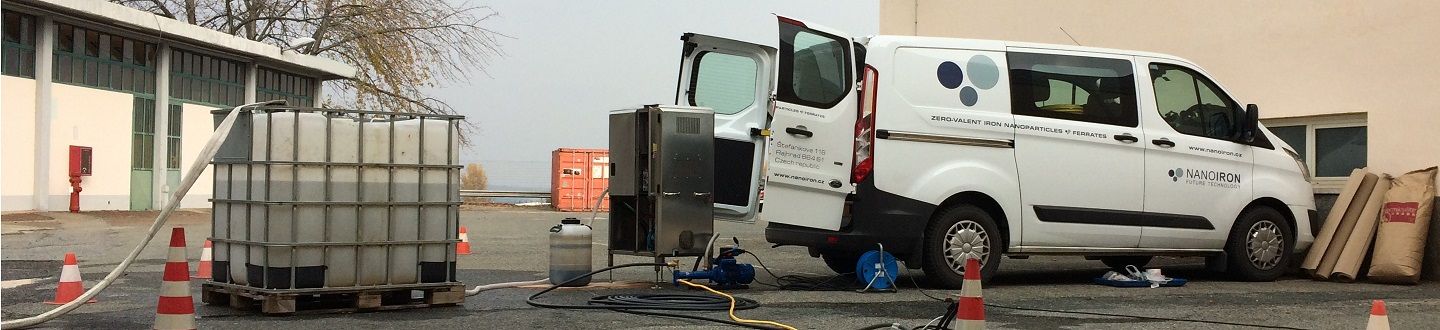
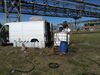
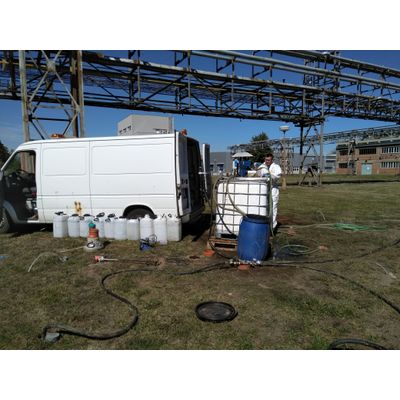
The material was injected in form of an aqueous suspension employing the pressure injection into permanent wells in August 2018. The groundwater and soil were periodically sampled before and after the remediation event. In-situ and ex-situ measurements of physical-chemical parameters, contamination levels, nZVI migration and changes in biota were performed by employing of the field-ready laboratory equipment as well as the advanced analytical techniques.
CONCLUSION
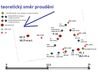
Monitoring of the subsurface has proved the decrease in average concentration of CHCs and chlorine number, especially in the highly contaminated deeper horizons. Application of NANOFER 25DS (S-nZVI) resulted in increasing pH, decreasing redox potential and evolution of gaseous products of CHCs degradation (ethane, ethene, acetylene).