- Home
- Companies
- Metrohm AG
- Articles
- Frequently Asked Questions (FAQ) about ...
Frequently Asked Questions (FAQ) about Raman spectroscopy: Theory and usage
As the spectrometer’s laser interacts with a sample, the energy of the light scattered back is shifted resulting in a Raman spectrum that gives valuable information about the chemical structure. This article covers some of the most frequently asked questions about Raman spectroscopy regarding the theory behind it and how it can be used in practice.
- What is Raman spectroscopy?
- What kinds of materials can be measured with Raman?
- What information can be obtained from the Raman spectrum?
- How do I read a Raman spectrum?
- What are the benefits of using Raman spectroscopy?
- Raman can be used for identification of unknown substances as well as material verification. What is the difference?
- Who should use Raman, as well as where, when, how, and why?
- What is SERS and how can it help me?
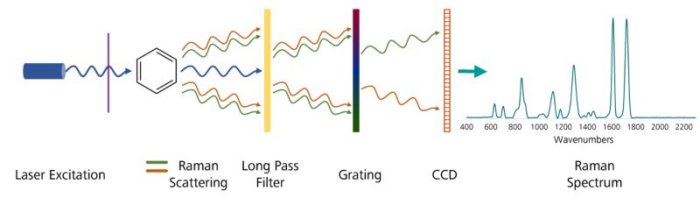
Raman is a form of molecular spectroscopy that is observed as inelastically scattered light when a sample is excited by a laser. While most scattering occurs elastically, about 1 in 106 scattering processes interact with the molecule through bond stretching and bending vibrations resulting in Raman-scattered light. Shifted by these molecular interactions, the detected Raman photons can be processed into a spectrum that relates to the unique bonds within a molecule, providing the user with an invaluable analytical tool for molecular fingerprinting. This «fingerprint» is used primarily for material identification and, increasingly, for quantification.
Note: molecular vibrational spectroscopies only detect two or more atoms that have a molecular bond between them—salts, ions, and metals require other analytical methods.
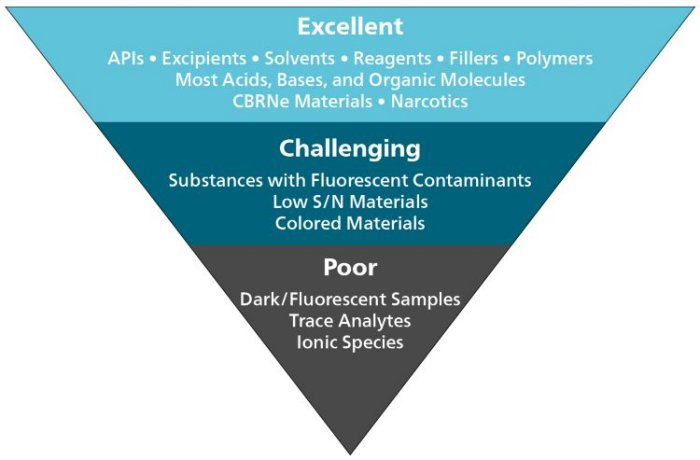
Raman spectroscopy can be used to identify most materials that are present at a sufficient quantity and purity and/or in simple mixtures. Raman can identify thousands of solid and liquid substances including pharmaceuticals, raw materials for food and personal care products, controlled substances and associated precursors and cutting agents, weapons of terror, toxic and non-toxic chemicals, solvents, and agricultural treatments (e.g., pesticides, insecticides).
Following are some general guidelines:
- Most molecules with covalent bonds are Raman active; however, the nature and intensity of their signal can vary.
- It is estimated that 80% of common active pharmaceutical ingredients (APIs) and excipients are well-suited for raw material identification (RMID) with Raman spectroscopy.
- Raman is an ideal technique for aqueous solutions, as water’s signal does not interfere with that of the solute.
- Some salts, ionic compounds, and metals are not suitable for Raman analysis.
- Fluorescence is one of the biggest challenges for Raman, as it can overwhelm the signal from Raman scattering.
How does fluorescence affect the results when measuring with Raman?
Fluorescence is traditionally the biggest limitation for Raman. It is a much more efficient emission process, causing overwhelming background noise in the Raman spectrum and obscuring Raman peaks. Natural substances (such as plant fibers), strongly colored materials, and substances with fluorescent contaminants can all fail to produce results with Raman spectroscopy. Luckily, this limitation is not insurmountable.
A common solution has been to move the wavelength of the excitation laser away from the absorbance wavelength of the material – typically 532, 638, or 785 nm. The most common choice of wavelengths for reduced fluorescence effects is 1064 nm.
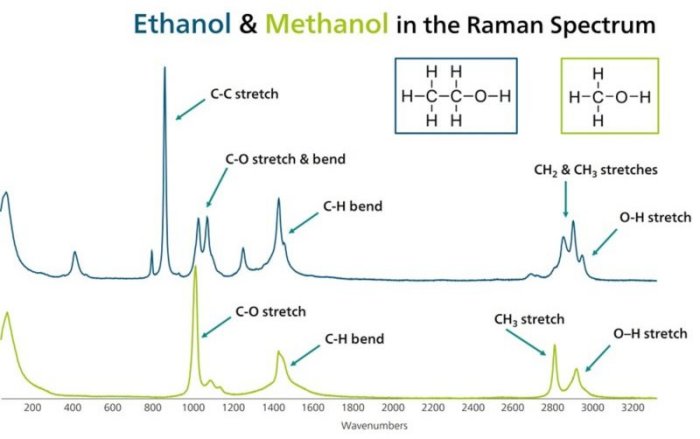
Raman spectroscopy can help users observe the progression of a chemical reaction, differences in crystallinity between polymorphs, and changes in bond energies that arise from applied stress on a material. The following Application Note offers even more insight into this kind of study.
Intensity in the Raman spectrum is directly proportional to sample concentration and can also be used for quantitative analysis. Learn more in our free Application Note below.
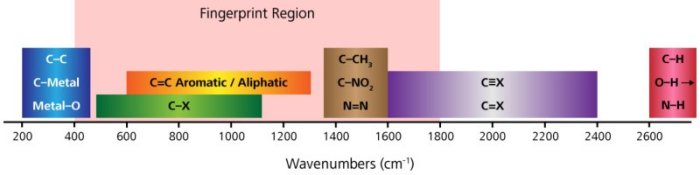
Although the Raman spectrum has a potential range from 0–4000 cm- 1, most applications can be satisfied with a narrower spectral range. The fingerprint region, 400–1800 cm-1, largely reveals the molecular environment of atoms. This is adequate for identification of unknowns and verification of materials (see image below), both of which rely on the identity of the molecular structure.
Raman is a powerful analytical technique:
- High chemical specificity and selectivity
- Little to no sample preparation
- Little to no consumable cost
- Non-destructive analysis
- Fast — from acquisition of data to results in seconds
- Simple user interfaces = ease of use
- Non-contact, through-barrier analysis
- Sampling flexibility
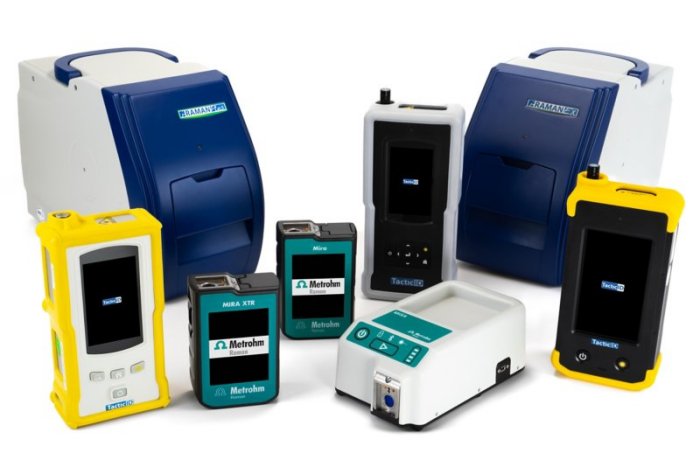
- Flexible form factor — from benchtop to handheld systems
Identification of unknowns is a measure of spectral similarity between the unknown substance and library spectra. This method of identification is easy to implement, fast, and suitable for use with extensive, customizable chemical libraries. An example of this technique would be on-site testing of a small bag of white powder confiscated at a traffic stop, providing fast evidence of illegality at the point of contact without exposing the authorities to any potential hazards. Download our White Paper below for more information on this subject.
Raman’s selectivity also makes it an excellent technique for verification of known materials, which confirms the consistency, purity, and quality of raw materials for manufacturers of food, pharmaceuticals, hair and skincare products, cosmetics, and more. The verification method detects slight spectral differences by projecting each sample spectrum onto a model. This either passes or fails based on how well the sample spectrum fits the model. Find out more about verification with Raman spectroscopy in the following White Paper.
Who?
Anyone requiring general, scientific, or industrial material analysis, including:
- Defense/Security professionals
- Chemists
- Forensics analysts
- Workers at receiving docks
- People working in research and education
Where?
- In the laboratory, at manufacturing facilities, crime scenes, or at the border.
- Portable and handheld systems are able to travel with the user directly to the testing location.
When?
When the identification, verification, or distinction of sufficiently pure substances is desired—especially when dealing with unknown white powders and synthetic materials.
How?
When the identification, verification, or distinction of sufficiently pure substances is desired—especially when dealing with unknown white powders and synthetic materials.
Why?
To determine the consistency of ingredients, find out whether something is hazardous, identification of a suspicious substance, or confirming the identity of a material.
Surface-enhanced Raman scattering (SERS) is a specialized Raman technique that helps users detect trace amounts of substances. Not all materials are SERS-active, but strongly SERS-active materials can be detected at parts-per-million (ppm, mg/L) or parts-per-billion (ppb, µg/L) levels. SERS can also be used to detect a specific component in a mixture or identify strongly colored dyes and materials, as it is not susceptible to fluorescence.
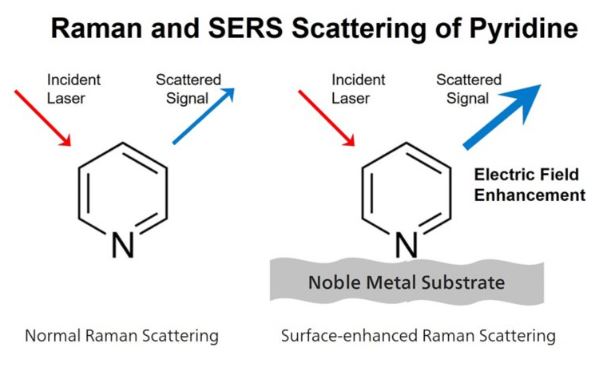
The biggest challenge for SERS is the detection of a target compound in complex matrices, including in water, pills (e.g., either regulated pharmaceuticals, over the counter drugs, or those sold on the street), and a variety of foodstuffs. With experience and investigation, the unique properties of SERS analysis can be exploited with simple sample preparation.
Ultimately, Raman spectroscopy is an ideal technique for material identification or verification that is available to technical and non-technical users in a wide variety of settings. Raman is easily implemented, preserves the sample, and can be used to analyze thousands of materials. To learn more about Raman and its many benefits, check out our other blog articles, our Application Notes, and White Papers.