


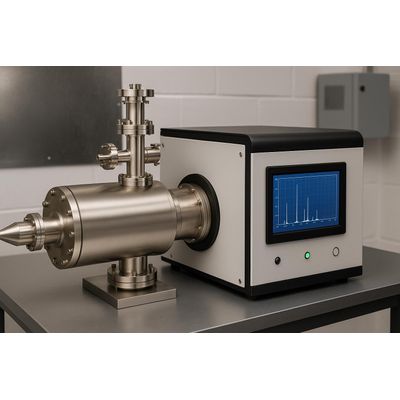
High-Resolution Gas Analysis with Hiden Dual Zone Mass Spectrometry
Hiden Analytical's Dual Zone mass spectrometry combines high-resolution mass separation with accurate partial-pressure measurement in a single instrument, addressing the challenge of separating species that share the same nominal mass in gas analysis. Systems such as HAL 101 X, DLS-20 and DLS-2 / DLS-2X enable this capability across vacuum science, materials research, catalysis and nuclear fusion research.
The Challenge of Overlapping Mass Peaks in Gas Analysis
A mass spectrometer measures gases by converting their partial pressure into an electrical ion current. Under normal operating conditions, the instrument operates in standard resolution mode (Zone 1) where peak widths are typically around 1 atomic mass unit (amu).
When a single gas species contributes to a measured mass peak, determining its partial pressure is straightforward. However, problems arise when two different gases share the same nominal mass.
- The instrument detects the combined signal from both gases
- The individual contribution of each species cannot be separated
- Accurate partial pressure measurement becomes impossible
This limitation can affect many real-world applications where gas mixtures contain isotopes or molecules with very similar masses.
Dual Zone Mass Spectrometry: High Resolution When You Need It
Hiden Dual Zone instruments introduce a second operating mode called Zone H, a high-resolution mass spectrometry mode capable of separating species with mass differences as small as 0.005 amu. This enables the instrument to distinguish gases that would normally overlap in standard mass spectrometry.
The workflow combines two complementary measurement modes:
Zone H – High Resolution Mode
- separates overlapping gas species
- measures the ratio between resolved ion signals
- identifies individual species within a shared nominal mass
Zone 1 – Quantitative Measurement Mode
- uses known sensitivity values
- provides reliable partial pressure measurement
- maintains standard residual gas analysis workflows
By combining these two modes, Dual Zone instruments allow users to separate gases with high resolution while still performing accurate quantitative analysis.
Accurate Partial Pressure Measurement in Complex Gas Mixtures
The Dual Zone approach enables users to extract meaningful data from gas mixtures that would otherwise be difficult to interpret. Instead of seeing only a combined mass peak, researchers can:
- separate overlapping species
- determine the individual partial pressure of each gas
- obtain more accurate gas composition data
- perform real-time analysis of complex environments
This capability significantly improves the analytical power of residual gas analysis (RGA) and high-resolution mass spectrometry systems. For laboratories working with light gases, isotopes, or closely spaced mass species, Dual Zone technology expands what can be measured with confidence.
Applications in Nuclear Fusion Gas Analysis
Fusion research frequently involves gases such as hydrogen (H2), deuterium (D2) and helium (He). These species often appear close together in the mass spectrum and can overlap under standard resolution conditions. Accurate measurement of these gases is essential for understanding fuel behavior, isotope ratios, plasma-wall interactions, gas balance in fusion reactors and helium ash production.
Using Dual Zone mass spectrometry, fusion researchers can resolve these closely spaced species and determine their individual partial pressures with much greater confidence, enabling more reliable interpretation of experimental data and supporting ongoing fusion reactor development and plasma diagnostics.
Example Application: Separating Helium and Deuterium
A practical example involves measuring helium and deuterium with a DLS-1 alongside Dual Zone instruments in fusion gas analysis workflows. Helium and deuterium signals can overlap in conventional analysis; Zone H separates the two species and determines their signal ratio. Zone 1 applies the known sensitivity factors to calculate their individual partial pressures. MASsoft Professional control software can display these values in real time, enabling monitoring of helium and deuterium concentrations during experiments. This approach converts a challenging overlapping peak into a clear, quantitative measurement.
The Advantage of Hiden Dual Zone Instruments
- high-resolution separation of overlapping species
- accurate partial pressure measurement
- improved analysis of light gases and isotopes
- real-time gas composition monitoring
- enhanced capability for demanding research applications
For applications where standard mass spectrometry reaches its limits, Dual Zone technology provides a powerful analytical solution.
Frequently Asked Questions
What is Dual Zone mass spectrometry? Dual Zone mass spectrometry combines two operating modes within a single mass spectrometer. A standard measurement mode (Zone 1) provides accurate quantitative analysis, while a high-resolution mode (Zone H) separates gases that share the same nominal mass. By combining information from both modes, users can resolve overlapping species and calculate their individual partial pressures.
Why is high-resolution mass spectrometry important for gas analysis? High-resolution mass spectrometry allows gases with very small differences in mass to be separated. In conventional residual gas analysis, species with similar masses may overlap and appear as a single peak. High-resolution techniques, such as Hiden’s Dual Zone operation, enable these gases to be distinguished even when their mass difference is extremely small, improving both identification and quantification.
What are overlapping species in mass spectrometry? Overlapping species occur when two or more gas molecules produce signals at the same nominal mass in a mass spectrum. This can happen when gases have very similar molecular weights or when isotopes are present. Without sufficient mass resolution, their signals combine into a single peak, making it difficult to determine the contribution of each gas.
How does Dual Zone operation improve partial pressure measurement? Dual Zone instruments first use high-resolution mode (Zone H) to separate overlapping species and determine the ratio of their signal intensities. This ratio is then combined with the quantitative signal measured in standard resolution mode (Zone 1), where sensitivity values are well known. This approach allows the individual partial pressures of each gas to be calculated accurately.
Which applications benefit most from Dual Zone mass spectrometry? Dual Zone mass spectrometry is particularly useful in applications where gases with very similar masses must be distinguished. These include: nuclear fusion research; hydrogen and isotope studies; vacuum science and residual gas analysis; materials science and surface analysis; catalysis research; semiconductor and thin film processing.
Why is Dual Zone analysis useful in nuclear fusion research? Fusion experiments frequently involve hydrogen isotopes such as hydrogen and deuterium, along with helium produced during reactions. These gases can overlap in conventional mass spectrometry. Dual Zone instruments allow these species to be separated with high precision and their individual partial pressures measured accurately, helping researchers understand fuel behavior, plasma-wall interactions and gas balance within fusion systems.
Can Dual Zone mass spectrometers analyse light gases such as helium and hydrogen? Yes. Dual Zone technology is particularly valuable for analysing light gases and isotopes such as helium, hydrogen and deuterium. These species often have very small differences in mass, making them difficult to resolve using standard mass spectrometry alone. The high-resolution capability of Zone H allows these gases to be separated and analysed more accurately.
Original: https://www.hidenanalytical.com/blog/high-resolution-gas-analysis-dual-zone-mass-spectrometry/?utm_source=rss&utm_medium=rss&utm_campaign=high-resolution-gas-analysis-dual-zone-mass-spectrometry