


- Home
- Companies
- Metrohm AG
- Articles
- History of Metrohm IC - Part 6
History of Metrohm IC - Part 6
In the mid-1970s the impact of organic halogens and sulfur became a topic of intensified focus, as these compounds were shown to increase ozone destruction and adversely impact the environment [1]. In addition, they are corrosive and can threaten human health during water treatment processes [2,3].
Most organic halogens are not water-soluble, therefore decomposition is necessary as a first analytical step [4–6]. Using combustion as a sample preparation method to decompose such compounds and to enable subsequent sulfur determination [6] in a closed system (i.e., «combustion bomb») under pressurized oxygen atmosphere began in 1881. In 1955, Schöninger developed the first convenient handling of the combustion process—the so-called «oxygen flask» [7–9].
The basic principle of Schöninger-based analytical methods is to burn a certain amount of sample in oxygen-rich atmosphere. The resulting gases are bubbled through an absorber solution which is then transferred to the analytical instrument for measurement (commonly microcoloumetric titration) [2,5,7]. Between samples, the container must be cleaned extensively to avoid cross-contamination [7]. However, these methods did not have the possibility to be automated. Over time, the once dangerous procedure was modified to be much safer. Still, the manual process of preparing samples with extensive rinsing steps in between remained cumbersome and time-consuming.
Around the same time, pyrohydrolysis was established for analytical purposes by Warf [10,11] as «high temperature hydrolysis» to measure halogens, boron, and sulfur especially in geological samples [12]. As IC was already established as a highly sensitive technique for measuring halogens and sulfur, a combination of combustion with IC was introduced as a possibility for fast, accurate, and sensitive multi-element analysis. High sensitivities could already be achieved by combining the oxygen-bomb combustion method with IC [13], but pyrohydrolysis with combustion ovens enabled development of fully automated procedures [14].
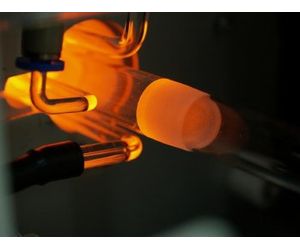
Classically, the absorber solution was analyzed using colorimetric titration in the case of AOX (e.g., ISO 9562:2004, DIN 38414-18:2019, or EPA 1650) or sulfur (e.g., ASTM C816-85 or [5]), or via potentiometric titration with ion-selective electrodes, e.g., for fluoride [5]. However, combining the combustion module with an IC revolutionized the field as detailed information about the analytes was now possible [15]. Halogens and sulfur are quantified individually, and additionally, analysts get fluoride results (DIN 38409-59) – a parameter which the classical techniques had trouble with.
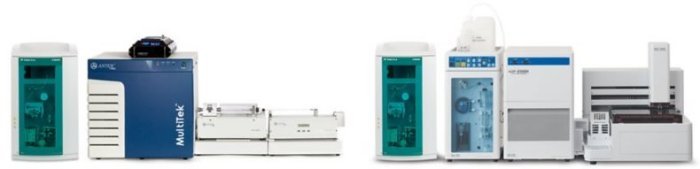
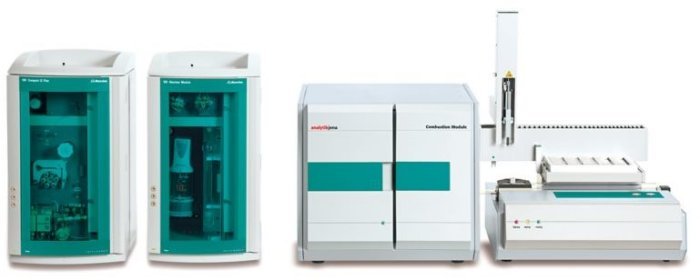
An alternative Metrohm CIC setup was introduced to the market in 2021, utilizing a combustion oven developed by Trace Elemental Instruments (TEI) (Figure 4). With these various CIC systems, Metrohm is confident to offer the perfect fit for different application needs and market demands.
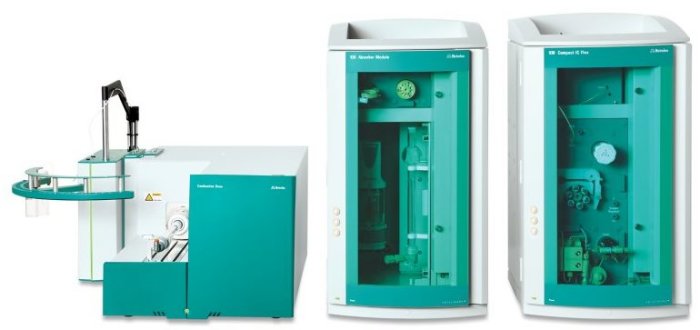
While the combustion ovens are still manufactured by Analytik Jena or Trace Elemental Instruments, respectively, the full CIC system is handled by application and service teams from Metrohm. All of this combined with the implementation of Dosinos and intelligent Dosing Units for controlled liquid handling made CIC ideal as a routine method for the petrochemical industry and more.
Learn more about Metrohm Inline Sample Preparation (MISP) possibilities for difficult sample matrices here.
When working with a large variety of samples, special method development is no longer necessary with the application of flame sensor technology from Analytik Jena. The light intensity is registered and translated into specific sample boat movements in order to conduct the combustion in minimal time.
For critical samples with a high content of fluoride or alkali and alkaline earth metals, the ceramic tube from Trace Elemental Instruments is highly recommended. The ceramic is resistant to such sample types which provoke devitrification in a quartz setup.
Low-quality petroleum may contain significant quantities of sulfur. During combustion, this produces sulfur dioxide (SO2) which contributes to air pollution. Sulfur compounds contained in petroleum are also a problem for oil refineries and internal combustion engines—they lead to corrosion and stress cracking and can poison catalysts (e.g., those used in catalytic reforming). To prevent this, sulfur must first be removed via hydrodesulfurization [16]. The standard DIN EN 228 sets a maximum of 10 mg/kg for the sulfur content in automotive fuels.
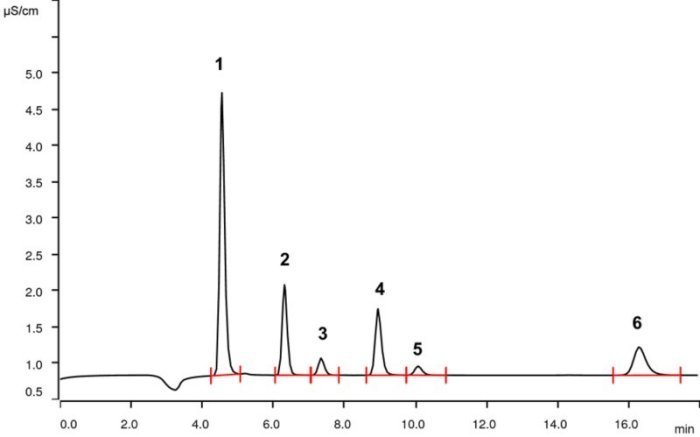
Sulfur is not the only analyte of interest for the petroleum industry. Halides (F-, Cl-, and Br-) also contribute to corrosion and must therefore be removed from petroleum through desalting processes [17]. The analysis of halogens and sulfur via CIC in liquefied petroleum gas (LPG) is shown in the chromatogram below (Figure 5).
Organic halogen compounds can enter the environment when they are being manufactured, used, or disposed of [4]. They can be detected in the air, in water, and in living organisms. Such fluorinated compounds are commonly known as either PFASs (per- and polyfluoroalkyl substances) or «forever chemicals», and their detrimental effect on human health is described at length in scientific literature and the news. This classification covers several thousands of chemicals and determining individual substances from the list is time-consuming and requires costly instrumentation. Therefore, some laboratories take a non-targeted screening approach instead to monitor the overall presence of these manmade chemicals.
Organic fluorinated compounds, such as PFASs in particular, can be easily monitored using non-targeted AOF (adsorbable organic fluorine) analysis by CIC. The new EPA draft method 1621 released in April 2022 describes a validated method for comprehensive AOF analysis using combustion ion chromatography. Find out more about this analysis in our free White Paper at the end of the article.
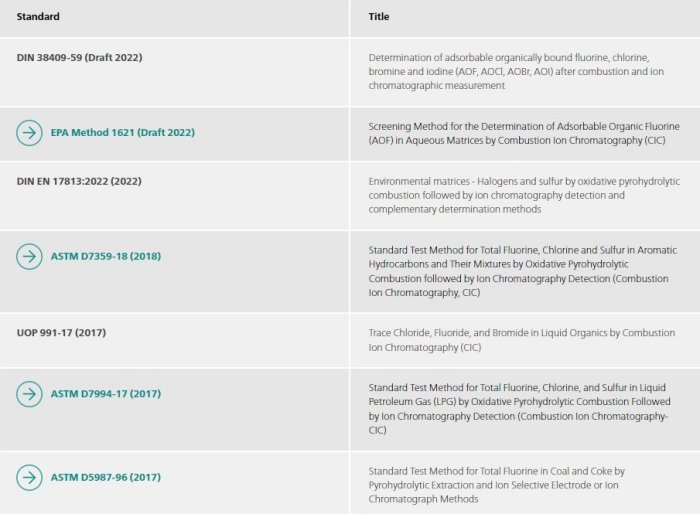
New applications for CIC are popping up everywhere with the rising need to monitor halogens and sulfur in several industries. As CIC has now matured into a reliable, automated analysis technique for these substances, it has become more commonly used to fulfill the analytical requirements of several international standards. A summary of recent standards is given in Table 1.
Table 1. Metrohm CIC: Compliant with official standards
So much has happened in the past decade since Metrohm CIC was first brought to the market! Combustion IC has already become established as a routine analysis method in many labs. The addition of Metrohm Inline Sample Preparation Techniques has increased the degree of automation, positively impacting accuracy, handling, and sample throughput. With a single supplier and software solution, organically bound halogens and sulfur can now be determined directly in a wide variety of sample matrices in various physical states (solid, liquid, or gaseous).
[1] Simpson, W. R.; Brown, S. S.; Saiz-Lopez, A.; Thornton, J. A.; von Glasow, R. Tropospheric Halogen Chemistry: Sources, Cycling, and Impacts. Chem. Rev. 2015, 115 (10), 4035–4062. DOI:10.1021/cr5006638
[2] McKinnon, L. M. AOX as a Regulatory Parameter; A Scientific Review of AOX Toxicity and Environmental Fate; British Columbia Ministry of Environment, Lands and Parks, Canada, 1994.
[3] Kampa, M.; Castanas, E. Human Health Effects of Air Pollution. Environ. Pollut. Barking Essex 1987 2008, 151 (2), 362–367. DOI:10.1016/j.envpol.2007.06.012
[4] Mazor, L. Analytical Chemistry of Organic Halogen Compounds, 1st ed.; International series of monographs in analytical chemistry; v. 58; 1975.
[5] Ma, T. S. Elemental Analysis, Organic Compounds. In Encyclopedia of Physical Science and Technology (Third Edition); Meyers, R. A., Ed.; Academic Press: New York, 2003; pp 393–405. DOI:10.1016/B0-12-227410-5/00220-9
[6] Barin, J. S.; de Maraes Flores, Erico Marlon; Knapp, G. Trends in Sample Preparation Using Combustion Techniques. In Trends in Sample Preparation (Marco A. Z. Arruda eds.); Nova Science Publishers, Inc., 2007; pp 53–82.
[7] Schöniger, W. The present status of organic elemental microanalysis. Pure Appl. Chem. 1970, 21 (4), 497–512. DOI:10.1351/pac197021040497
[8] Schöniger, W. Die mikroanalytische Schnellbestimmung von Halogenen und Schwefel in organischen Verbindungen. Microchim. Acta 1956, 44 (4), 869–876. DOI:10.1007/BF01262130
[9] Fung, Y. S.; Dao, K. L. Oxygen Bomb Combustion Ion Chromatography for Elemental Analysis of Heteroatoms in Fuel and Wastes Development. Anal. Chim. Acta 1995, 315 (3), 347–355. DOI:10.1016/0003-2670(95)00317-S
[10] Mishra, V. G.; Jeyakumar, S. Pyrohydrolysis, a Clean Separation Method for Separating Non-Metals Directly from Solid Matrix. Open Access J. Sci. 2018, 2 (6), 389–393. DOI:10.15406/oajs.2018.02.00103
[11] Warf, J. C.; Cline, W. D.; Tevebaugh, R. D. Pyrohydrolysis in Determination of Fluoride and Other Halides. Anal. Chem. 1954, 26 (2), 342–346. DOI:10.1021/ac60086a019
[12] Evans, K. L.; Tarter, J. G.; Moore, C. B. Pyrohydrolytic-Ion Chromatographic Determination of Fluorine, Chlorine, and Sulfur in Geological Samples. Anal. Chem. 1981, 53 (6), 925–928. DOI:10.1021/ac00229a050
[13] Zhang, S.; Zhao, T.; Wang, J.; Qu, X.; Chen, W.; Han, Y. Determination of Fluorine, Chlorine and Bromine in Household Products by Means of Oxygen Bomb Combustion and Ion Chromatography. J. Chromatogr. Sci. 2013, 51 (1), 65–69. DOI:10.1093/chromsci/bms108
[14] Pereira, L. S. F.; Pedrotti, M. F.; Vecchia, P. D.; Pereira, J. S. F.; Flores, E. M. M. A Simple and Automated Sample Preparation System for Subsequent Halogens Determination: Combustion Followed by Pyrohydrolysis. Anal. Chim. Acta 2018, 1010, 29–36. DOI:10.1016/j.aca.2018.01.034
[15] Peng, B.; Wu, D.; Lai, J.; Xiao, H.; Li, P. Simultaneous Determination of Halogens (F, Cl, Br, and I) in Coal Using Pyrohydrolysis Combined with Ion Chromatography. Fuel 2012, 94, 629–631. DOI:10.1016/j.fuel.2011.12.011
[16] Pfahler, B. Halogen-Containing Hydrocarbons from Petroleum and Natural Gas. In Literature Resources; Advances in Chemistry; American Chemical Society, 1954; Vol. 10, pp 381–394. DOI:10.1021/ba-1954-0010.ch040
[17] Al-Otaibi, M. B.; Elkamel, A.; Nassehi, V.; Abdul-Wahab, S. A. A Computational Intelligence Based Approach for the Analysis and Optimization of a Crude Oil Desalting and Dehydration Process. Energy Fuels 2005, 19 (6), 2526–2534. DOI:10.1021/ef050132j