
- Home
- Companies
- Oil Skimmers, Inc.
- Articles
- How food producers can Reduce costs and ...
How food producers can Reduce costs and Increase efficiency in their Wastewater treatment system
Foremost in many companies` capital-investment strategies these days is achieving fast return on investment (ROI). This especially is true in packaged foods, an industry adjusting co higher commodity prices and increased price sensitivity. At the same time, consumers are pressuring packaged-foods manufacturers to make their processes more environmentally friendly, or "green."
Producers that can meet both of these challenges will have a competitive advantage in a market that analysts expect to be under increased stress in the short term. Moody`s Investors Service warned in February 2009 of a worsening outlook for U.S. food producers in the next 12 to 18 months.
"Most food producers have significant fixed casts; hence, a drop in sales volume is likely to hurt profitability and cash flow. In addition, the tight credit markets intensify problems for lower-rated packaged-food companies and especially for meat producers."
This white paper examines how smart food producers are investing in equipment that lowers costs while enabling the manufacture of high-quality products through efficient processes. Specifically, we will examine equipment known as oil skimmers that separate oil from other fluids (usually separating used cooking oil from wastewater for food producers). We will list the various ways companies remove used oil from wastewater and document how two Midwest packaged-food manufacturers have used continuous-tube oil skimmers to reduce costs for energy, waste treatment, waste removal, machine maintenance, and regulatory fees. They also have improved their images as green producers and found new potential revenue streams in the resale of used oil. Both report that their continuous-tube oil skimmers solutions achieved substantial ROI quickly and easily.
Smart Capital Investment
Foodprocessing.com research revealed that 97% of interviewed companies are worried about energy costs. In the prior year`s survey, 90% said they were worried.2 This reflects concerns within the entire manufacturing sector, which is the largest consumer of energy in the United States. Uncertainty in energy supply will continue to drive up costs.
One way companies can offset rising energy bills is by investing in equipment that makes processes more efficient, such as oil skimmers. According to the IndustryWeek/Manufaeiunng Performance Group 2007 Census of Manufacturers, more than 70% of surveyed manufacturers said they were able to improve financial performance through the application of new capital equipment.
The key to improving financial performance through capital equipment purchases is to invest in well-made, market-tested machinery that will address problems immediately and continue to address them in the future without further investment.
The Challenge
One such problem that exists for many food producers is the presence of oil in wastewater. With the increase demand for prepared and snack foods, companies have increased their production thus putting additional strain on their wastewater treatment system. large quantities of oil are used in the preparation of a wide variety of food products such as salad dressings, chicken or potato chips. A majority of the spent oil is drained from the cooking "pots" and recycled, but a surprising amount remains behind and is flushed out during the cleaning process. This oil becomes part of the wastewater stream and a challenge for most food producers.
The presence of vegetable oil and /or animal fats lead to greater use of treatment chemicals thus additional costs. The life of filter media and it`s efficiency is reduced. The amount of sludge requiring disposal increases, and labor costs associated with the treatment increases. Municipal surcharges may be imposed and a valuable commodity is lost. Thus it is most essential that this oil be separated and removed.
Removal Methods
Food manufacturers traditionally have used a variety of methods to remove used oil from wastewater. These include:
- Displacement: Operators raise the water level in order to overflow the oil that rests on top. This method rarely separates the oil and water fully, so oil remains in the tank, and the displaced oil contains water, which lowers or eliminates its resale value.
- Floating Pump: A pump sucks the oil off of the top of the water. This, too, is an inefficient method in terms of clean separation of oil and water, because a large amount of water remains in the removed oil. Also, it requires hands-on maintenance, which Is time-consuming and labor-intensive. Alternative methods such as continuous-tube skimmers can safely operate independently.
- Absorbent Padding: Pads made from oil-absodiing materials are cast upon the mixture in an attempt to soak up the oil. This method often is used for oil-spill incidents, but it does not make sense as an ongoing, procedural solution for a business because it is expensive and labor-intensive.
- Removal Services: Third-party technicians pump out the oil and remove it from the customer`s site. This can be expensive and inefficient, as it requires someone to take time to set up a service. Also, allowing oil to build up degrades the quality of the oil and increases chances for the oil to escape.
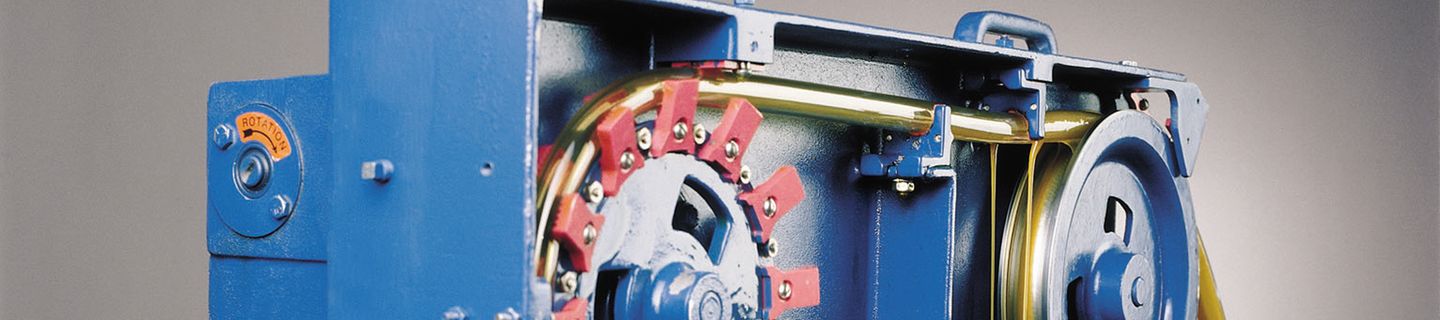
- Oil Skimmers: Equipment removes oil by cyclically introducing an oil-attracting surface into the mixed oil and water and then cleaning the oil off the surface before it is reintroduced. The oil collects in a separate repository as it is removed. The oil-adhering surface can be made from a variety of materials and be introduced using a variety of methods. Oil skimmers can use floating drums, belts, mops, discs, or tubes.
Oil skimmers achieve fast ROl because they can be a low-impact capital investment in terms of cost, space, and time. Compact skimmers sell for under $10,000, are quickly and easily installed, and have an immediate impact.