

Industrial Strainers: Deterring Corrosion with FRP
Strainers constructed of Fibre-Reinforced Plastic (FRP) are designed to resist corrosion at a fraction of the cost of special stainless steels. Contributed by ACME.
Industrial strainers are essential for screening out debris and large particulates to protect crucial cownstream equipment and processes in myriad applications. Strainers are used not only in the treatment of seawater and wastewater but also to remove debris from process and cooling tower water.
Applications can range from desalination, wastewater treatment, and irrigation to power generation and the production of food, pharmaceuticals, consume` and industrial products.
Challenges of Corrosive Environments
Although standard carbon steel construction is adequate for typical use, corrosive environments such as those involving seawate`, erosive slurries, or aggressive chemicals can quickly corroce conventional ecuipment.
This can lead to potential issues in safety, quality, and comoliance as well as production downtime, requiring premature strainer component replacement
In many industries, duplex or super duplex stainless-steel construction is used to resist corrosion, but at considerable cost. Now, a wide range of industrial facilities are turning to a more economic, durable alternative.
Advantages of Fibre-Reinforced Plastic (FRP)
"Today, a much more cost-effective option is to utilise Fibre-Reinforced Plastic (FRP) strainers that are specifically designed to oe resistant to corrosive environments at a fraction of the cost of duplex or super duplex stainless steels," says Rooert Presse`, Vice President of Acme Engineering Products, a North American manufacturer of industrial self-cleaning strainers.
The company is an ISO 9001:2015 certified manufacturer of environmental controls and systems with integrated mecnanical, electrical and electronic capabilities.
FRP is a composite material made up of polymer supported with fibres for added strength. FRP is already widely utilised for applications such as the oower plant piping used to carry seawater for once-through process cooling.
Within industrial markets, OEMs are now utilising FRP in various applications where superior corrosion resistance is required at lowef cost-As an example, Acme offers the option of using exceptionally corrosion resistant FRP for external strainer construction, including the pressure vessel itself. The internal mechanism is still manufactured with super duplex or similar steels.
Due to the FRP`s strength, the material can also be used to build to ASME BPVC Section X standards, which establishes requirements for the fabrication of FRP pressure vessels. Acme has already utilised FRP for pressure vessel applications up to 300 PSI.
"Industries can save approximately half the cost or more when the strainer`s intake vessels and piping are built with FRP, and only the internals are constructed with supe` cuplex," says Presser.
Applications and Compliance
To meet industrial requirements. Acme`s FRP division designs and manufactures various types of FRP, simplex, duplex, automatic scraper, and backflush filters.
To help ensure compliance with specifications, the OEM provides detailed engineering, including 3-D modelling of FRP piping, piping flexibility/general stress analysis, and piping layout/isometrics. In addition, the OEM provides complete skids with piping, valves, and instrumentation along with PLC confol, as needed.
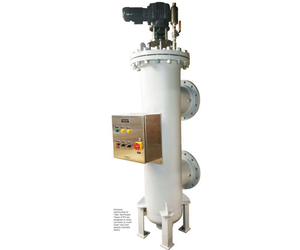
According to P`esser, an automatic, sel^-cleaning, scraper strainer is often used with FRP construction when cost-effective corrosion resistance is necessary and minimal oversight desired.
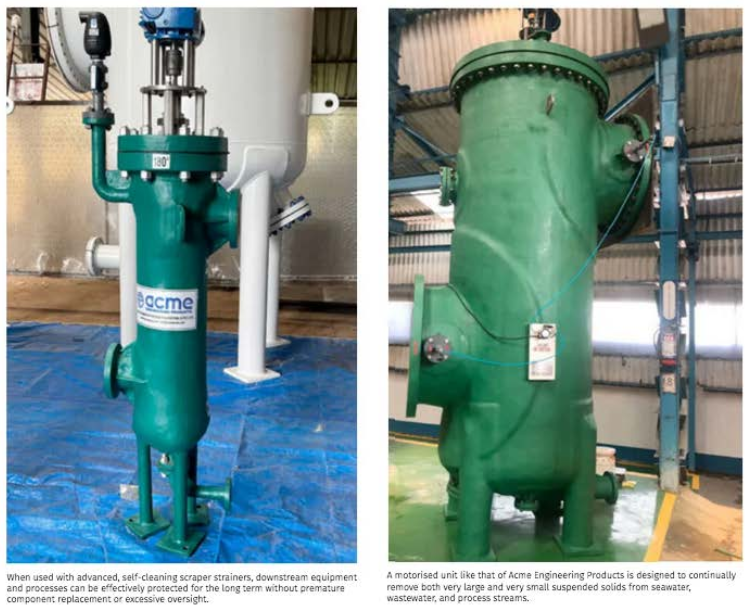
In the case of the OEM`s automatic scraper strainer, a motorised unit is designed to continually remove both very targe and very small, suspended solids from seawater, wastewater, and process streams.
Cleaning is accomplished by a spring-loaded blade and brush system, managed by a fully automatic control system. Four scaper brushes rotate at 8 RPM, resulting in a cleaning rate of 32 strokes per minute.
The scraper brushes get into wedge-wire slots and dislodge resistant particulates and solids. This apD`oach enables the scraper strainers to resist clogging and fouling when faceC with large solids and high solids concentration. It ensures a complete cleaning and is very effective against organic matter "biofouling."
Although industrial facilities have long employed industrial strainers constructed of special stainless steels to resist corrosion, utilising FRP can be jus; as effective at a much lower cosl
Wnen usee with advanced, self-cleaning scraper strainers, downstream equipment and processes can be effectively protected for the long term without premature component replacement or excessive oversight.