

Lagoon Upgrades vs. New Plants: How Utilities and Public Works Compare Risk, Cost, and Timelines
When aging lagoons meet modern regulations, choices must be made
Wastewater lagoons have been around for decades. They offer a reliable and affordable solution for treating wastewater, especially for small rural communities.
While this approach to wastewater treatment has been effective for years, lagoon systems are now struggling to comply with tighter regulatory standards and higher treatment demands. When these systems can no longer cope, utilities and public works departments face a critical decision: to upgrade existing lagoon systems or build new treatment capacity.
Consider a side-by-side comparison, examining schedule certainty, capital exposure, feasibility, and long-term operational risk, from an owner’s and an engineer’s perspective.
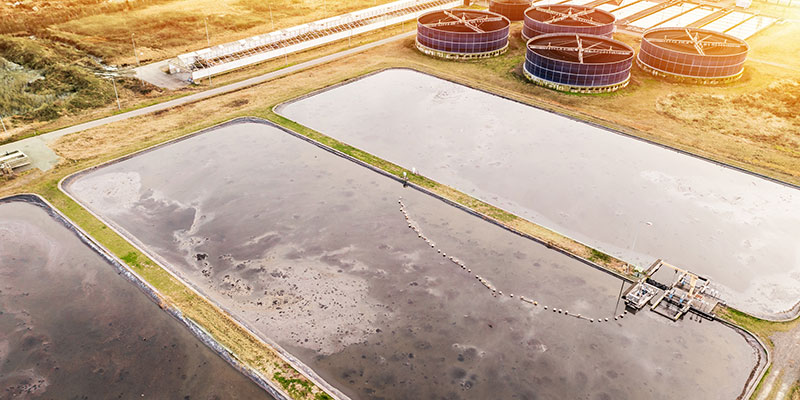
With tighter nutrient limits on nitrogen and phosphorus, many lagoon systems struggle to comply, particularly when receiving waters are designated as sensitive.
Because many treatment lagoons were built decades ago, utilities are often left with aging assets and limited upgrade options using traditional methods. Some lagoons have limited space available for expansion or conventional retrofits.
In practice, many lagoon owners don’t face a clean upgrade-versus-replacement decision. What is often seen instead is a narrow compliance window combined with uncertainty around long-term growth. That tension shapes nearly every technical and financial choice that follows.
Once compliance pressure and growth uncertainty converge, schedule certainty often becomes the defining constraint in project selection.
One option is building a new plant sized for future growth and designed to meet current and anticipated regulations. This involves extensive design, permitting, and construction timelines that can stretch over years, if not decades. Lengthy infrastructure construction projects might also face permitting delays, supply chain issues, contractor availability, and severe weather.
By contrast, lagoon upgrades can be delivered much more quickly, particularly when modular or add-on treatment solutions are implemented. Because they use existing assets and site footprints, permitting is typically simpler and construction disruption lower, sometimes with little change to service while upgrades are implemented.
In many cases, the schedule risk isn’t the technology — it’s coordination. Delays often come from permitting overlap, funding release time, or contractor availability rather than treatment performance itself. This is one reason modular lagoon upgrades are frequently used as compliance bridges, even when long-term replacement is still on the table.
Modular lagoon upgrades can shorten schedules significantly, reducing the risk of missing regulatory deadlines. Every unmet milestone increases the chance of penalties as well as the need for interim treatment requirements or emergency measures that can drive up costs and erode public trust.
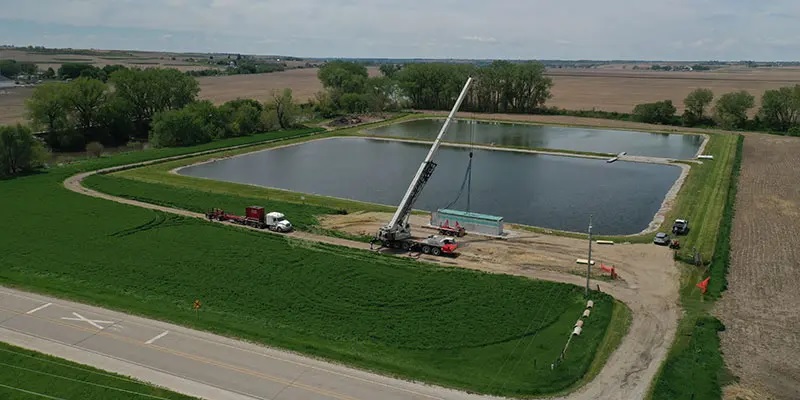
In practice, this approach is often used to enhance treatment performance while preserving existing lagoon infrastructure. For example, in Dow City, Iowa, a lagoon-based system was upgraded using membrane aerated biofilm reactor (MABR) technology to improve nutrient removal without requiring full plant replacement. The phased upgrade allowed the community to meet regulatory requirements within a constrained footprint and timeline, while maintaining operational continuity.
Compared to upgrades, the amount of upfront capital required for new plants is significant. Constructing a new treatment facility requires a significant investment, often financed through loans that start incurring debt service fees and interest long before the plant is operational and generating revenue. Utilities must size new plants based on long-term projections, and if that growth doesn’t materialize, communities are left paying for an oversized system.
Many communities don’t have suitable sites close by, and the cost of hauling or pumping water to a new treatment site can be prohibitive.
Lagoon upgrades, on the other hand, typically allow for phased expansion in line with growth. Treatment capacity can be added as demand increases or regulatory standards tighten, reducing the financial burden of large upfront investment. And because upgrades are implemented on existing sites, the cost of purchasing and excavating land is lower, and permitting is less complex.
One common mistake is treating future growth as a fixed number rather than a range. When growth assumptions shift - as they often do - fully built plants can become financial liabilities, while phased upgrades preserve optionality.
Building a plant also requires long-term operational and maintenance costs. The cost of chemicals, energy, and mechanical repairs must be recovered from consumers even if the plant is not being fully utilized. A modern plant with advanced treatment processes requires skilled operators and a more intensive monitoring schedule.
Lagoon upgrades can keep operations simple yet still meet modern performance requirements. This reduces the need for training specialized staff and lowers the risk of operator error.
When weighing choices, engineers tend to look at the big picture, evaluating costs over the life of the plant rather than focusing on the initial capital expenses. These lifecycle costs include long-term O&M, energy use, chemical consumption, staffing requirements, and asset longevity.
In many cases, a well-designed lagoon upgrade will have lower lifecycle costs compared to a new plant and may be a more viable option, especially for smaller plants with fewer staff and limited budgets. However, it is not always the appropriate choice. For lagoons that have space constraints, are poorly sited, or are too degraded, replacement might be a better option.
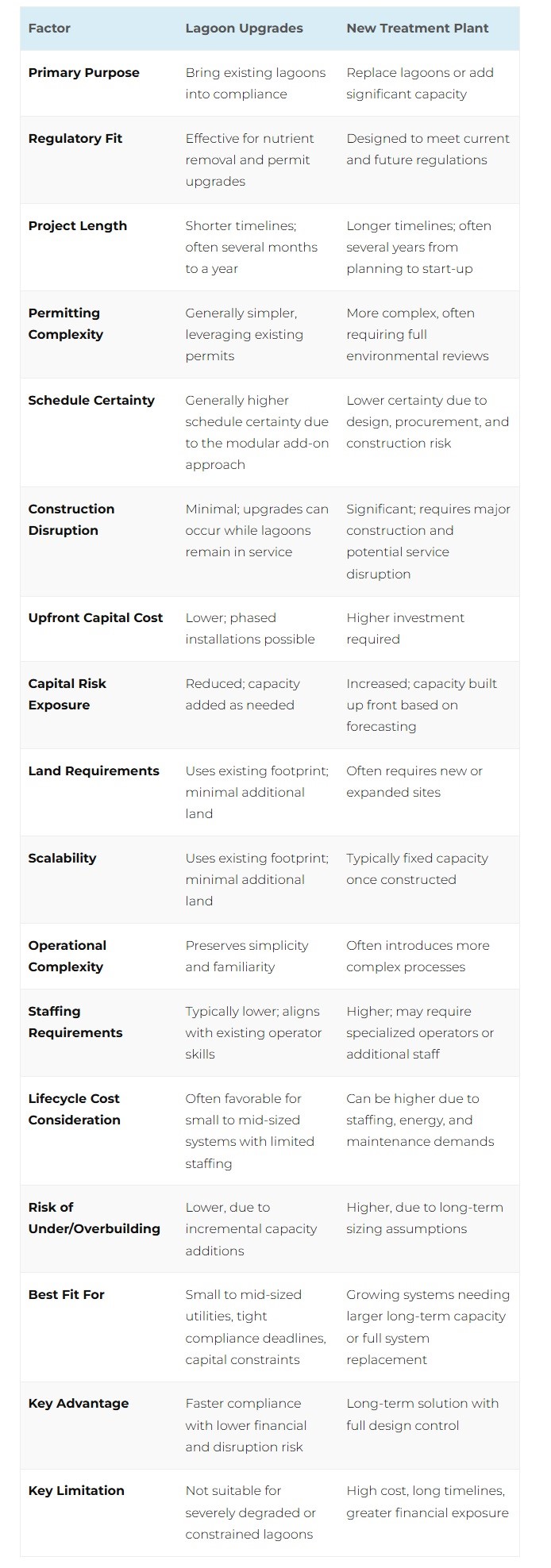
When choosing between a lagoon upgrade and a lagoon replacement, there are several factors to consider. They include:
- Current and future regulatory requirements
- Compliance timelines and enforcement risk
- Available capital and financing flexibility
- Land constraints and site conditions
- Staffing capacity and operational expertise
- Long-term growth uncertainty
Feasibility studies and pilot solutions can help utilities identify the most cost-effective, long-term solution for their needs.
Early collaboration and open communication between utilities and engineers is equally important. When designers are aware of utility owners’ pain points, risk tolerance, compliance deadlines, and long-term goals, outcomes are improved regardless of the path chosen.
For utilities navigating lagoon compliance under tightening timelines, the decision is rarely binary. Experience across multiple upgrade and replacement pathways can help clarify which risks are manageable — and which ones aren’t.
Fluence works with utilities and engineers to evaluate those tradeoffs early, before schedules and budgets harden.