


- Home
- Companies
- Genesis Water Technologies, Inc.
- Articles
- Optimizing Cycles of Concentration: ...
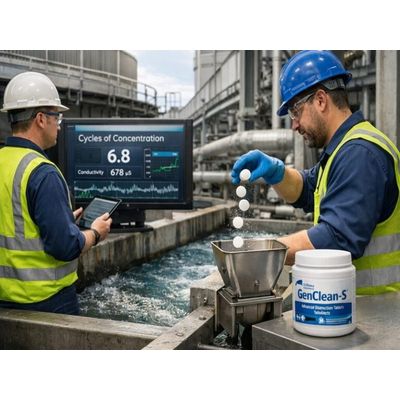
Optimizing Cycles of Concentration: Advanced Strategies with Genclean-S Tablet Technology
Industrial facilities operating cooling towers face a persistent challenge: balancing water conservation with system reliability. The answer lies in maximizing cycles of concentration (COC), but achieving this without compromising equipment integrity requires sophisticated chemistry and monitoring protocols. Genclean-S tablet technology represents a breakthrough approach that enables facilities to operate at higher COC levels while maintaining superior system protection.
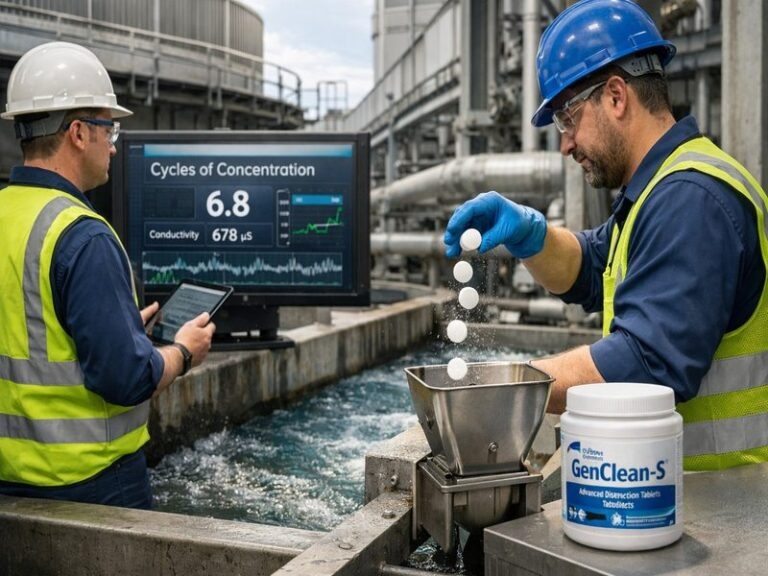
Cycles of concentration measure the ratio of dissolved solids in circulating cooling water compared to makeup water. A cooling tower operating at 4 COC contains water with four times the mineral concentration of incoming makeup water. This metric directly determines water consumption, chemical costs, and environmental compliance.
The mathematics reveal substantial savings potential. A 1,000-ton cooling tower operating at 3 COC consumes approximately 720 gallons per minute of makeup water. Increasing operation to 6 COC reduces makeup water requirements to 480 gallons per minute—a 33% reduction. For a facility running 8,760 hours annually, this translates to over 125 million gallons of water saved.
Data centers and hyper scale facilities demonstrate even more dramatic impacts. A typical 10-megawatt data center operating cooling infrastructure at 3 COC consumes roughly 35 million gallons annually for cooling. Optimizing to 7 COC drops consumption to approximately 18 million gallons—saving 17 million gallons while simultaneously reducing blow down discharge by similar volumes.
Wastewater treatment costs amplify these savings. Municipal sewer charges for industrial blow down typically range from $4 to $12 per thousand gallons. Combined with potable water costs averaging $3 to $8 per thousand gallons, facilities achieving higher COC realize $120,000 to $340,000 in annual savings for every million gallons conserved.
Most industrial cooling systems operate at 3 to 5 COC, far below theoretical limits. Three primary challenges prevent optimization: mineral scale formation, corrosion acceleration, and biological proliferation.
Mineral Scaling Dynamics
As water evaporates in cooling towers, dissolved minerals concentrate. Calcium carbonate, calcium sulfate, silica, and magnesium compounds approach saturation limits. When these thresholds are exceeded, precipitation occurs on heat transfer surfaces. Scale deposits reduce thermal efficiency by 10% to 30%, forcing increased energy consumption and eventually requiring mechanical or chemical cleaning.
Traditional scale inhibitors—typically phosphonate-based chemistries—function effectively at lower COC ranges but lose efficacy as mineral concentrations increase. Calcium hardness above 800 ppm and alkalinity exceeding 600 ppm overwhelm conventional inhibitor capacity.
Corrosion in Concentrated Environments
Higher mineral concentrations create aggressive corrosion conditions. Chloride levels above 500 ppm accelerate pitting corrosion in stainless steel components. Sulfate concentrations exceeding 200 ppm attack carbon steel and copper alloys. Simultaneously, traditional corrosion inhibitors—often zinc, phosphate, or molybdenum compounds—face solubility constraints at elevated COC.
The result creates a paradox: facilities attempting higher COC without appropriate chemistry experience accelerated equipment degradation, forcing return to lower concentration operation.
Biological Growth Amplification
Concentrated cooling water provides ideal conditions for bacterial proliferation, particularly Legionella pneumophila. Biofilm formation on heat exchanger surfaces reduces thermal transfer efficiency and creates corrosion cells beneath deposits. Traditional biocide programs using oxidizing chemicals face dosing challenges—increased concentrations stress system metallurgy while insufficient levels fail to control biological growth.
Planktonic bacteria counts acceptable at 3 COC become problematic at 6 COC without enhanced biological control. Many facilities resort to aggressive oxidizing biocide programs that introduce new corrosion risks.
Genclean-S represents a paradigm shift in cooling water treatment chemistry. This sustainable tablet technology integrates silver ion biocidal protection with synergistic mineral formulations for comprehensive scale and corrosion control, specifically engineered for higher COC environments.
Silver Ion Biocidal Mechanism
Silver ions deliver persistent antimicrobial protection through multiple cellular disruption pathways. Unlike oxidizing biocides that rapidly dissipate, silver ions maintain residual concentrations, providing continuous biological control. Effective concentrations of 20 to 40 parts per billion silver suppress bacterial populations, including Legionella, without the metallurgical stress imposed by halogen-based oxidizers.
This non-toxic mechanism that meets NSF and REACH compliance eliminates discharge permit complications associated with chlorine or bromine residuals. Silver’s oligodynamic effect disrupts bacterial cell membranes and interferes with enzymatic processes, preventing biofilm establishment that typically limits higher COC operation.
Integrated Scale Prevention Chemistry
Genclean-S tablets incorporate mineral-based scale inhibitors that remain effective at elevated hardness and alkalinity levels. The formulation prevents calcium carbonate, calcium sulfate, and silica precipitation through crystal modification and dispersion mechanisms. Unlike phosphonate inhibitors that lose effectiveness above specific calcium thresholds, this mineral-based approach maintains performance at COC ranges of 6 and above in certain cases.
Field testing demonstrates scale prevention in systems operating with calcium hardness of 1,200 ppm and total alkalinity above 800 ppm—conditions that defeat conventional treatment programs.
Advanced Corrosion Protection
The tablet technology delivers multi-metal corrosion inhibition without relying on compounds that precipitate at high mineral concentrations. Corrosion rates for carbon steel, copper alloys, and stainless steel remain below 2 mils per year even at COC levels of 6-8, comparable to performance in systems operating at 3 to 4 COC with traditional inhibitors.
This protection extends to system components typically vulnerable in high COC environments: condensers, heat exchangers, piping networks, and tower fill materials. In application testing this formulation creates passive protective films that persist despite elevated chloride and sulfate concentrations.
Achieving maximum COC requires rigorous monitoring and control. Generic protocols fail in high-concentration environments—parameters that appear acceptable at 4 COC signal impending problems at 7 COC or above.
Essential Parameter Tracking
Conductivity provides real-time COC indication. Establishing baseline makeup water conductivity enables automatic COC calculation: system conductivity divided by makeup conductivity equals COC. Modern controllers continuously monitor this ratio, triggering blow down when target COC is approached.
pH control becomes increasingly critical at higher concentrations. Optimal ranges narrow: while 7.5 to 8.5 pH suffices at lower COC, high-concentration systems require tighter control between 7.8 and 8.2 to prevent both scale formation and corrosion acceleration.
Calcium hardness, total alkalinity, and silica monitoring shifts from weekly to daily frequency. These parameters directly determine maximum achievable COC. Silica, in particular, must remain below saturation limits—typically up to 150 ppm in circulating water—regardless of COC level.
Advanced Analytical Requirements
Facilities optimizing COC implement online monitoring for critical parameters. Turbidity sensors detect particulate formation before visible scale appears. Oxidation-reduction potential (ORP) monitoring identifies biological activity changes. Copper and iron tracking reveal corrosion events before significant damage occurs.
Silver concentration verification ensures Genclean-S maintains effective residuals. Atomic absorption spectroscopy or ion-selective electrodes confirm silver levels between 20 and 40 ppb, the range providing biological control without material waste.
Microbiological Surveillance
Biological monitoring intensifies in high-COC systems. Planktonic bacteria counts should remain below 10,000 CFU/mL, with Legionella testing quarterly minimum. Sessile bacteria assessment through biofilm sampling from heat exchangers identifies problems before performance degradation occurs.
ATP (adenosine triphosphate) testing provides rapid biological activity assessment. Readings below 100 relative light units indicate effective biological control, while excursions above 500 RLU signal treatment program adjustments are needed.
Traditional reactive maintenance fails in optimized cooling systems. Facilities achieving COC cycles above 7 implement predictive protocols that identify developing issues before equipment damage occurs.
Heat Transfer Efficiency Monitoring
Approach temperature—the difference between leaving water temperature and ambient wet bulb—provides early warning of fouling. A 10-megawatt data center cooling system should maintain approach temperatures within 7°F to 10°F. Increases exceeding 2°F signal scale formation, biological fouling, or airflow restrictions requiring investigation.
Heat exchanger effectiveness calculations track thermal performance degradation. Declining effectiveness from baseline 85% to 80% indicates fouling requiring chemical cleaning or mechanical intervention. At optimized COC, this monitoring shifts from annual to monthly frequency.
Corrosion Rate Assessment
Corrosion coupon analysis provides definitive metal loss data. Facilities operating above 6 COC install multiple coupon racks monitoring carbon steel, copper, and stainless steel. Quarterly evaluation ensures corrosion rates remain acceptable, typically below 2 mils per year for carbon steel and 0.2 mils per year for copper alloys.
Instantaneous corrosion monitoring using linear polarization resistance (LPR) probes delivers real-time corrosion rate data. Sudden increases trigger immediate chemistry adjustments before significant damage accumulates.
Automated Chemistry Control
Modern cooling tower automation integrates conductivity, pH, and chemical feed control. When conductivity indicates approaching target COC, automated blow down activates. Simultaneously, Genclean-S tablet feeders adjust dissolution rates maintaining silver residuals within specification.
pH controllers modulate acid feed preventing scale formation. Sophisticated systems employ predictive algorithms: monitoring makeup water quality variations and adjusting treatment chemical dosing proactively rather than reactively.
Quantifying COC optimization benefits requires comprehensive analysis encompassing water consumption, wastewater discharge, chemical costs, and energy impacts.
Water Consumption Calculations
The makeup water formula: M = E + B + D, where M equals makeup, E equals evaporation, B equals blow down, and D equals drift. Evaporation remains constant regardless of COC—determined by cooling load and ambient conditions. Blow down, however, decreases dramatically with COC increases.
Blow down calculation: B = E / (COC – 1). For a system evaporating 100 gallons per minute, operation at 3 COC requires 50 gpm blow down. Increasing to 6 COC reduces blow down to 20 gpm—a 60% reduction. Total makeup drops from 150 gpm to 120 gpm, saving 30 gpm continuously.
Chemical Cost Analysis
Higher COC operation reduces chemical consumption proportionally. Makeup water treatment chemicals—corrosion inhibitors, scale preventers, biocides—dose based on makeup water flow. A 30% makeup water reduction generates equivalent chemical savings.
Genclean-S tablet technology introduces additional economies. The slow-dissolution tablet delivery system minimizes waste compared to liquid feed systems prone to overfeed during upset conditions. Facilities report 15% to 25% chemical cost reductions beyond savings from reduced makeup water volume.
Energy Impact Assessment
Scale prevention maintains design heat transfer efficiency. A pharmaceutical manufacturing facility operating chillers with scaled condensers experienced 18% increased energy consumption. Maintaining clean heat transfer surfaces through effective high-COC operation eliminated this penalty, saving approximately $85,000 annually in electricity costs for their 500-ton cooling system.
Conversely, reduced blow down volume decreases pumping energy. While modest compared to other savings, a large industrial facility blowing down 200 gpm at 4 COC versus 80 gpm at 8 COC saves roughly 15 horsepower continuously—approximately 100,000 kWh annually worth $12,000 to $15,000.
Even with advanced chemistry, facilities encounter challenges optimizing COC. Systematic troubleshooting resolves most limitations.
Persistent Scaling Despite Proper Inhibitor Levels
Investigate makeup water composition variability. Municipal water supplies experience seasonal changes—hardness, alkalinity, and silica fluctuate. What appears as adequate treatment during winter may fail during summer when mineral concentrations increase.
Solution: Implement continuous makeup water monitoring with automated chemistry adjustment. Alternatively, establish conservative COC targets based on worst-case makeup water quality.
Biological Growth at Higher COC
Elevated nutrient concentrations sometimes overwhelm biocidal capacity. Verify silver residuals reach all system areas—dead legs, remote heat exchangers, and tower basins may exhibit low residual.
Solution: Increase tablet feed rate temporarily to establish higher baseline silver concentration. Ensure proper water circulation eliminates stagnant zones. Consider supplemental oxidizing biocide shock treatments quarterly such as Genclean-Disinfect.
Corrosion Acceleration
If corrosion rates increase following COC optimization, examine chloride and sulfate levels. Some makeup water sources contain elevated concentrations that become aggressive at higher COC.
Solution: Adjust maximum COC based on chloride limits (typically maintain below 600 ppm in circulating water). Verify pH remains within optimal range—both high and low pH accelerate corrosion at elevated mineral concentrations.
Unable to Achieve Target COC
Silica frequently limits maximum achievable COC. Unlike calcium-based scale preventable through chemistry, silica has absolute solubility limits.
Solution: Calculate theoretical maximum COC based on silica: Maximum COC = 150 ppm (limit) / makeup water silica concentration. Facilities with 30 ppm silica in makeup water face a practical COC limit of 5 regardless of treatment chemistry. Consider reverse osmosis pre-treatment for makeup water if economic analysis justifies investment.
Modern facilities integrate cooling tower chemistry control with broader building management systems (BMS). This integration optimizes performance and enables predictive analytics.
Conductivity controllers communicate with BMS platforms via typical Modbus protocols. Facility managers monitor COC, chemical feed rates, blow down volumes, and water consumption through centralized dashboards. Automated alerts notify personnel when parameters drift outside specifications.
Advanced implementations employ machine learning algorithms analyzing historical data to predict chemistry adjustments needed based on weather forecasts, production schedules, and seasonal patterns.
A Texas data center reduced chemistry excursions by 34% using predictive control compared to reactive manual adjustment.
Higher COC operation delivers significant environmental advantages extending beyond water conservation. Reduced blow down discharge minimizes aquatic impacts from temperature and dissolved solids. Facilities operating in water-stressed regions demonstrate corporate environmental responsibility while achieving operational cost savings.
Genclean-S non-toxic tablet formulation simplifies discharge permitting. Unlike systems using chromium, zinc, or halogenated biocides, silver ion technology faces minimal regulatory restrictions. Most jurisdictions impose no discharge limits on silver at concentrations used in cooling water treatment that has compliance with US NSF and EU REACH requirements.
Sustainability reporting increasingly emphasizes water stewardship. Facilities document COC optimization as quantifiable environmental improvement.
Successful COC optimization follows a structured approach:
Phase 1: Baseline Assessment (2-4 weeks) Document current COC, water consumption, chemistry parameters, and heat transfer performance. Analyze makeup water composition including seasonal variations. Identify system limitations—metallurgy, heat exchanger design, existing chemistry compatibility.
Phase 2: Chemistry Transition (4-6 weeks) Implement Genclean-S tablet feeders and transition from existing treatment program. Clean system thoroughly to remove existing deposits. Establish monitoring protocols and baseline operating parameters.
Phase 3: Gradual COC Increase (8-12 weeks) Incrementally increase COC target by 0.5 to 1.0 per week while monitoring scaling tendency, corrosion rates, and biological activity. Optimize blow down control and chemical feed rates. Document water savings and system performance at each COC level.
Phase 4: Optimization and Validation (Ongoing) Operate at target COC while continuously monitoring performance. Conduct quarterly corrosion coupon analysis and biological testing. Adjust protocols based on seasonal variations and operational changes.
Return on investment for COC optimization typically achieves payback within 6 to 18 months depending on water costs, system size, and current operating conditions. Facilities in high-cost water markets—California, Southwest US regions, or locations with expensive wastewater treatment—realize faster returns on investment.
A representative 1,000-ton cooling system operating 8,000 hours annually in a moderate water cost market ($6 per thousand gallons combined water and sewer) saves approximately $95,000 annually increasing from 3.5 to 7 COC. Implementation costs including Genclean-S feed equipment, enhanced monitoring instrumentation, and system cleaning typically total $35,000 to $55,000, yielding 5 to 7-month payback.
Larger facilities experience economies of scale. A 5,000-ton complex achieves proportionally greater absolute savings while implementation costs increase less than linearly with system size.
Optimizing cycles of concentration represents one of the most impactful operational improvements industrial facilities can implement. The combination of substantial water conservation, cost reduction, and environmental benefits creates compelling business cases across virtually all cooling system applications.
Genclean-S tablet technology removes traditional barriers preventing high-COC operation. By delivering integrated scale prevention, corrosion protection, and biological control specifically engineered for concentrated cooling water environments, this sustainable chemistry enables facilities to achieve 6 to 8 COC reliably and safely.
Success requires commitment to proper monitoring, gradual implementation, and systematic troubleshooting. Facilities treating COC optimization as a continuous improvement initiative rather than a one-time project achieve superior long-term results.
The convergence of water scarcity concerns, increasing utility costs, and regulatory pressure on water consumption makes COC optimization essential for forward-thinking operations teams. Genclean-S tablet technology provides the chemistry foundation enabling facilities to meet these challenges while improving reliability and reducing environmental impact.
Get Your Free Cycles of Concentration Optimization Analysis – Our water treatment specialists will evaluate your specific cooling system, analyze makeup water quality, and provide customized Genclean-S recommendations projecting water savings, cost reduction, and implementation road map.
Contact Genesis Water Technologies by email at customersupport@genesiswatertech.com or by phone at 877 267 3699 to schedule your comprehensive COC optimization assessment and discover your facility’s water conservation potential.
Q: What are cycles of concentration and why do they matter for cooling tower operation?
A: Cycles of concentration (COC) measure how many times dissolved minerals concentrate in cooling water compared to makeup water. Higher COC means less makeup water needed and less blow down waste water generated. A facility operating at 6 COC instead of 3 COC can reduce water consumption by 30-40%, translating to significant cost savings and environmental benefits.
Q: What prevents most cooling towers from operating at higher cycles of concentration?
A: Three primary barriers limit COC: mineral scale formation (calcium carbonate, silica), corrosion acceleration from elevated chloride and sulfate levels, and biological growth including Legionella. Traditional treatment chemistries lose effectiveness as mineral concentrations increase, forcing facilities to operate at lower COC to prevent equipment damage.
Q: How does Genclean-S tablet technology enable higher COC operation than conventional treatments?
A: Genclean-S integrates specialized silver ion biocidal protection with mineral-based scale and corrosion inhibitors specifically engineered for higher-concentration environments. Unlike phosphonate-based treatments that fail above certain calcium levels, Genclean-S maintains protection at typical COC levels up to 6-8, with calcium hardness around 1,200 ppm and alkalinity up to 800 ppm.
Q: Is silver ion technology safe for cooling tower applications and discharge?
A: Yes. Silver ions at concentrations used in cooling water treatment (20-40 ppb) provide effective biological control without toxicity concerns associated with traditional biocides. The non-toxic mechanism eliminates discharge permit complications, and most jurisdictions impose no restrictions on silver at these concentrations. Silver ion technology is environmentally preferable to chlorine or bromine-based biocides and is compliant with NSF and EU Reach regulations.
Q: What water chemistry parameters require monitoring when optimizing COC?
A: Essential monitoring includes conductivity (real-time COC tracking), pH (maintain 7.8-8.2), calcium hardness, total alkalinity, and silica. Advanced programs add turbidity, ORP, copper, iron, and silver concentration verification. Biological monitoring includes planktonic bacteria counts, Legionella testing, and ATP measurements for biofilm activity.
Q: How quickly can a facility see water savings after implementing COC optimization?
A: Water savings begin immediately upon achieving higher COC operation. Most facilities complete gradual COC increases within 8-12 weeks, with incremental savings realized throughout the transition. A typical 1,000-ton system increasing from 3.5 to 7 COC saves approximately 125 million gallons annually worth $95,000 in moderate-cost water markets. The cost savings are higher in higher priced water markets.
Q: What is the typical return on investment for COC optimization projects?
A: ROI varies by water costs, system size, and current operating conditions, but payback periods typically range from 6 to 18 months. Facilities in high-cost water markets (California, Southwest US regions and regions across the world) or those with expensive wastewater treatment achieve faster returns, often under 12 months. Implementation costs include feed equipment, monitoring instrumentation, and initial system cleaning.
Q: Can all cooling systems achieve the same maximum COC?
A: No. Maximum achievable COC depends on makeup water composition, particularly silica content. Silica has absolute solubility limits around 150 ppm regardless of treatment chemistry. Facilities with 30 ppm silica in makeup water face practical COC limits around 5, while those with 15 ppm silica can achieve 10 COC. System metallurgy and heat exchanger design also influence maximum practical COC.
Q: How does COC optimization affect energy consumption?
A: Higher COC operation maintains design heat transfer efficiency by preventing scale formation. Facilities report 10-18% energy savings by eliminating scale-related performance degradation. Additionally, reduced blow down volume decreases pumping energy requirements, though this represents a smaller portion of total savings compared to improved heat transfer efficiency.
Q: What should facilities do if they experience scaling despite proper COC optimization procedures?
A: First, verify makeup water composition hasn’t changed—municipal supplies vary seasonally. Implement continuous makeup water monitoring with automated chemistry adjustment. If scaling persists, establish conservative COC targets based on worst-case water quality. In cases where silica limits COC, consider reverse osmosis pretreatment if economic analysis justifies the investment.