


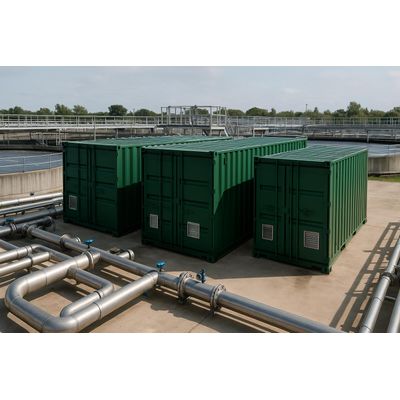
Phased Wastewater Expansion: Containerized MABR Reduces Long-Term Risk
Utilities face a challenging balancing act: expanding wastewater treatment capacity to meet uncertain future demand while avoiding premature, capital-intensive overbuilds. Phased, containerized MABR-based expansion allows utilities to add capacity in stages as needs arise, reducing long-term risk and preserving capital for other priorities.
Historically, communities plan for future needs at project outset, often targeting a full-scale plant well above near-term demand. When growth is slower than expected, capital sits unutilized; when growth outpaces forecasts, facilities may struggle to meet compliance and drive expensive upgrades. The volumetric target of 3 million GPD (11,356 m3/d) is an example of a long-duration forecast that may not materialize evenly over time, complicating funding and asset management in an environment of rising costs and aging assets.
Phased Expansion in Practice
Phased expansion installs only the capacity required today and enables additional treatment to be added later in stages, based on actual population and flow data rather than long-range forecasts. This approach gives communities room to respond to changing conditions, whether growth accelerates or slows.
It aligns with a broader move toward distributed infrastructure where timing, site constraints, and capital discipline matter. Flexible, modular infrastructure can often be deployed faster and configured to meet present and near-term needs.
Why Containerized MABR Works for Phased Infrastructure
Fluence’s Aspiral Flex system is designed for compact deployment, enabling phased wastewater expansion even in space-constrained or remote settings. The system uses membrane aerated biofilm reactor (MABR) technology to deliver compact, energy-efficient treatment. Additional capacity can be added without rebuilding the entire plant, with upgrades that fit on constrained sites and can improve existing assets, changing the economics of expansion. The combination of modular biological treatment and containerized deployment supports capacity growth with minimal disruption to operations.
The Case for Adding Capacity in Stages
- Strategic risk reduction: increments align capital with real demand, reducing stranded capacity risk and easing commissioning.
- Operational continuity: new modules integrate into an ongoing operating framework rather than triggering a plant-wide shutdown.
- Faster deployment: staged builds can proceed without waiting for a full-scale, single-phase project.
- Financing flexibility: timeline-based leasing and service contracts align delivery and spending with demand.
Planning for Variability, Not Just Volume
Wastewater infrastructure should be viable under future variability, not just sized for today’s capacity. Planning for changing growth patterns, site conditions, and financial realities without forcing premature overbuilding is essential. Fluence’s experience in decentralized and modular treatment supports that approach. Its MABR-based systems, including Aspiral Flex, are built for staged expansion, compact deployment, and lower-risk growth. Fluence can pair modular phasing with timeline-based leasing and offer contracts for public and private customers through its Water Management Services, which finance, build, and operate a plant under a performance-based service agreement, enabling utilities to align infrastructure delivery with real-world demand over time.
For utilities seeking to reduce long-term exposure while maintaining growth capacity, modular phased installation with MABR technology provides a practical path forward that aligns with real-world demand.
Original: https://www.fluencecorp.com/phased-wastewater-treatment-expansion-with-mabr/